
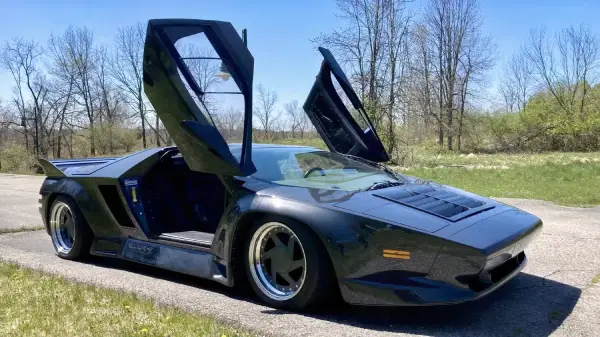
America’s Forgotten Supercar: The 1990 Vector W8 Twin Turbo didn’t just challenge Ferrari and Lamborghini it ignored the rulebook entirely.
In the late 1980s American performance cars still revolved around big V8s, familiar platform and cost driven engineering. Muscle ruled the streets, but true supercars? Those were still considered Europe’s territory.
While You Care for Your Car, Care for Your Child’s Future Too 💖
A fun and educational book every parent should gift their kid.
 Get Kiddy Store Fortune Now
Then came Vector — a tiny, audacious company that believed America could build something far more radical than a warmed-over Corvette competitor.
What they created wasn’t just fast.
It was uncomfortably futuristic.
The Vector W8 Twin Turbo look like it came from a stealth fighter program not a Detroit design studio. Its materials, layout and performance targets were decades ahead of what most manufacturers dared to attempt. And yet, despite numbers that rivaled the world’s best exotic it quietly faded into obscurity.
So how did one of the most ambitious American car ever built become one of the most forgotten?
The Vector W8 Was Never Meant to Play Detroit’s Game
Introduced in 1989, the Vector W8 was built in extremely limited numbers — just 19 examples by most credible accounts. That scarcity wasn’t marketing hype it was the result of an engineering vision that outpaced the company’s resources.
Founder Gerald Wiegert didn’t want to copy Ferrari or Lamborghini. He wanted to leap past them.
Instead of traditional automotive thinking, the W8 was shaped by aerospace principles:
- Systems-first engineering
- Exotic composite materials
- Extreme performance targets
- A cockpit that felt more jet fighter than grand tourer
This wasn’t a muscle car evolution.
It was an American supercar experiment — built as if no compromises were allowed.
Engineering That Predicted the Future of Supercars
At a time when most exotic cars still relied on steel or aluminum frames the Vector W8 used:
- Carbon fiber
- Kevlar
- Aluminum honeycomb construction
This approach was closer to race prototypes than road cars. Manufacturing was difficult, expensive, and slow — but the stiffness and theoretical performance were groundbreaking.
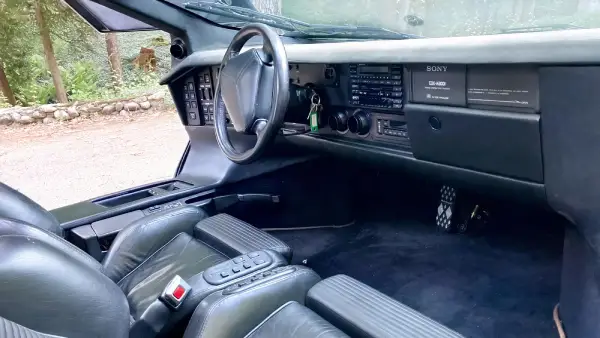
Inside, the W8 looked nothing like its peers.
The cockpit featured:
- Digital displays
- Aircraft-style switchgear
- Tight, driver-focused ergonomics
While other supercar celebrated leather and analog gauges, Vector treated the car like a controlled machine, not a luxury object. That mindset wouldn’t become mainstream until decades later.
Twin-Turbo Power That Shocked the 1990s
Under the rear deck sat a twin turbocharged 6.0-liter V8 based on a Chevrolet small block but heavily rework.
Depending on configuration, output figures ranged from:
- 625 horsepower
- To claims exceeding 700 horsepower
Torque? A massive 630 lb-ft.
Paired with a reinforced three-speed automatic, the setup prioritized durability over driver feel — a controversial choice, but understandable given the torque levels.
Performance numbers were staggering for the era:
- 0–60 mph: about 3.8 second
- Maximum velocity: 217 mile per hour
At the beginning of the 1990 those number seemed almost unreal.
Why the Vector W8 Couldn’t Fully Deliver
The W8 didn’t fail due to lack of vision.
It struggled because ambition outran execution.
Building an aerospace-inspired supercar is one thing. Supporting it with:
- Reliable electronics
- Refined engine management
- Long-term serviceability
…is something entirely different — especially for a small, independent company.
Vector lacked:
- Deep financial backing
- Supplier redundancy
- A global service network
Early turbo technology and engine management systems also demanded constant attention. Ownership wasn’t just expensive — it required patience and technical commitment.
Add business instability and shifting priorities, and the W8 never received the long-term refinement it needed.
Why the W8 Faded While Others Became Legends
Cars like the Bugatti EB110 and McLaren F1 shared similar low production numbers, but they had something Vector didn’t:
- Strong financial support
- Stable leadership
- Sustained development
The Vector W8 arrived too early, stumbled publicly, and disappeared before the industry caught up to its ideas.
Without racing success, ongoing updates, or broad exposure, it became a curiosity rather than a benchmark.
What a Vector W8 Is Worth Today
Today, the Vector W8 lives in a narrow collector niche.
Prices are difficult to track due to rarity, but when examples surface, they command serious attention. A 1990 Vector W8 listed on Bring a Trailer recently drew bids up to $740,000 though it ultimately failed to meet reserve.
Collectors don’t buy the W8 for usability.
They buy it as a historical artifact — proof that American engineering once dared to think far beyond convention.
A Supercar That Was Simply Too Far Ahead
The Vector W8 didn’t disappear because it was slow, boring, or irrelevant.
It vanished because it existed outside the systems that preserve legends.
Today, its legacy isn’t about what it failed to become —
It’s about how clearly it predicted the future of supercars, long before the world was ready.
FAQs
Q: Why is the Vector W8 considered ahead of its time?
A: Because it used aerospace material, advanced composites, digital interior and extreme performance target year before they became common in production supercar.
Q: How many Vector W8s were built?
A: Most reliable sources agree that only 19 units were produced.
Q: Why did Vector fail as a company?
A: Limited funding, production challenge, unreliable early technology and business instability prevent long term success.
Q: Is the Vector W8 valuable today?
A: Yes. When available price can approach or exceed $700,000 depending on condition and provenance.
Also Read: Which Toyota Is the Lexus GX 550 Most Similar To? The Answer Might Surprise You