

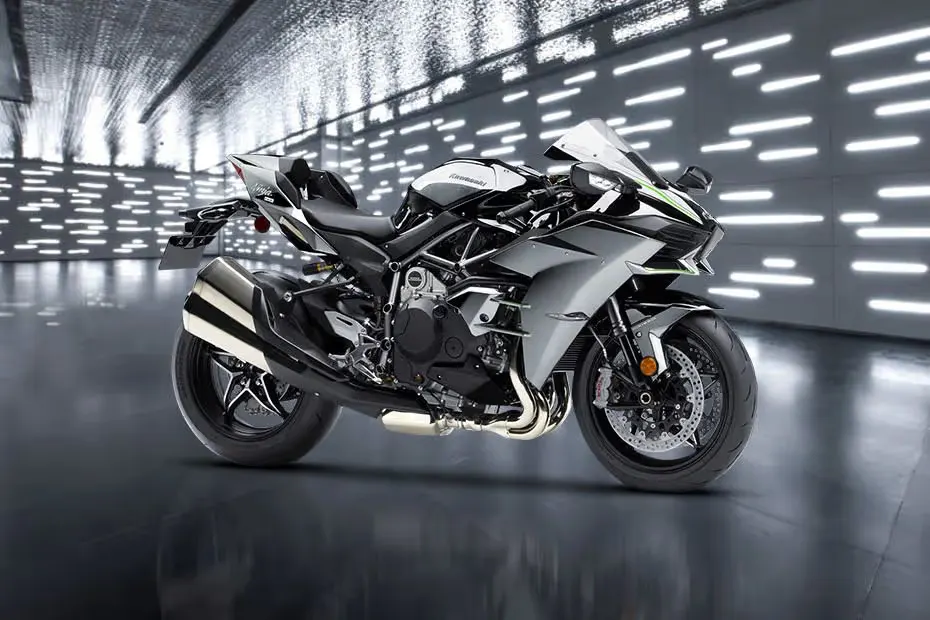
Whilst Kawasaki unleashed the Ninja H2R in 2015, it didn’t simply enter the superbike game — it rewrote the rulebook. This music-simplest monster changed into one designed to dominate, no longer just compete. With over 300 horsepower, a supercharged engine, and aerospace-grade carbon fibre winglets, the H2R remains one of the maximum outrageous bikes ever constructed.
Not Built for the Streets, Built to Shatter Limits
Let’s get one thing straight — the Kawasaki Ninja H2R is not street legal.
No headlights. No mirrors. No turn signals. No emissions compliance.
This isn’t a bike for Sunday rides or red-light drags — it’s a closed-course weapon built purely for speed records and high-adrenaline runs on airstrips.
While You Care for Your Car, Care for Your Child’s Future Too 💖
A fun and educational book every parent should gift their kid.
 Get Kiddy Store Fortune Now
Under its carbon-fiber skin sits a 998cc inline-four with a centrifugal supercharger that pushes output to a wild 321 horsepower at 14,000 rpm. That’s more power than some compact cars.
When World Supersport Champion Kenan Sofuoğlu hit 248.5 mph (400 km/h) on a stock H2R in 2016, it wasn’t just a record — it was a statement.
Blistering Top Speed, But What About 0–60?
The Ninja H2R takes about 2.9 seconds to go from 0 to 60 miles per hour, despite its insane top speed. Even though it’s still very fast, the H2R doesn’t win hands-down in the acceleration category.
Several high-performance liter bikes are just as quick — or quicker — off the line:
There’s BMW’s razor-sharp S1000RR and Yamaha’s track-focused YZF-R1M. Then there’s the street-legal sibling of the H2R — the Kawasaki Ninja H2 — which cranks out 240 horsepower and hits 0 to 60 in just 2.6 seconds. And let’s not forget the electric Energica Ego+ RS, with instant torque that makes it a serious contender off the line.
What’s holding the H2R back? Ironically, it’s the electronics. Kawasaki’s suite of rider aids — traction control, launch control, and more — work overtime trying to tame that power and avoid spinning the tire to oblivion. But all that intervention slightly delays the off-the-line punch.
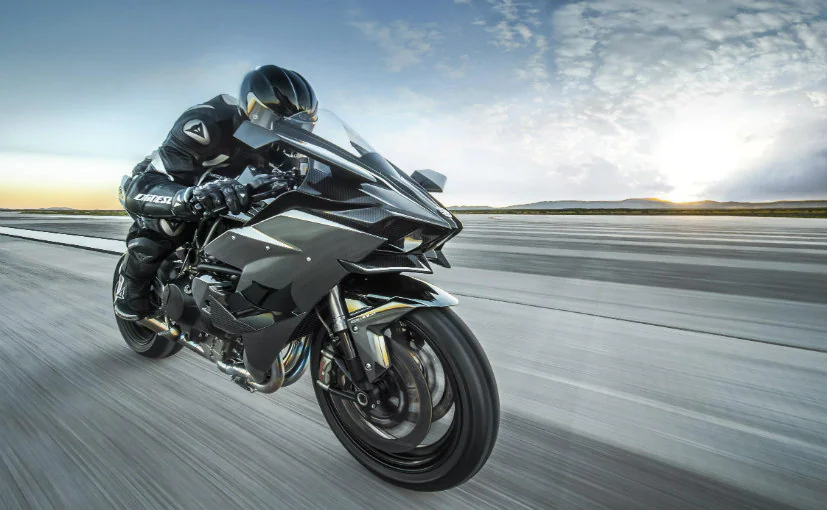
Even so, once the H2R hooks up, it really takes off:
- 0–200 mph in 16.83 seconds
- 0–180 mph in just 11.77 seconds
More Flex Than Function (But Still Iconic)
The H2R isn’t built for practicality — it’s a flex of engineering muscle.
It laughs in the face of the 186 mph “gentleman’s agreement” between manufacturers and rockets way past that limit.
You won’t see an H2R idling at traffic lights or slicing through city streets. It’s a garage trophy, a track legend, and the ultimate proof that Kawasaki’s engineers can out-crazy anyone else in the superbike world.
Yes, it costs over $60,000, but when you consider its performance-per-dollar ratio, it’s arguably the cheapest ticket to experience 240+ mph on two wheels.
Final Verdict: The Quickest? Not Quite. The Fastest? Probably.
In relation to pinnacle pace, the Kawasaki Ninja H2R nonetheless reigns ultimate.
Certain, other bikes might also beat it in 0–60 sprints, but not anything touches its warp-velocity acceleration beyond a hundred and fifty mph or the natural madness it gives you at the runway.
If your dream motorcycle sounds like a fighter jet, looks like a stealth bomber, and hurries up like a rocket, the H2R isn’t simply fast sufficient to flex.
Also read: Bernie Moreno Car Collection: A Look Inside His $15M Supercar Garage