
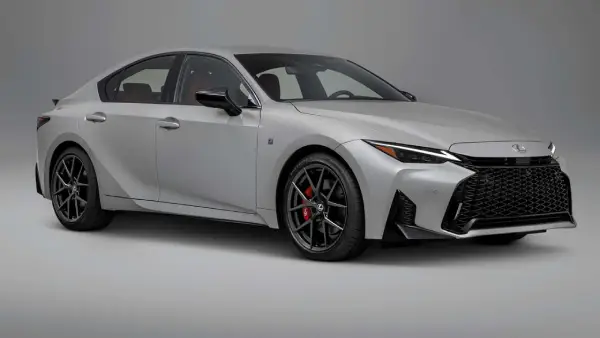
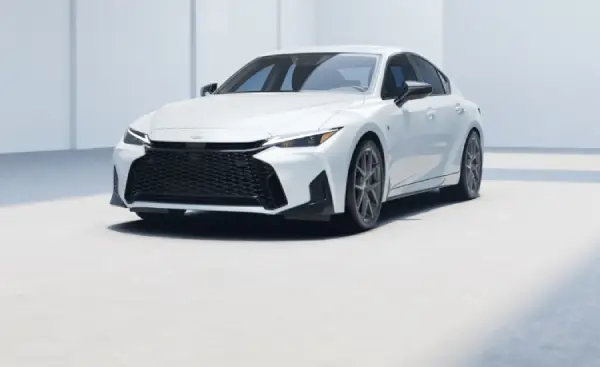
2026 Lexus IS: For years, the message from the automotive industry seemed pretty clear: if you want a new luxury vehicle buy an SUV.
Want performance? There is an SUV for that.
While You Care for Your Car, Care for Your Child’s Future Too 💖
A fun and educational book every parent should gift their kid.
 Get Kiddy Store Fortune Now
Want comfort? Another SUV.
Do you want something costly enough to make you feel unique but still useful enough for the whole family? You are already aware of the direction this is taking.
Sedans, meanwhile have been slowly pushed toward the sidelines.
That makes what is happening with the Lexus IS particularly interesting.
The compact Lexus sports sedan isn’t the newest car in its class. It isn’t the fastest. It doesn’t have the biggest engine the most aggressive hybrid system, or the wildest technology package. In fact the current-generation IS has been around for years.
Yet the car continues to attract buyers.
And that matters more than it might seem.
The Lexus IS has undergone more stylistic, technological and chassis upgrade while keeping a natural aspirated V6 engine and an optional rear wheel drive configuration which are becoming more and more uncommon in the luxury market.
According to Lexus the IS is a small front engine, rear wheel drive sports sedan that has sold almost 1.3 million unit in 40 countries and territories since its launch.
Why, therefore is this traditional formula still effective?
More significantly is the Lexus IS proof that consumers are still interested in sporty sedans?
The Sedan Was Supposed To Be Finished
Walk around a typical new-car dealership and it is easy to understand why sedan have lost their spotlight.
SUVs dominate showroom space. Automakers continue investing heavily in crossovers and electrified utility vehicles while several familiar sedan nameplates have disappeared or been dramatically repositioned.
But enthusiast never completely stopped wanting cars that sit low to the ground.
There is a reason.
A sedan generally gives engineers a lower seating position, a lower center of gravity, a more compact driving position, and a shape that naturally lends itself to a sportier chassis.
You don’t have to convince someone that a sports sedan is fun. You simply have to drive one.
That is where the Lexus IS remains interesting.
It doesn’t try to disguise itself as an SUV. It doesn’t need a giant ride height or enormous wheel to create a sense of occasion.
It is simply a four door performance oriented luxury car.
And in 2026 that simplicity is becoming part of its appeal.
Lexus Hasn’t Tried To Turn The IS Into Something It Isn’t
The biggest reason the IS stand out isn’t necessarily its styling.
It is what Lexus decided not to change.
For 2026, the IS lineup has been simplified around the IS 350. Buyer can choose between F SPORT Design and F SPORT grade with rear-wheel drive or all-wheel drive available depending on configuration.
Under the hood is a 3.5-liter natural aspirate V6 producing 311 horsepower and 280 lb-ft of torque.
Yes naturally aspirated.
That alone makes the IS unusual in a market increasingly fill with turbocharged four cylinder engine, hybrid system and downsize powertrain.
Lexus pair the rear wheel drive IS 350 with an eight speed automatic transmission. All-wheel-drive version use a six speed automatic.
On paper none of this sounds revolutionary.
That is exactly the point.
The IS doesn’t need to be revolutionary.
It needs to be enjoyable.
The Naturally Aspirated V6 Is Becoming A Luxury Feature
There was a time when a 3.5 liter V6 in a luxury sedan would not have been particular unusual.
Now it almost feels nostalgic.
Modern turbocharged engine have obvious advantage. They can produce huge amounts of torque at low rpm deliver strong acceleration and often achieve impressive efficiency.
But there is something different about a naturally aspirated engine.
Power accumulates in a predictable manner.
Without waiting for a turbocharger to produce boost the engine reacts when you push the throttle. As the revs rise the engine keeps pulling as you continue to accelerate.
It’s a distinct feeling.
That is important to an enthusiast.
The 311 horsepower of the IS 350 is insufficient to make it the fastest vehicle in its class. It is not need to be.
The delivery of power is what makes it appealing.
That is becoming less and less common.
The 2026 IS 350’s naturally aspirated V6 and smooth automatic transmission give it a character that is hard to match, even if it can’t equal the acceleration or grip of some more recent German competitors, as Car and Driver’s testing of the vehicle revealed.
That distinction is crucial.
The Lexus isn’t necessarily trying to win the specification war.
It is trying to give drivers something they can actually enjoy every day.
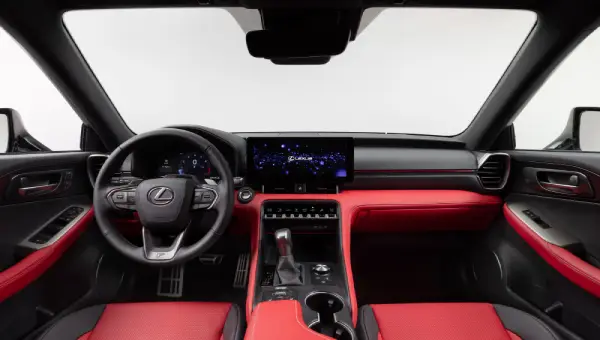
The 2026 Lexus IS Gets A Much Needed Interior Update
One criticism of the IS over the year has been that its cabin began to feel older than those of newer competitor.
Lexus finally address that for 2026.
A larger 12.3-inch touchscreen, a new instrument cluster, a redesigned dashboard and modifications to the center console and interior trim are all included in the upgraded IS. Additionally Lexus standardized the Lexus Safety System+ 3.0 and Lexus Interface.
That has an impact.
Even tho the IS is based on an antiquated mechanical principle, you don’t have to live in an antiquated cabin.
This is a good balance.
You get modern connectivity and driver assistance technology without the car feeling like it was designed entirely around a touchscreen.
That is becoming an increasingly valuable combination.
Not every driver wants a vehicle that feels like a smartphone with seats.
Some people still want buttons.
Some still want a physical steering wheel with a proper sense of connection.
And some simply want to get in, start the engine, and drive.
The F SPORT Is Where Things Get Interesting
If you’re shopping for an IS because you want a comfortable luxury sedan, the F SPORT isn’t necessarily required.
But if you actually care about driving, this is the version worth paying attention to.
The F SPORT treatment goes beyond appearance.
Depending on configuration, buyers can get performance focused suspension tuning, larger brakes, sportier wheels and additional chassis hardware.
The result isn’t a sports car disguised as a sedan.
It is something more usable.
You can drive it to work Monday through Friday, take it on a road trip Saturday, and still find an enjoyable stretch of road on Sunday.
That’s the original sports-sedan formula.
The car doesn’t force you to choose between practicality and entertainment.
Rear-Wheel Drive Still Matters
This is another area where the IS feels different from many modern alternatives.
Rear wheel drive isn’t automatically better for every driver or every road.
But for enthusiasts it changes the personality of a vehicle.
The front wheels can focus more naturally on steering while the rear wheel handle propulsion. That creates a familiar layout for anyone who enjoys driving.
The 2026 IS 350 keeps that option alive.
And that may be more important than the raw performance numbers.
You can find faster cars.
You can find more powerful cars.
You can find cars with more advanced drivetrains.
But finding a modern luxury sedan with a naturally aspirated V6 and rear wheel drive is becoming considerably harder.
That makes the IS something of a survivor.
Lexus Is Playing The Long Game
There is another reason the IS continues to attract attention Lexus has never been obsessed with replacing it every few years.
The current generation has had an unusually long life but Lexus has repeatedly refined it rather than throwing the entire formula away.
That approach can seem strange in an industry where new platforms and dramatic redesigns are major selling points.
But it has one advantage.
The engineers have had years to figure out what functions.
Rather than beginning from scratch Lexus has progressively enhanced the cabin, technology, steering, suspension, chassis rigidity, and appearance.
Therefore the 2026 automobile is more about refinement than reinvention.
According to Lexus the most recent IS was create to enhance steering enjoyment vehicle reaction and the relationship between driver input and the vehicle.
That sounds less exciting than announcing an entirely new platform.
From behind the wheel, though, it can be more meaningful.
The Numbers Aren’t Everything
This is where the Lexus IS becomes easy to misunderstand.
If you judge the car entirely by acceleration, it loses.
If you judge it by horsepower-per-dollar, it isn’t going to dominate.
If your priority is lap times, there are better choices.
Newer German performance sedans can deliver breathtaking acceleration, and some have significantly more sophisticated performance hardware.
But cars aren’t spreadsheets.
A vehicle can be objectively slower and subjectively more enjoyable.
That’s particularly true when you are talking about a car that will spend most of its life on public road.
You don’t need 500 horsepower to enjoy a winding road.
You don’t need a four second 0 to 60 time to have fun merging onto a highway.
And you certainly don’t need a race car suspension to enjoy a drive home after work.
The IS understands that.
The Price Makes The IS Even More Interesting
According to Lexus the F SPORT Design Lexus IS 350 with rear wheel drive starts at $46,895. All-wheel-drive models have greater beginning costs than the F SPORT which starts at $49,345.
This places the IS in an intriguing segment of the market for luxury sedans.
It is not inexpensive.
However, it is not attempting to compete in the realm of extremely costly performance sedans.
Rather it offer consumer the opportunity to get something unique without going into the six-figure price range.
That combination makes sense for someone who want a single vehicle that can accommodate people, long distance driving, commuting and the occasional intense trip.
And Then There Is The Reliability Question
This is arguably one of the IS’s biggest advantages.
German performance sedans can be fantastic to drive. They can also be technologically impressive and brutally quick.
But Lexus has built its reputation around long-term ownership.
That reputation matters when you’re spending tens of thousands of dollar on a car.
The IS doesn’t have to be the quickest car in the parking lot if an owner expects to keep it for years.
There is something reassuring about buying a performance-oriented sedan that isn’t completely dependent on exotic engineering solutions.
The naturally aspirated V6 is a relatively straightforward concept.
The automatic transmission is conventional.
The vehicle itself has been refined over many years.
That doesn’t guarantee trouble-free ownership forever but it does help explain why the IS continue to attract buyer who care about keeping their car for a long time.
The IS Also Looks Different From The Crowd
Let’s be honest: styling matters.
People don’t spend this much money on a vehicle purely because of an engine.
The IS has always had a more aggressive personality than the average Lexus sedan.
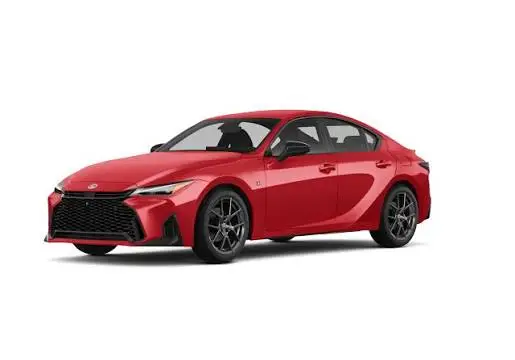
The 2026 update pushes that further with revised front end styling and a sharper overall appearance. Lexus has also introduced new exterior and interior details while the F SPORT models receive their own visual upgrade.
It doesn’t look anonymous.
That is important in a luxury market where many vehicles are beginning to blend together.
Park an IS next to a collection of crossovers and it immediately looks different.
Lower.
Longer.
Sportier.
More intentional.
For some buyers that’s reason enough to take a closer look.
Could The Lexus IS Actually Help Save The Sports Sedan?
This is the bigger question.
One successful model isn’t enough to reverse the industry’s shift toward SUVs.
But the IS proves that the demand for sedans hasn’t completely disappeared.
That’s the interesting part.
The industry often responds to sales trends by removing vehicles that don’t generate enormous volumes.
But enthusiasts don’t necessarily want the biggest-selling vehicle.
They want the right vehicle.
The continued existence of cars like the IS, BMW 3 Series, Cadillac CT4-V, and Hyundai Elantra N suggests there is still room for different interpretations of the performance sedan formula.
And that is good news.
Competition keeps manufacturers honest.
If every brand builds the same crossover buyers eventually get a very predictable market.
Sports sedans give manufacturers somewhere to experiment with steering, suspension, chassis balance, power delivery and driver engagement.
They also give enthusiasts something to get excited about.
The Future Could Still Change Everything
There is one major caveat.
The IS’s future remains an interesting question.
Reports have suggested that the next generation IS could eventually move toward a fully electric powertrain, potentially arriving as early as 2027. Those report have not been confirm by Lexus so they should be treated as speculation rather than establish fact.
If that happens, the IS could enter an entirely different era.
An electric IS could be dramatically quicker.
It could have instant torque.
It could use sophisticated all-wheel-drive technology.
It could even deliver performance that the current V6 car simply cannot match.
But it would also mean saying goodbye to the naturally aspirated V6.
And that is why the 2026 IS feels particularly interesting.
It may represent one of the last opportunities to buy a new Lexus sports sedan with this particular combination of ingredients.
A V6.
Rear-wheel drive.
A traditional automatic.
A low seating position.
A physical connection between the driver and the car.
Those things aren’t necessarily disappearing overnight.
But they are becoming harder to find.
The Lexus IS May Be A Sign That Buyers Aren’t Done With Cars
For years, the industry has treated the decline of sedans as inevitable.
Maybe it is.
But the Lexus IS makes the situation a little more complicated.
There are still drivers who don’t want to climb into an SUV every morning.
There are still enthusiast who want a naturally aspirated engine.
There are still luxury buyers who appreciate a quiet, comfortable car that can become genuinely entertaining when the road opens up.
And there are still people who simply like sedans.
The IS doesn’t need to outsell every crossover to prove that point.
It only needs to survive.
In 2026 that’s exactly what it is doing.
And if the appetite for cars like the Lexus IS continues automakers may have a reason to keep building sports sedans after all.
Maybe the sedan isn’t making a huge comeback just yet.
Maybe it’s something more interesting.
Maybe it never actually went away.
Final Verdict
The Lexus IS isn’t trying to win the horsepower war.
It isn’t trying to be the fastest sedan on the road.
And it certainly isn’t trying to become another SUV.
That’s precisely why it remains interesting.
At a time when the automotive industry is moving toward electrification, bigger vehicles, and increasingly complicated performance systems the Lexus IS continues to offer something refreshingly straightforward.
A V6.
Four doors.
Rear-wheel drive.
A comfortable cabin.
And a reason to take the long way home.
For a car that many people probably expected to fade away years ago, that’s a pretty convincing comeback.
FAQ’s
Q: Does the IS have a naturally aspirate engine?
A: Yes The IS 350 continue to use a natural aspirate 3.5 liter V6 rather than a turbocharge four cylinder or hybrid powertrain.
Q: Is the IS available with rear wheel drive?
A: Yes. Rear wheel drive is available on the IS 350 while buyer can also choose all-wheel drive. RWD model use an eight speed automatic while AWD version use a six speed automatic.
Q: How much does the IS 350 cost?
A: Lexus list the IS 350 F SPORT Design at $46,895 include the list delivery processing and handling fee. The F SPORT starts at $49,345 with AWD versions price higher.
Also Read: 2027 Kawasaki Ninja ZX-6R Is Back: Kawasaki Refuses to Let the Supersport Era Die