
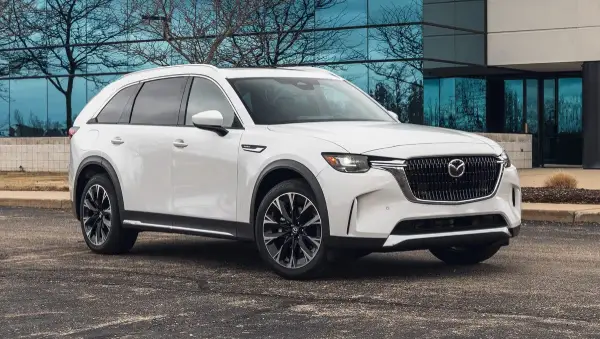
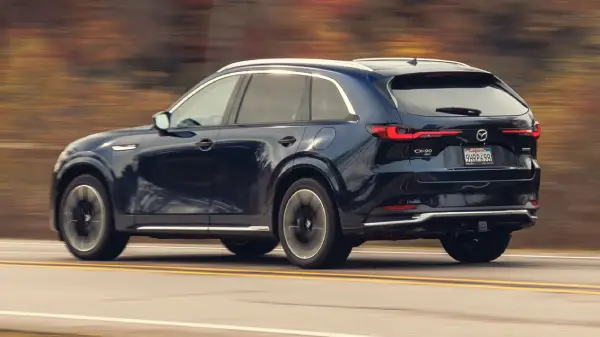
2026 Mazda CX-90: The 2026 Mazda CX-90 offers almost everything that luxury three-row SUV shoppers want, such as attractive styling, a sophisticated interior and plenty of power, all underpinned by a rear-wheel-drive platform. The biggest challenge that remains for Mazda is its plug-in hybrid system.
Over the years, Mazda has perfected the art of creating affordable cars that don’t feel like they cost that much. With the CX-90, Mazda is continuing that trend with a vehicle that brings the best of both worlds, sophisticated styling and powerful engine options, to a class of vehicles that are traditionally a lot more expensive.
While You Care for Your Car, Care for Your Child’s Future Too 💖
A fun and educational book every parent should gift their kid.
 Get Kiddy Store Fortune Now
As appealing as the CX-90 looks, it’s the PHEV model’s driving dynamics that fail to live up to the promise. There is limited range and the system has poor integration between its gas and electric motors. Perhaps the biggest downside of the PHEV is that there is a negligible fuel savings over other models.
There are bright spots. A better hybrid system will provide the luxury competition with a run for their money. In the meantime, inline six cylinder models at a much lower price point might offer the better value proposition.
The 2026 Mazda CX-90 Already Has the Ingredients of a Luxury SUV
The CX-90 isn’t your typical family crossover. From the design standpoint, the vehicle leans on the luxury side with both an elegant, refined exterior and an even more refined interior.
While its design is appealing, what truly gives it a step up from most family vehicles is the vehicle’s rear-wheel-drive design. When combined with Mazda’s turbocharged engine and premium inline-six configuration, it results in a more sophisticated offering than the vehicles of most of its competitors.
While offering good power, the CX-90 is more cost effective than other entry-level luxury SUVs. Unlike many of the more economical family haulers, the CX-90 gives you a selection of two turbocharged powertrains.
While style, comfort and power aren’t all it has to offer, the CX-90 stands out as an alternative option from other premium manufacturers for its styling.
The catch is in its plug-in hybrid option. As with most firsts, this package isn’t quite up to snuff when it comes to refining and design as with the other areas.
The CX-90 Plug-In Hybrid Has a Few Problems
For buyers who are after an electric driving option without forgoing too much in the way of engine performance, the 2026 Mazda CX-90 PHEV might fit the bill.
For one thing, its powertrain offers a respectable combination of a 2.5-liter gasoline four-cylinder engine with a battery pack and electric motor, producing a total 323 hp and 369 lb-ft of torque.
Those numbers compare well with a lot of three-row SUVs, and especially impressive is the torque figure, which is identical to what you’ll find in the CX-90 Turbo S.
The trouble is, there’s no guarantee a great spec sheet will translate into a great behind-the-wheel experience.
One big disappointment with the PHEV is the rather disjointed feeling experienced during the powertrain transitions, where gasoline meets electric. A modern, high-end hybrid is supposed to be almost imperceptible.
When the engine engages, the sound and vibration increase noticeably.
That can put a sudden and rather unwelcome interruption in what would otherwise be a fairly smooth drive.
Buyers paying the kind of premium price a luxury SUV commands probably shouldn’t have to compromise that way.
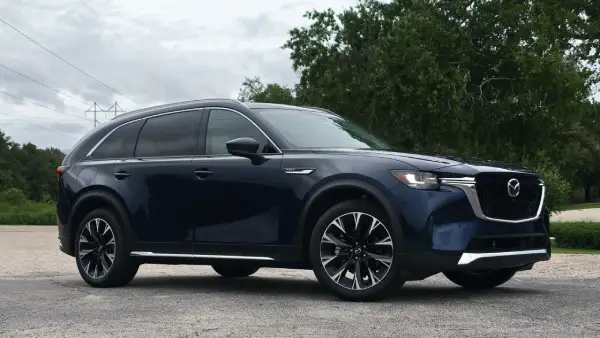
A 27-Mile Electric Range Feels Disappointing
The Mazda CX-90 PHEV’s limited all-electric driving range is a downside.
With an estimated range of about 27 miles, most plug-in hybrid SUV shoppers will find that unimpressive, even if it covers a trip or two to the grocery store.
Those with long commutes to work will exhaust the range rapidly, leaving them to rely on a traditional engine.
That said, a plug-in hybrid vehicle doesn’t have zero utility. The vehicle will likely find an audience with buyers who live in an area with public EV infrastructure, such as those who have home chargers, and with a lifestyle that relies on shorter daily commutes.
Most people aren’t going to get very far before having to shell out more cash on gas.
It’s probably the most glaring fault, because after all is said and done, a larger battery will likely just serve as a reason to charge more for the PHEV, leaving shoppers to look at what competitors have to offer.
The Fuel Economy Advantage Isn’t Particularly Impressive
One major incentive for buyers to select a plug-in hybrid vehicle is the vehicle’s capability to operate with better fuel efficiency than the non-hybrid vehicle alternatives.
This vehicle model is expected to provide substantial savings when it is compared against its conventional alternatives.
With an estimated 26 mpg (combined) fuel economy, the Mazda CX-90 PHEV really doesn’t provide enough savings compared to other versions in the same class like the Mazda Turbo or Turbo S (at an estimated 25 mpg).
After all, one mile is not that much difference.
Obviously, there is a lot of variance in how often people choose to recharge the vehicle and how often people choose to charge it in between long drives. For those who frequently use the vehicle’s ability to run on electricity, the vehicle can be worth the extra purchase price, but for many buyers, the difference isn’t enough.
For potential customers, who do not have an option to conveniently charge the car at home, buying a conventional Inline Six Mazda is better.
Mazda’s Inline-Six Engine Is the Better Choice
This is where it gets more interesting.
The engines in the CX-90 provide a premium experience. With these engines you get good performance and they have a good, relaxed feel that is less demanding than the PHEV’s four-cylinder setup.
The standard engine for the CX-90 makes 280 horsepower and 332 lb-ft of torque. Those in need of more power should consider the Turbo S, with either 340 or 319 horsepower depending on whether the owner puts in premium or regular fuel, respectively.
Both of these engine options are available with a 48 volt mild hybrid setup.
The setup assists in shutting down the engine while stopping, then helping with restarting the engine smoothly. It also provides a refined operation without the inconvenience of a big battery for plug-in charging.
The smooth operation and natural power delivery give this engine an appeal of a more refined luxury vehicle, making it feel more fitting for a customer in the market for an SUV in that class.
In this regard, perhaps Mazda’s first shot at a plug-in hybrid SUV might have been an honest try. Just maybe, the powertrain for that effort was a poor choice.
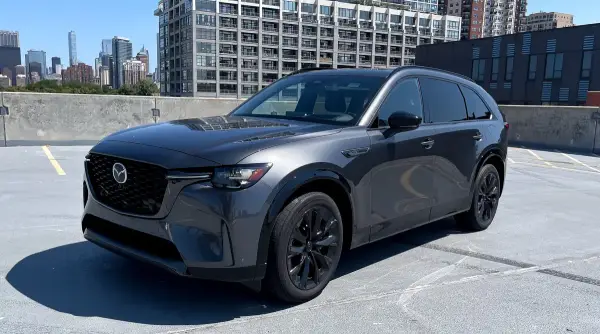
The Regular CX-90 Could Save Buyers Thousands
Inline-six models are even more appealing when the cost difference is considered.
From the pricing in the first review, a 2026 CX-90 Turbo Select comes in at $41,345, though a Turbo S Premium Sport can come in as low as $56,385 and will obviously get more for the customer.
$6,660.
In the case of a lot of families, that amount would cover a couple of years of insurance and car care.
It isn’t a guaranteed money-saver to go the plug-in hybrid route either. The Plug-in Hybrid does start lower, however it starts at $56,385 when upgraded to the Premium Sport Trim and that is $760 over the price quoted for the alternative mentioned.
This makes buying one of these SUVs a tough decision.
There really is no point in spending additional money on a Plug-in Hybrid. Especially when you consider it doesn’t even provide you with as much refinement and you are essentially paying for more of something you aren’t even going to use.
There are lots of other reasons to purchase a regular six cylinder engine. For customers who don’t even have an at-home charging solution, it isn’t very hard to come to a decision.
Mazda Needs to Make Two Important Changes to Its PHEV
For Mazda to gain an edge as a premium SUV player, the CX-90 has all the foundations in design and engineering. It just needs an improved hybrid system. There are two potential routes.
1. Give the Battery More Electric Range
The simplest improvement would be to increase the battery capacity and improve charging performance.
The current 27-mile electric range is one of the biggest limitations of the CX-90 PHEV. Increasing that figure to approximately 40 miles would make the SUV much more practical for everyday commuting.
A larger battery would allow more drivers to complete their regular journey using electric power.
However, simply installing a bigger battery wouldn’t solve everything. Mazda would also need to improve charging speed and ensure that the additional capacity doesn’t make the vehicle significantly more expensive.
A better balance between battery size, charging time and electric range could make the CX-90 PHEV much more competitive.
2. Consider a Series-Hybrid Powertrain
There’s the possibility of rethinking the powertrain of the hybrid system as well.
The CX-90 could be more electric car like with a series-hybrid.
In this scenario, electric motors are responsible for moving the car, and the gas engine works to help power the electric motors and fill up the battery.
Instead of the gas engine moving the car directly, the car is driven via electric motors.
Owners don’t need to be so reliant on the gas stations.
Nissan’s e-Power technology has brought this to production vehicles.
If Mazda were to go down a similar route with the CX-90, it would help provide customers with an all-electric driving feel, in addition to further distinguishing itself from the numerous PHEV vehicles that compete with the SUV.
Should You Buy the 2026 Mazda CX-90?
The 2026 Mazda CX-90 offers some unique characteristics for a three-row family crossover that is a step above the ordinary crossover.
The attractive styling and premium cabin combined with an inline-six engine on a rear-drive-based platform gives the CX-90 many characteristics that families look for in an upscale SUV.
However, recommending the plug-in hybrid model is tricky without knowing the specific driving needs of a customer.
For instance, the plug-in hybrid is a great fit for customers that can install a home charger and tend to make shorter, daily trips. Some customers also value the added benefits from the combined engine and electric motor power.
However, for a smoother, more value-focused, and better-character option, either the Turbo or Turbo S models are great options.
Luckily for customers, Mazda did the bulk of the heavy lifting. The CX-90 is good-looking and great to drive, plus its performance helps it stand out against other crossovers in the market.
Now, Mazda just needs to find a more compelling hybrid system to help put it over the top.
Until then, spending less money on the inline-six model will probably be the best luxury value proposition that one could ask for.
Frequently Asked Questions
Q1. Is the 2026 Mazda CX-90 a luxury SUV?
A: The 2026 Mazda CX-90 isn’t a true luxury SUV. While it is certainly upscale for a three-row family vehicle, luxury still falls outside of Mazda’s territory.
Q2. How much horsepower does the 2026 Mazda CX-90 PHEV produce?
A: The 2026 Mazda CX-90 PHEV has 323 total horsepower and 369 lb-ft of torque thanks to its combination of a 2.5 liter four-cylinder engine and electric motor.
Q3. How long is the range of the 2026 Mazda CX-90 PHEV?
A: The range of the CX-90 PHEV is approximately 27 miles when fully charged.
Q4. Which CX-90 engine option is the better choice, the Turbo or the PHEV?
A: Depending on how a person intends to use their car, either engine option can be better. For the person looking for smoothness and refinement at a more affordable price point, the Turbo should be their first choice. However, the PHEV is the right option for drivers who are willing to regularly charge and need to utilize an all electric drive.
Q5. What is the power of the Turbo S model?
A: Using premium fuel, the Turbo S model can produce up to 340 horsepower, but if run on regular fuel, the output decreases to 319 horsepower.
Also Read: Ducati’s Rarer, Cheaper Streetfighter Has More Torque Than BMW’s 218-HP M 1000 RS