

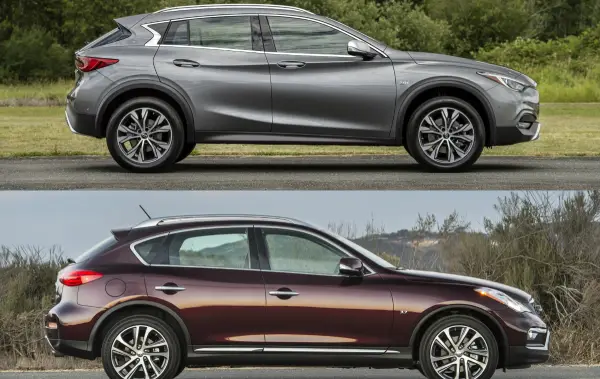
Compact Cars vs Subcompact SUVs: For many buyers, SUVs are now the preferred option. They appear more rugged, provide a dominant driving stance, and frequently make the driver feel as though they have more space.
However, there is more to the tale.
While You Care for Your Car, Care for Your Child’s Future Too 💖
A fun and educational book every parent should gift their kid.
 Get Kiddy Store Fortune Now
The distinction between an SUV and a conventional compact hatchback becomes quite minimal when you go down to the subcompact SUV category. In many instances, the engines, platforms, and interior proportions of the two cars are comparable.
So what exactly are you paying extra for?
More ground clearance, a taller body and even all-wheel drive are common examples. Although those features can be helpful, an SUV isn’t always a better everyday car because of them.
Compact hatchbacks frequently offer better road manners, less weight, and a lower center of gravity. Additionally, they are less expensive to buy and can provide better fuel efficiency.
Because of this, it makes perfect sense to compare the two body designs before going to a dealership.
1. Honda HR-V vs Honda Civic Hatchback: Which Honda Makes More Sense?
Honda gives buyers two interesting options: the Honda HR-V and the Honda Civic Hatchback.
The HR-V is a practical little crossover with a comfortable cabin and a useful driving position. However its standard 2.0-liter naturally aspirated four-cylinder engine produces 158 horsepower, which isn’t particularly exciting.
In Car and Driver’s testing, the HR-V needed 9.4 seconds to reach 60 mph. Its estimated combined fuel economy is 28 mpg with front-wheel drive and 27 mpg with all-wheel drive.
The Civic Hatchback adopts an alternative strategy. With a hybrid powertrain that can achieve a combined fuel economy of up to 49 mpg, it provides a more captivating driving experience.
It’s interesting to note that the Civic also maintain a high level of practicality. Six carry-on bags could fit in its cargo area behind the back seats—just one less than the HR-V.
Our opinion: The Civic Hatchback merits careful consideration if driving pleasure, performance, and fuel economy are more important than a tall seat.

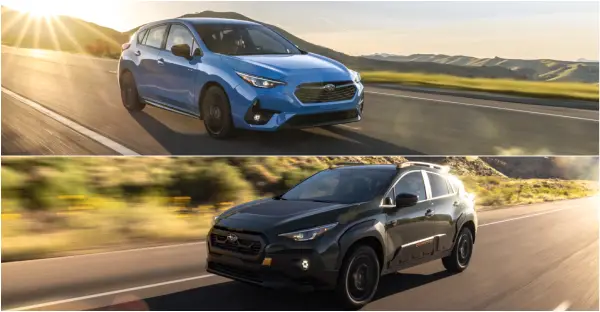
2. Subaru Crosstrek vs Subaru Impreza: Is Extra Ground Clearance Worth It?
The Subaru Crosstrek looks ready for an adventure, with rugged styling, extra ground clearance, and standard all-wheel drive.
However the Subaru Impreza offers an interesting alternative for buyer who mostly drive on regular roads.
Both vehicles share much of their engineering DNA, but the Impreza has some clear advantages. According to the comparison the hatchback is quicker, more fuel-efficient, and offers comparable interior space.
It is also less expensive than the Crosstrek, which has a starting price of $28,520, at $25,890.
There is a $2,630 discrepancy.
The Crosstrek still has a purpose, of course. Its available hybrid powertrain may appeal to consumers seeking electric efficiency, and its extra ground clearance can help on bumpy roads.
Our opinion: If driving in cities, on highways, and for commuting is part of your everyday routine, go with the Impreza. If you frequently come across rough roads or want its extra capability the Crosstrek makes more sense.
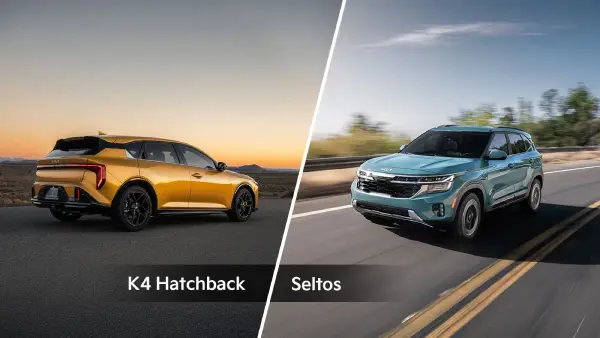
3. Kia Seltos vs Kia K4 Hatchback: A Surprisingly Close Battle
In the subcompact SUV market the updated 2027 Kia Seltos offers new style and additional powertrain options.
Its optional turbocharged engine boost output to 190 horsepower, while its base four-cylinder engine generates 147 horsepower. Another intriguing innovation is a hybrid powertrain.
However it’s important to consider the K4 Hatchback.
The K4 hatchback, which starts at $26,335, is marginally less expensive than the Seltos, which starts at $26,485.
The K4’s lower center of gravity and more engaging handling qualities make up for the lack of a hybrid option.
Another intriguing aspect of this comparison is performance. During testing the K4 Hatchback with the optional 190-hp turbocharged engine reached 60 mph in 7.0 second.
It took 8.2 seconds for the equally potent turbocharged Seltos.
For purchaser who appreciate quick acceleration that makes a big difference.
Our opinion: If you want SUV styling with hybrid availability the Seltos is the more adaptable choice. However, if value and fun of driving are more important to you should give the K4 some thought.
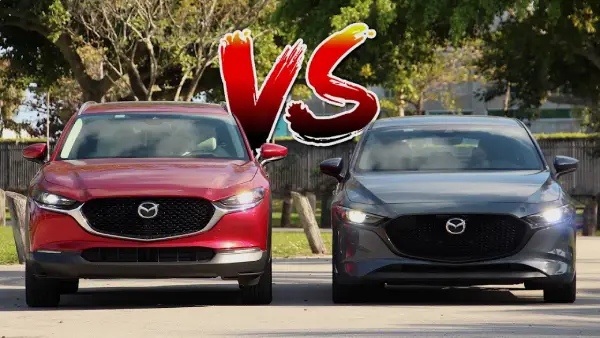
4. Mazda CX-30 vs Mazda3 Hatchback: The Driver’s Choice
Mazda has built a reputation for making everyday vehicles that are enjoyable to drive. Both the Mazda CX-30 and Mazda3 Hatchback reflect that philosophy.
The CX-30 is an appealing small SUV with a premium-feeling interior, standard 186-hp 2.5-liter four-cylinder engine, and an available turbocharged engine producing 250 horsepower.
However, the Mazda3 Hatchback offers a different kind of appeal.
Its starting price of $26,885 is below the CX-30’s $27,870 entry price. It also weighs less, with the front-wheel-drive model coming in at an estimated 3,111 pounds.
The Mazda3 seems more responsive in turns because to its reduced weight. Additionally, buyers have the option of a six-speed manual transmission, which will appeal to aficionados.
Additionally, practicality is not a big issue. During testing, both versions could fit 16 carry-on bags with the back seats folded.
The Mazda3 could accommodate five bags with the seats in place, while the CX-30 could accommodate six.
In our opinion, the CX-30 is a fantastic option for those who want a higher seating position with SUV design. For drivers who value fast handling and a cheaper starting price, the Mazda3 Hatchback is a more appealing choice.
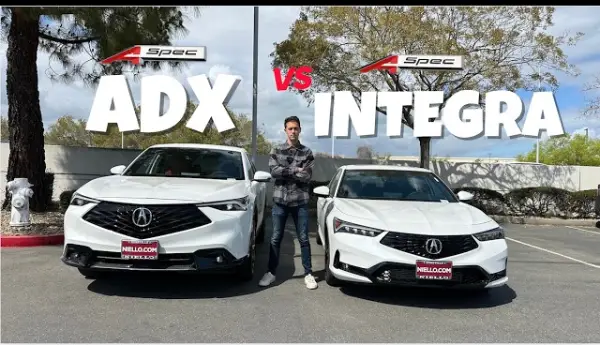
5. Acura ADX vs Acura Integra: Why Pay More for the SUV?
Luxury buyer face a similar decision when comparing the Acura ADX with the Acura Integra.
The ADX starts at $36,550 while the Integra begins at $34,795. That makes the hatchback $1,755 cheaper.
Both vehicle use a turbocharged 1.5-liter four-cylinder engine paired with a continuously variable automatic transmission in their standard configuration.
However, the Integra produces 200 horsepower and 192 pound-feet of torque. It also benefit from a lighter sportier setup.
The Integra took 7.1 seconds to reach 60 mph during testing. It took 8.7 seconds for the ADX with all-wheel drive.
When it comes to cargo flexibility, the SUV does have an advantage. The ADX could fit 22 carry-on bags when the back seats were folded, but the Integra could only fit 18.
These figures were seven and five, respectively, when the back seats were upright.
In our opinion, consumers who value performance and don’t require more SUV cargo versatility will find the Integra to be a better value. If you want additional cargo capacity, available all-wheel drive, and a higher seating position, the ADX makes more sense.
Compact Cars vs Subcompact SUVs: The Biggest Differences
Before making a decision, it’s worth looking beyond styling and comparing the features that actually affect everyday ownership.
| Category | Compact hatchbacks | Subcompact SUVs |
| Starting price | Often lower | Often higher |
| Fuel economy | Often better | Can be lower |
| Handling | Lower centre of gravity | Taller body |
| Ground clearance | Generally lower | Generally higher |
| Driving position | Lower seating | Higher seating |
| All-wheel drive | Limited availability | More common |
| Cargo space | Can be surprisingly generous | Often competitive |
Should You Buy a Compact Hatchback or a Small SUV?
How you really use your car will determine the answer.
A small hatchback might be a better investment if you spend the majority of your time driving around cities, commuting, and occasionally traveling on the interstate.
Nonetheless, tiny SUVs still have certain advantages that shouldn’t be overlooked.
On rough roads, its greater ground clearance may be useful. While available all-wheel drive offers extra traction in some situation the elevated seating position may make getting in and out easier.
Before investing further funds in SUV styling thoroughly consider your priorities.
The car with the tallest body or the most aggressive appearance isn’t always the smartest one. It’s the one that meets your daily requirement without charging you for feature you don’t often use.
FAQs
Q1. Should I buy a compact hatchback or a subcompact SUV?
A: It depends. Compact hatchbacks are more economical, have lower starting prices, and handle better. On the other hand, subcompact SUVs might be more your speed if you like being able to sit up higher and if you value ground clearance.
Q2. Do smaller SUVs have more room in the back for your gear than a hatchback?
A: Sometimes, but it’s surprising how some hatchbacks can have a surprisingly generous amount of storage room. Take, for example, the Mazda3 and the Honda Civic Hatchback.
Q3. What kind of car uses less gas: a compact car or a small SUV?
A: Usually, compact cars are more efficient due to the fact that they’re lighter and more aerodynamic. There are hybrid SUVs on the market today that are even more efficient than most standard hatchbacks.
Q4. Should you pay more to buy a subcompact SUV?
A: If your priority is to have all-wheel drive and a higher driving position or additional ground clearance, you might find a subcompact SUV to be worthwhile. Otherwise, a hatchback might offer more value.
Q5. Will a hatchback fit a family’s needs for daily use?
A: Hatchbacks provide plenty of cargo room and seat capacity for day-to-day use. But be sure to evaluate the trunk capacity and the size of the rear seats before you buy.
Also Read: 2027 Ducati Diavel V4 And V4 S First Look: More Tech, More Muscle, And A Premium New Upgrade