
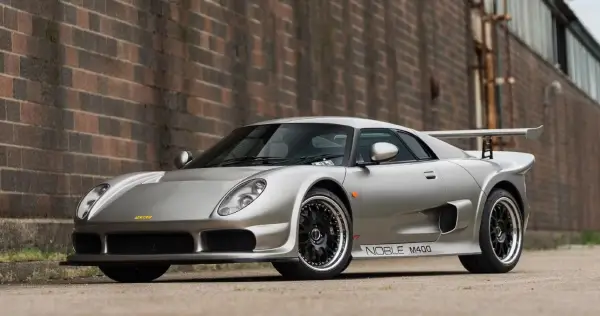
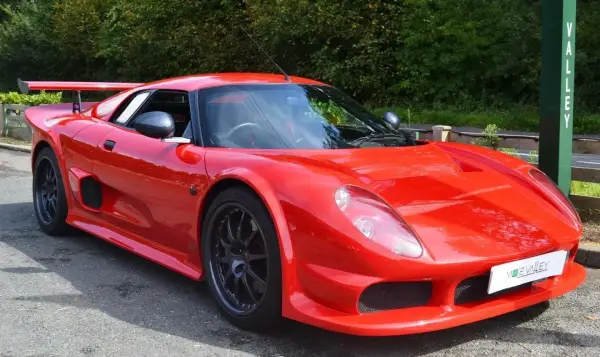
Noble M400: Imagine spending thousands of dollars on a serious supercar, only to discover that its rear light came from a regular Hyundai family sedan. Sound like something an automotive designer would joke about, right?
Well, it actually happened.
While You Care for Your Car, Care for Your Child’s Future Too 💖
A fun and educational book every parent should gift their kid.
 Get Kiddy Store Fortune Now
Meet the Noble M400 a rare British supercar that prove you don’t need an expensive badge, a luxurious interior or a mountain of electronic technology to deliver an unforgettable driving experience.
Constructed in a time when automakers were progressively incorporating electrical assistance and comfort amenities into their performance vehicles the M400 adopted an entirely different strategy. It was mechanically oriented, lightweight, strong, and unreservedly demanding.
Indeed, there is a connection between the Hyundai Sonata and those peculiar back lights.
The intriguing part is that, if you realize what Noble was attempting to accomplish the borrowed taillights are arguably the least shocking aspect of this amazing machine.
Why Supercars Started Feeling Too Comfortable
During the 1980 and 1990 owning a supercar often meant accept a few compromise. Heavy steering, stiff suspension, noisy cabin and demanding gearboxes were all part of the experience.
These cars weren’t necessarily easy to drive, but that was part of their appeal.
As manufacturers started to improve the comfort and accessibility of high-performance automobiles, things progressively altered. Advanced suspension systems, automated gearboxes, better electronics, and other luxury features proliferated.
That advancement was not intrinsically flawed. Supercars of today have developed into extremely powerful vehicles. But other aficionados began to miss the direct interaction between the driver and the vehicle.
A new philosophy was introduced with the Noble M400.
Noble intended its drivers to feel all that was going on beneath the car, not to make them feel comfortable.
This meant putting driver participation, mechanical grip, and weight reduction ahead of superfluous luxury.
Noble Automotive: A Small British Company With a Big Idea
Noble Automotive which Lee Noble founded in 1999 had a reputation for producing high performance vehicle that prioritize driving pleasure over sophisticated electronic.
The engineering philosophy of the company’s early model was rather simple. Noble focuses on building a lightweight chassis and providing their vehicle with enough power to produce noteworthy performance rather than adding extra features.
The original M10 roadster had a small body and a mid mounted V6 engine. The later M12 cars, which have a dual Ford turbocharged engine and a six-speed manual transmission, further expand the idea.
Due to their minimal electrical aid, these vehicles were very fascinating.
Traction control and advanced stability systems were not enough to fix every driver error. Careful attention to detail, seamless input, and a solid grasp of vehicle behavior were required for the mechanical arrangement.
The foundation was established by the M12. The M400 was a more harsher version of that recipe.
Noble M400 The Supercar That Put Driving First
The Noble M400 which debut in 2004 was essentially the track oriented, more focused version of the M12.
Rather than its actual engine output its moniker reflects its projected power to weight ratio of about 400 brake horsepower per ton.
A 3.0-liter Ford Duratec V6 twin-turbo engine was located behind its muscular bodywork. Although it had significant performance improvement the engine was based on the one found in the Ford Mondeo ST220.
Noble installed forged internal parts, upgraded Garrett turbocharger and made other adjustment to handle the increased output.
This produced about 425 horsepower and 390 lb-ft of torque.
A six-speed Getrag manual gearbox that sent power to the rear wheels gave driver complete control over the engine’s performance.
In addition the M400 had a lightweight composite body double wishbone suspension and a steel spaceframe chassis.
It weighed about 1,060 kg (2,337 pound) based on the parameter that were publish which makes its power to weight ratio quite remarkable.
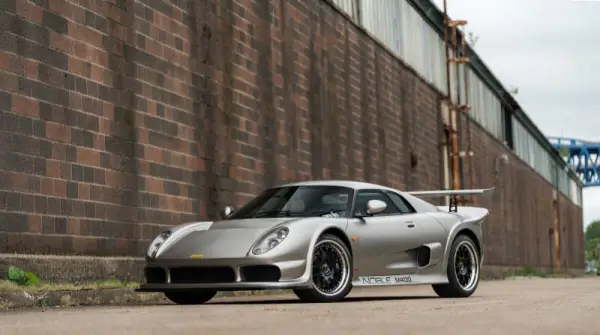
Noble M400: Key Specifications
| Specification | Details |
| Production years | 2004–2007 |
| Engine | 3.0-liter twin-turbo V6 |
| Engine origin | Ford Duratec |
| Maximum power | 425 hp |
| Torque | 390 lb-ft |
| Transmission | Six-speed manual |
| Drivetrain | Rear-wheel drive |
| Chassis | Steel spaceframe |
| Body | Composite |
| Weight | Approximately 2,337 lbs |
| 0–60 mph | Approximately 3.5 seconds |
| Top speed | Approximately 185 mph |
No ABS, No Traction Control, and Very Little Room for Mistakes
This is where the Noble M400 gets quite intriguing.
Contemporary performance vehicle are equipped with numerous technological system that are intended to keep driver out of trouble. They can control engine output, modify brake pressure and step in when the car begin to lose traction.
The M400 adopt a far more straightforward strategy.
Due to the lack of traction control and ABS, the driver was left with a lot of responsibility.
The Noble may seem intimidating to someone used to modern supercars, but that’s precisely why fans of vintage cars found it fascinating.
The car quadruple wishbone suspension, balanced chassis and incredibly low weight all contribute to its remarkable mechanical grip.
Additionally, it was reported that the M400 produced around 1.2 G of lateral acceleration under suitable testing conditions.
This car, of course, did not promote careless driving. Due to the lack of technological safety aid, particularly in inclement weather or on unfamiliar routes, the driver had to respect the available grip.
It didn’t try to hide the fact that it was a driver machine.
A Rare Supercar That Didn’t Need a Famous Badge
Another reason the M400 is worth consider is its rarity.
Compared to Ferrari, Lamborghini, and Porsche, Noble was a very small business with significantly fewer resources.
Hi-Tech Automotive produced the M400 in South Africa from 2004 to 2007.
The steel spaceframe and composite body assembly highlighted the company’s specialized approach as opposed to the big volume production technique used by other automakers.
Additionally, the vehicle entered the American market in an unconventional way.
Ohio-based 1G Racing provided US-market examples in component form enabling individual vehicles to be finished and titled in accordance with relevant laws.
Through this arrangement, American aficionados who might not have otherwise been able to purchase the British-designed supercar were able to do so.
Claim about the precise quantity of M400s construct should be treated with caution because production statistic differ among published source. Unquestionably the type is still somewhat rare when compare to popular exotic vehicles.
Its exclusivity contribute to its allure for collector.
Is the Noble M400 Still Affordable in 2026?
Things become much more intriguing at this point.
A supercar with 425 horsepower, a six speed manual transmission and a weight of about 2,337 pound seems like it should be extremely expensive.
But historically the Noble M400 has been far less expensive than many of its more well known Italian competitor.
Example can still be found at cost that seem shockingly affordable for the performance being offer.
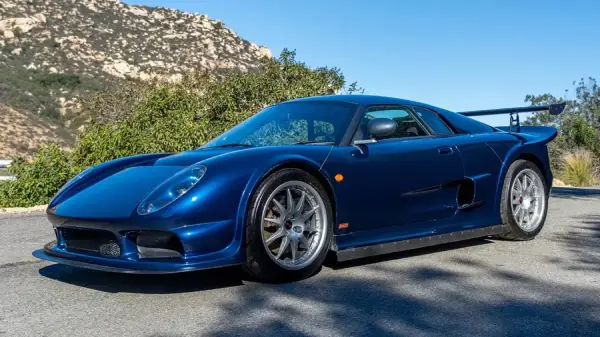
For instance as of November 18, 2026 a 2006 Noble M400 posted on Bring a Trailer was sold for $46,000. It had a modified twin turbo V6, a six-speed manual transmission, with roughly 15,000 miles on the odometer.
This specific specimen include conditions and revision and the auction bid is not a guaranty of the final sale price.
For the Noble M400, a market benchmark of $58,713 was report. In August 2026 a different example from 2006 sold for $56,400.
Naturally purchasing one isn’t always the same as purchasing a standard secondhand sports vehicle.
The engine maintenance history turbocharger condition, gearbox, chassis, suspension and the availability of specialty replacement part should all be looked into by the prospective owner.
The M400 is still a specialist performance vehicle that require specialized care, despite the fact that it may be an alluring place to start if you want to own an analog supercar.
FAQs
Q1. What is a Noble M400?
A: The Noble M400 is a British mid-engine supercar that was launched in 2004 and is equipped with a twin-turbo 3.0L Ford Duratec V6. This car also has a composite body and a manual six-speed transmission.
Q2. Are Hyundai Sonata taillights on the Noble M400?
A: Yes, they are. In fact, the car is famous for utilizing fourth generation Hyundai Sonata taillights, but the upside-down way they are installed into the body work gives the rear a unique look.
Q3. How much horsepower is there in a Noble M400?
A: The 3.0 L V6 with twin turbos puts out approximately 425 hp and 390 lb-ft of torque.
Q4. What is the performance like for the Noble M400?
A: The factory estimated 0 to 60 mph is 3.5 seconds and a top speed of 185 mph.
Q5. Does the M400 feature a traction control system?
A: It does not, nor does the car include ABS, making it an advanced car that requires great driver input.
Also Read: 5 Sports Cars That Get Better Gas Mileage Than the Subaru BRZ
1 thought on “The Noble M400 Is a 425-HP Supercar With Hyundai Sonata Taillights”
Comments are closed.