
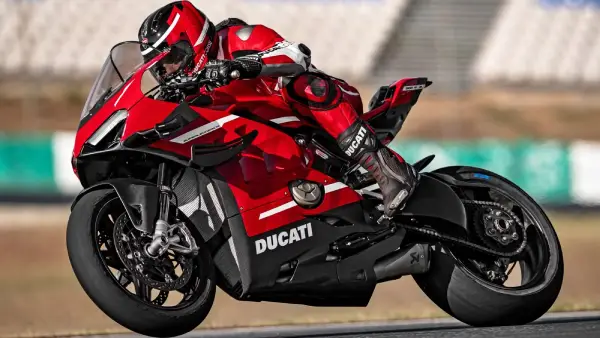
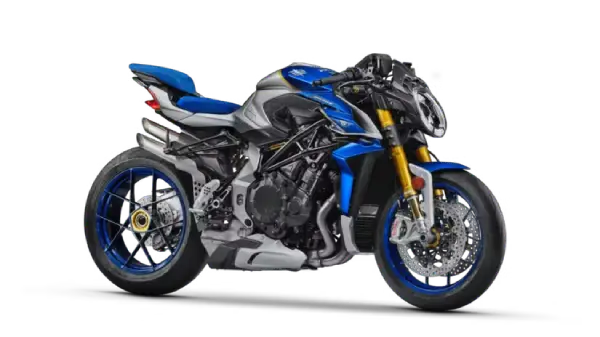
Motorcycles With Better Power-to-Weight Ratios: One of the most capable superbikes on the road is the Honda CBR1000RR. It offers strong performance, outstanding handling and sufficient horsepower to amuse seasoned riders. However, there is always another motorcycle willing to push the boundaries in terms of raw performance numbers.
Horsepower alone does not tell the whole story. Both how quickly a motorcycle accelerates and how well it responds to rider inputs are greatly influenced by its weight. In this case, the power-to-weight ratio is important. For every pound the motorcycle weighs, it determines how much horsepower is available.
While You Care for Your Car, Care for Your Child’s Future Too 💖
A fun and educational book every parent should gift their kid.
 Get Kiddy Store Fortune Now
The Honda CBR1000RR weighs about 432 pounds and generate about 171 horsepower. As a result, its power-to-weight ratio is around 0.396 horsepower per pound. While that is indeed impressive, a handful of high-performance motorcycles have even higher figure.
Here are ten motorbikes that outperform the Honda CBR1000RR in terms of power-to-weight, ranging from costly Italian performance machines to Japanese superbikes.
1. Suzuki GSX-R1000R – 0.43 hp/lb
For the past year, Suzuki has been a significant rival in the superbike market. It is one of the most well-known brands in the liter-bike class thanks to its edgy look and potent inline-four engine.
For its 40th anniversary update in 2026, Suzuki added several engine enhancements, such as better camshafts, an enhanced crankshaft, and revised pistons. The motorcycle is able to meet Euro5+ emission regulations while maintaining excellent performance thanks to these changes.
The international model weights about 448 pounds and has about 192 horsepower. It performs better than the ordinary Honda CBR1000RR with a power-to-weight ratio of about 0.43 hp/lb.
The American model and the international model differ significantly though. The GSX-R1000R offered in the US produces roughly 169 horsepower according to EPA testing results. At the same weight the ratio decreases to roughly 0.38 horsepower per pound.
Despite this geographical difference the worldwide version demonstrate how competitive Suzuki’s flagship superbike is.
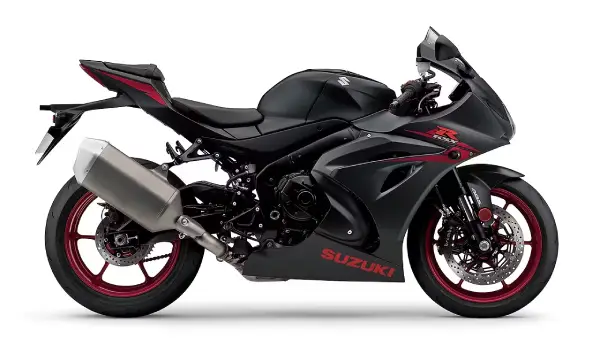
2. Yamaha YZF-R1 – 0.44 hp/lb
Few motorcycles have influenced the superbike industry quite like the Yamaha YZF-R1. When it arrived in 1998 it changed expectation for liter class sportbike by combining a powerful engine with a lightweight chassis and advanced engineering.
More than two decades later the R1 remain a serious performance machine.
Depend on the market the motorcycle’s output varies. According to EPA testing data American version generate about 184 horsepower although Yamaha’s Japanese-market specification indicate about 200 horsepower.
The Japanese version, which weighs about 448 pounds, has a power-to-weight ratio of about 0.44 horsepower per pound. Even the American version can produce about 0.41 horsepower per pound.
This means that no matter which market specification is taken into account, the R1 has an advantage over the regular CBR1000RR.
Experienced sportbike enthusiasts are still drawn to the R1 because of its powerful acceleration, accurate handling, and race inspired engineering.
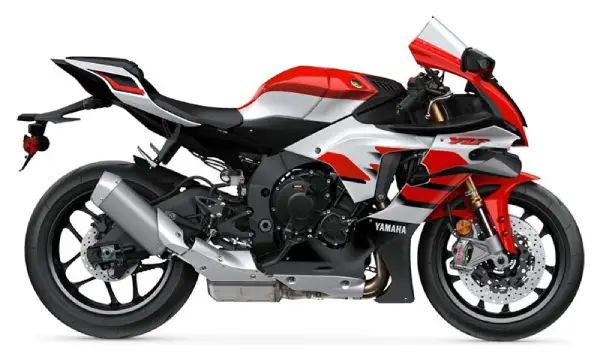
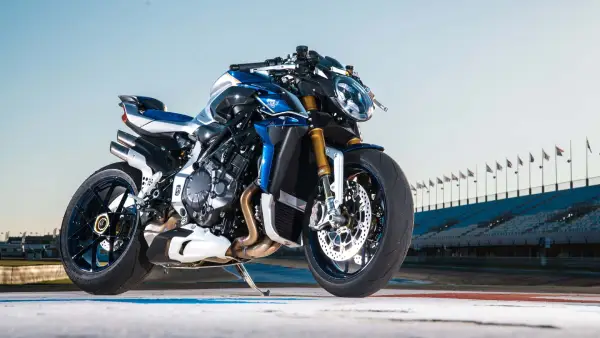
3. MV Agusta Brutale 1000 RR Assen – 0.46 hp/lb
If there’s one motorcycle that knows how to attract attention, it’s the MV Agusta Brutale 1000 RR Assen.
Developed as a special-edition model celebrating the famous Assen racing circuit, this hypernaked motorcycle takes an already powerful platform and adds several performance focused upgrades.
Its 998cc inline-four engine can produce up to 212 horsepower with the available performance kit. The motorcycle also benefit from a revised gearbox and lightweight components designed to improve its overall performance.
Here weight calculation need a little more care. The minimal weight specified by MV Agusta is roughly 436.52 pounds without gasoline. The total comes to about 460.4 pounds when the estimated weight of a 4.23-gallon fuel tank that is 90% full is added.
The Brutale 1000 RR Assen has an amazing power-to-weight ratio of 0.46 hp/lb despite that extra weight.
At about 0.44 horsepower per pound, the basic Brutale 1000 RR is also rather powerful.
The Brutale blends tremendous performance with an edgy, exposed naked-bike design, in contrast to conventional fully faired superbikes. Although the motorcycle is pricey, its engineering is well supported by its performance metrics.
4. Honda CBR1000RR-R Fireblade SP – 0.49 hp/lb
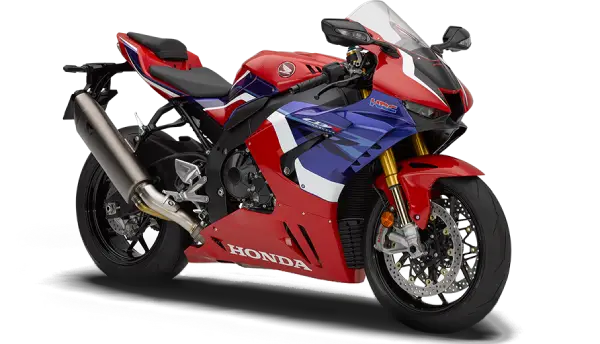
Honda’s already outstanding superbike the CBR1000RR is elevated with the CBR1000RR-R Fireblade SP.
This is not merely an upgraded motorcycle. It is a far more track focused car thanks to MotoGP-inspired engineering, an electronically controlled Öhlins suspension, a Brembo braking component and a titanium Akrapovič exhaust.
According to the demand of the worldwide market, the high revving engine produce about 214.5 horsepower.
For 2027 Honda has made additional improvements, including new chassis, a variable length intake system and lighter wheels. These change enhance the Fireblade SP performance advantage.
According to EPA figures the American-market version weighs about 445 pounds at the curb and generates about 189.1 horsepower. That translates to about 0.43 horsepower per pound.
International models are more spectacular, weighing around 438.7 pound and producing about 214.5 horsepower. This combination raises the ratio to about 0.49 horsepower per pound.
5. Ducati Streetfighter V4 SP – 0.49 hp/lb
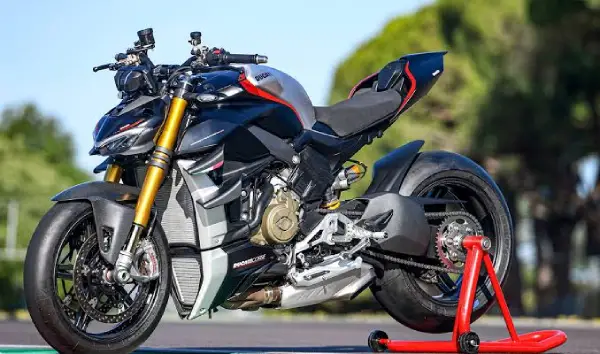
The Streetfighter V4 SP demonstrates that exceptional performance can be achieve without a full sportbike bodywork.
The Streetfighter, which is based on the Panigale V4 platform, blends Ducati’s potent Desmosedici Stradale engine with aggressive naked-bike appearance and a more upright riding position.
At the top of the Streetfighter lineup is the SP variant. It is lighter than the standard model because to lightweight carbon-fiber parts, such as carbon-fiber wings and wheels.
Although American models are rated at roughly 205 horsepower, the engine produces roughly 214 horsepower according to international market specifications.
Without fuel, Ducati claims to weigh about 414 pounds. The motorcycle weighs about 437.7 pounds when the anticipated weight of a 90% full gasoline tank is included.
This results in a power-to-weight ratio of about 0.49 horsepower per pound.
Because it blends superbike level horsepower with the unique riding position of a naked motorbike the Streetfighter V4 SP is very intriguing. It’s a great choice for rider who want fast speed without the classic completely faired superbike look.
6. Aprilia RSV4 1100 – 0.49 hp/lb
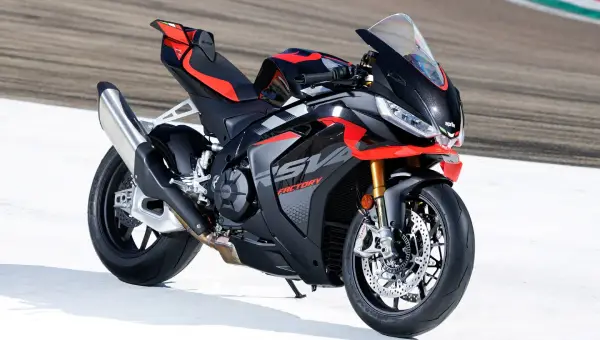
Aprilia might not receive as much attention as Ducati or BMW in some markets but its RSV4 1100 has establish itself as a serious competitor in the high performance superbike world.
The motorcycle is powered by a powerful V4 engine producing approximate 220 horsepower. Unlike some competitor Aprilia offer the same claim peak output across different market meaning American buyers aren’t facing the same substantial power reductions seen with certain other motorcycle.
There is more to the RSV4’s performance than just engine output. It is a capable machine on challenging roads and racetracks because to its racing-inspired chassis, sophisticated electronics, and well-developed aerodynamics.
Including fuel, its wet weight is roughly 449.7 pounds. The motorbike has a power-to-weight ratio of about 0.49 hp/lb with its 220 horsepower.
As a result, it easily surpasses the Honda CBR1000RR.
The unique V4 engine nature of the RSV4 1100 is another unique feature that numbers cannot adequately describe. There is much to like here for riders seeking a superbike with an exciting motor and significant track potential.
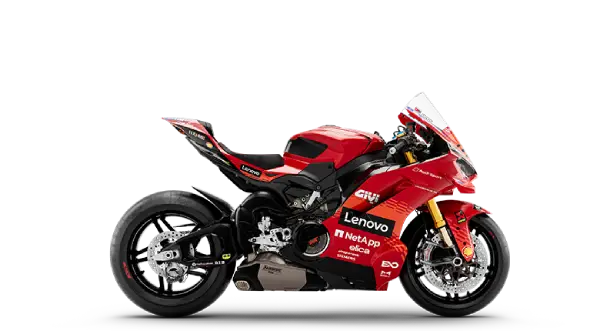
7. Ducati Panigale V4 R – 0.50 hp/lb
Racing performance is at the core of the engineering of Ducati’s Panigale V4 R.
The V4 R has a 998cc Desmosedici Stradale R powertrain designed with racing needs in mind, in contrast to the standard Panigale V4, which has a larger 1,103cc engine.
At an amazing 15,750 rpm, its international-market engine generates about 218 horsepower. The motorcycle also has cutting-edge electronic Ducati’s Racing Gearbox technology, and aerodynamic features inspired by MotoGP.
Ducati claims a wet weight of roughly 411 pounds without gasoline. When the estimated weight of a 90% full fuel tank is included, the figure increase to roughly 436.4 pounds.
The Panigale V4 R delivers about 0.50 horsepower per pound using the international horsepower figure.
A slightly detuned variant with about 208.4 horsepower, which brings the ratio closer to 0.48 hp/lb, is sent to American customers.
The Panigale V4 R is still a very capable superbike in spite of that distinction. It is one of the most thrilling motorcycles in Ducati’s portfolio thanks to its high-revving power, lightweight design and racing derived technology.
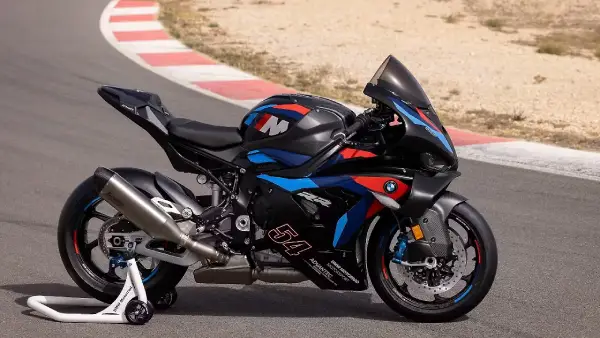
8. BMW M 1000 RR – 0.51 hp/lb
Although BMW Motorrad has a solid reputation for building high-end bikes, the M 1000 RR reflects the company’s more ambitious performance goals.
The M 1000 RR, a homologation-focused superbike with racing performance in mind, is positioned above the standard S 1000 RR.
According to international standards, the 999cc inline-four engine generates about 218 horsepower. About 205 horsepower is produced by American models.
The international version has a power-to-weight ratio of about 0.51 horsepower per pound and a reported curb weight of about 428 pounds.
This places it ahead of a number of other motorcycles on this list, including the Honda CBR1000RR.
Aerodynamics has also received a lot of attention from BMW. Its winglets improve stability during aggressive riding by producing more downforce at high speeds.
The motorcycle also boasts a chassis designed for high-speed performance and sophisticated rider support systems.
The M 1000 RR is obviously made with track lovers in mind, but it still has a number of technological systems that help control its massive performance.
Anyone considering high-end European superbikes should give the BMW careful thought.
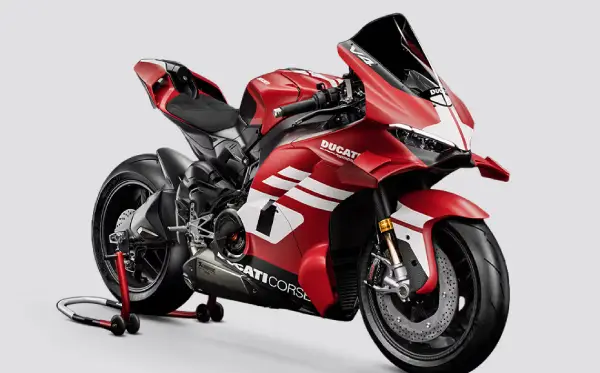
9. Ducati Superleggera V4 Centenario – 0.63 hp/lb
The pinnacle of production motorcycle engineering has always been represent by Ducati Superleggera model. That heritage is spectacularly carried on by the Superleggera V4 Centenario.
This unique motorcycle, designed to commemorate Ducati’s 100th anniversary blend lightweight design with an incredibly potent engine.
Its significant usage of carbon fiber is one of its most notable features. To cut weight without sacrificing the performance one would expect from a flagship superbike, Ducati used lightweight materials in the chassis and other parts.
In road configuration, the motorcycle’s new 1,103cc Desmosedici Stradale 1100 R engine generates about 228 horsepower.
When the racing Akrapovič exhaust and special race engine oil are used, the output can reach approximately 247 horsepower.
In its lightest race configuration without fuel, Ducati claims to weigh about 368 pounds. The predicted weight rises to about 393.4 pounds after fuel is added.
With 247 horsepower, the race configuration has an impressive power-to-weight ratio of about 0.63 horsepower per pound.
Even the road configuration produces about 0.56 horsepower per pound.
This is not your typical superbike made for daily riding. It’s a very special performance machine that shows how far engine technology and lightweight materials can be developed by manufacturers.
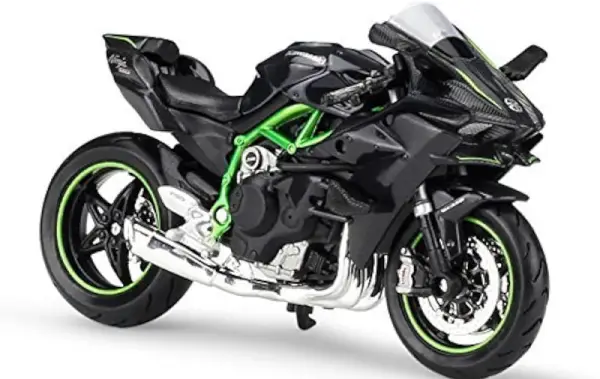
10. Kawasaki Ninja H2R – 0.67 hp/lb
The only motorcycle on our list that complete changes the conversation is the Kawasaki Ninja H2R.
Unlike conventional superbike, the H2R’s supercharged 998cc inline four engine generates an amazing 322 horsepower.
A motorcycle weighing approximately 476.3 pounds has more power than many standard passenger cars.
With an incredible power to weight ratio of almost 0.67 horsepower per pound, it is the top performer on our list.
The secret is Kawasaki supercharger technology, which was developed using engineering expertise from Kawasaki Heavy Industries. It allows the engine to produce far more power than a motorcycle engine of a similar displacement that is typically aspirated.
For the 2027 model year the H2R’s engine was also updated with new intake parts, a reworked supercharger impeller and a higher compression ratio.
It’s interesting to see that the power of the street-legal Ninja H2 has decreased in 2027, from roughly 240 horsepower to 206 horsepower. However the amazing 322 horsepower output of the track only H2R is still present.
One significant restriction that prospective purchaser should be aware of is that the Ninja H2R is not a motorcycle that is permitted on public roads. It is only intended for usage in closed courses.
Nevertheless, the H2R is in a class by itself when it comes to production motorcycle performance metrics.
FAQs
Q1. Calculate the power-to-weight ratio for a Honda CBR1000RR.
A: With a weight of 432 pounds and a power of 171 horsepower, the CBR1000RR has a power-to-weight ratio of .396 horsepower per pound.
Q2. What is the motorcycle with the most power per unit of weight on this list?
A: Kawasaki Ninja H2R has the most with a weight of 476.3 pounds and a power of 322 horsepower for a power-to-weight ratio of .67 horsepower per pound.
Q3. What motorcycle has the most horsepower, the Honda CBR1000RR or the Ducati Superleggera V4 Centenario?
A: The Ducati produces the most horsepower of the two at either 228 horsepower on the road, or a max of 247 horsepower with race equipment. That easily beats the Honda’s 171 horsepower.
Q4. Is the Yamaha YZF-R1 faster than the Honda CBR1000RR?
A: Although the Yamaha has a better power-to-weight ratio than the other motorcycles in this list, factors like weight and aerodynamics make the Yamaha just as fast as the Honda, at least for drag races.
Q5. What is the advantage of a motorcycle with a better power-to-weight ratio?
A: With more engine power available for each pound of the motorcycle’s weight, the bike can be quicker off the start and have improved acceleration and speed, though it will not have a significant effect on how the bike handles and how well the motorcycle can stop.
Also Read: The Noble M400 Is a 425-HP Supercar With Hyundai Sonata Taillights