
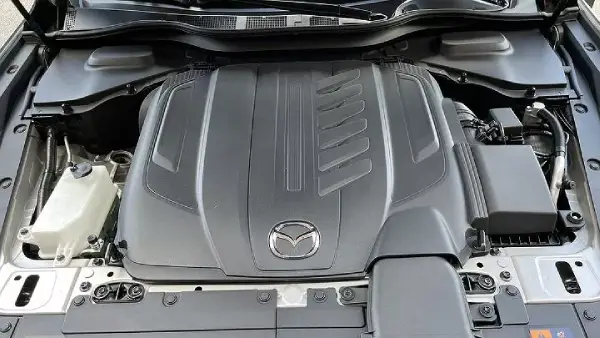
Mazda Inline-6 Engine: Mazda has never shied away from trying new things. While many manufacturers are sticking to turbocharged four-cylinder engines Mazda introduced an all-new Mazda Inline-6 Engine, which was an unexpected move. It’s a daring move that gives the brand’s biggest SUVs luxury engineering, rear-wheel drive characteristics, and smooth performance.
This is the intriguing part, though.
While You Care for Your Car, Care for Your Child’s Future Too 💖
A fun and educational book every parent should gift their kid.
 Get Kiddy Store Fortune Now
There are two distinct personalities for this smart six-cylinder, depending on where you live. While many international markets benefit from an extraordinarily efficient turbo diesel version, North American consumers receive a potent turbocharged gasoline engine.
Which is superior, then?
Is the diesel’s mountain of low-end torque worth sacrificing horsepower? Does the gasoline engine deliver enough excitement to justify its higher fuel consumption? And are American buyers really missing out by not getting Mazda’s diesel?
Let’s dive deep into Mazda’s newest powertrain family and discover which inline-six deserve the crown.
Why Mazda Built an Inline-Six Engine
For decades Mazda built its reputation around lightweight sports cars and practical family vehicle. Then came a dramatic shift.
The company wanted to move further into the premium SUV segment without abandoning its signature driving experience.
Mazda created a completely new longitudinal platform especially for rear-wheel-drive and all-wheel-drive cars rather than just adding a larger turbocharged four-cylinder.
One of the most ambitious engines the firm has ever made is the Mazda Inline-6 Engine.
Because its cylinders balance one another without the need for complicated balancing shafts, an inline-six inherently produces smoother operation than V6 engines which dominate the SUV market.
The benefits include:
- Silky smooth acceleration
- Lower engine vibration
- Improved refinement
- Better weight distribution
- Premium driving characteristics
This engine now powers Mazda flagship SUVs and represent the brand’s biggest leap toward luxury.
Where Can You Find Mazda’s Inline-Six?
Not every market receives the same version.
North America
Buyer in the United States and Canada currently receive:
- Mazda CX-90
- Mazda CX-70
Both model use the gasoline powered turbocharged inline-six.
The CX-90 offer three rows of seating while the CX-70 is a two-row SUV aimed at buyer wanting extra cargo space and sportier styling.
Europe and Japan
International markets receive Mazda’s diesel-powered inline-six in:
- CX-60
- CX-80
Australia is one of the few regions where buyers can actually choose between both gasoline and diesel version making it a fascinating real-world comparison.
Same DNA, Different Personalities
At first glance, these engines look almost identical.
Both feature:
| Specification | Gasoline | Diesel |
| Configuration | Inline-6 | Inline-6 |
| Displacement | 3.3L | 3.3L |
| Bore | 86 mm | 86 mm |
| Stroke | 94.2 mm | 94.2 mm |
| Turbocharger | Single Turbo | Single Turbo |
| Aluminum Block | Yes | Yes |
| Aluminum Head | Yes | Yes |
| Mild Hybrid Available | Yes | Yes |
Mazda essentially developed one engine architecture capable of supporting two very different combustion strategies.
That’s impressive engineering.
Where these engines begin to separate is in how they deliver their performance.
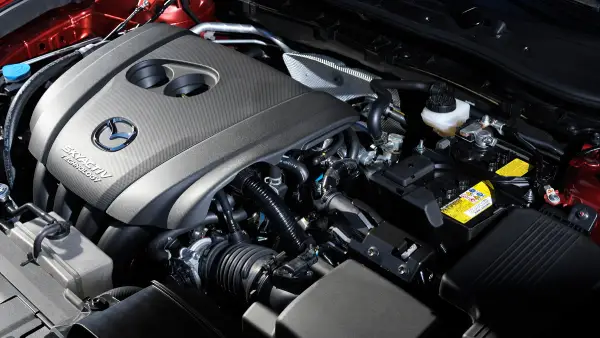
Understanding Diesel vs. Gasoline Performance
Many people assume horsepower tells the entire story.
It doesn’t.
How quickly a car accelerates at greater speed is determined by its horsepower.
How easily it can move from a stop, climb slopes or tow large objects depends on its torque.
Because of this even though diesel engines have fewer horsepower, they can feel extremely powerful.
Every generation of the inline-six was created by Mazda with a distinct driving characteristic in mind.
Diesel: Built for Torque and Efficiency
The diesel engine’s much higher compression ratio makes it stand out right away.
Diesel engine use compression alone to ignite fuel rather than spark plugs like gasoline engines do.
This enable Mazda to produce remarkable torque at incredibly low engine speeds while optimizing fuel efficiency.
Compare to the gasoline variant the diesel redline is significantly lower at about 5,000 RPM.
However that is deliberate.
High rpm are not necessary for diesel engines to feel strong.
Instead, as soon as the accelerator is depressed, they provide enormous pulling power.
This makes everyday driving surprisingly effortless.
Whether merging onto highways or overtaking slower traffic the diesel rarely feel like it’s working hard.
Its broad torque curve also means fewer downshifts and quieter cruising on long journey.
For driver covering thousands of highway miles every year this relaxed character becomes a major advantage.
Gasoline: Built for Speed and Refinement
The gasoline-powered Mazda Inline-6 Engine is the sprinter if the diesel engine is the long runner.
Mazda’s six-cylinder turbocharged gasoline engine loves to rev, in contrast to the diesel. It provides greater acceleration over the rev range because of a higher 6,500-rpm redline and a lower 12:1 compression ratio.
There are presently two gasoline-powered models available from Mazda.
Standard Output
- 280 horsepower
- 332 lb-ft of torque
- Peak torque available from around 2,000–3,500 rpm
This version already feels stronger than most competitor turbocharged four cylinder engine. Power delivery is smooth, predictable and refined making daily driving enjoyable without feeling overly aggressive.
High Output
The real excitement begins with Mazda’s High Output engine.
It is the most potent production engine Mazda has ever produced, with 340 horsepower and 369 lb-ft of torque when running on premium fuel.
It is one of the most powerful six-cylinder SUVs in its class with an astonishing 319 horsepower even while using ordinary fuel.
The gasoline engine continue to pull harder all the way to the redline in contrast to the diesel, which runs out of breath as the revs rise.
This additional top-end performance is evident for driver who like fast acceleration, interstate passing or driving on mountain road.
Performance Comparison
Here’s how Mazda’s latest inline-six engines stack up.
| Engine | Horsepower | Torque | Character |
| Diesel Low Output | 197 hp | 332 lb-ft | Maximum economy |
| Diesel Standard | 228 hp | 369 lb-ft | Balanced torque |
| Diesel High Output | 251 hp | 406 lb-ft | Best towing performance |
| Gas Standard | 280 hp | 332 lb-ft | Strong everyday performance |
| Gas High Output | 340 hp | 369 lb-ft | Best overall acceleration |
Looking strictly at numbers, the gasoline engine clearly wins in horsepower.
However, horsepower isn’t the whole story.
The diesel produces its maximum torque at much lower engine speeds giving it a stronger feeling during relaxed driving and towing.
Diesel Has a Significant Advantage in Fuel Efficiency
This is where diesel serves as a reminder to everyone of its continued popularity in many regions of the world.
Mazda’s overseas diesel model achieve far higher fuel efficiency than the gasoline-powered CX-70 and CX-90 which typically yield about 25 mpg combined.
Diesel version can achieve combined fuel economy of more than 40 mpg depending on the market and setup; some test cycles can reach or surpass 45 mpg.
Over time that represents a substantial difference in fuel expenses for driver who travel considerable highway miles on a weekly basis.
Imagine traveling hundreds more miles before the tank needs to be refilled.
That’s precisely where diesel excels.
Driving Experience: Which One Feels Better?
Number only tell part of the story.
What matters most is how each engine feel from behind the wheel.
Diesel Driving Experience
The diesel feels calm and effortless.
Press the accelerator lightly and the SUV moves forward with authority.
You rarely need high engine speeds because maximum torque arrives early.
This creates a relaxed driving style that’s perfect for:
- Long-distance highway travel
- Family road trips
- Towing trailers
- Carrying heavy loads
- Everyday commuting
The engine remains quiet while cruising and require fewer gear changes.
Drivers who value comfort over outright speed will appreciate this character.
Gasoline Driving Experience
The gasoline inline-six delivers a completely different personality.
Throttle response is quicker.
Acceleration feels stronger.
The engine enjoys revving higher rewarding enthusiastic driving with smooth and continuous power.
Instead of encouraging relaxed cruising it invites drivers to push harder through corners and enjoy the rear-wheel-drive platform Mazda engineered specifically for these SUV.
It feel more like a luxury performance SUV than a traditional family crossover.
Towing Capability
When towing, torque is important.
For this reason consumer of trucks and SUVs have long preferred diesel engines.
Mazda’s high-output diesel engine generate an incredible 406 lb-ft of torque making it the torque champion of the lineup.
Whether pulling a boat, camper or utility trailer the diesel offers effortless low-speed strength.
The gasoline engine particularly the 340-horsepower type, still performs remarkably well, but drivers who frequently tow might prefer the diesel more relaxed pulling capabilities and improved fuel efficiency under load.
Why the Diesel Wasn’t Released in North America
Why Mazda never released the diesel inline-six in the US is a question that many enthusiasts have.
That choice was probably impacted by a number of variables.
Tight Emissions Regulations
To comply with U.S. regulations, modern diesel engines need costly emissions control systems.
The cost of manufacturing is greatly increased by adding this technology.
Demand in the Market
The majority of SUV purchasers in North America favor electric, hybrid or gasoline-powered vehicles.
The market for diesel passenger cars is still niche.
Costs
While catering to a very tiny market, providing both gasoline and diesel engines would complicate manufacture.
It probably made more financial sense for Mazda to concentrate on a strong gasoline engine.
Is the Plug-In Hybrid the Better Choice?
Ironically, the most balanced powertrain may not be either inline-six.
Mazda plug-in hybrid combine a naturally aspirate 2.5-liter four cylinder engine with an electric motor.
Together they produce:
- 323 horsepower
- 369 lb-ft of torque
- Electric-only driving capability
- Significantly improve fuel economy
The plug-in hybrid provides sufficient of performance for longer trips while offering silent electric driving around town for customers with short daily commutes.
It provides a great balance of power and efficiency, but it falls short of the inline-six’s smooth nature.
Pros and Cons of Each Mazda Inline-6 Engine
Gasoline Inline-6
Pros
- Best horsepower in the lineup
- Smooth, refined, and quiet operation
- Excellent highway passing performance
- More engaging driving experience
- Readily available in North America
Cons
- Lower fuel economy than the diesel
- Premium fuel recommended for maximum output
- Less low-end torque than the high-output diesel
- Higher running costs for high-mileage drivers
Diesel Inline-6
Pros
- Outstanding fuel economy
- Massive low-end torque
- Excellent for towing and long-distance driving
- Relaxed and effortless power delivery
- Longer driving range between fill-ups
Cons
- Not available in the U.S. or Canada
- Lower horsepower than the gasoline version
- Higher emissions-control complexity
- Limited availability outside select global markets
The Bigger Picture: Mazda’s High-End Objectives
More than just an engine Mazda’s new inline-six makes a statement about the company’s future.
Instead of adhering to the industry trend of just using smaller turbocharged four-cylinder engines, Mazda invested in a sophisticated rear-wheel-drive design and a refined six-cylinder powertrain that is typically associated with luxury firm.
This decision has made the CX-70 and CX-90 respectable alternative to expensive SUVs from Mercedes-Benz, BMW, and Genesis often at a lower cost.
The inline-six exemplifies Mazda’s dedication to provide a more enjoyable driving experience regardless of your preference for efficiency or performance.
Final Verdict
The Mazda Inline-6 Engine demonstrates that the SUV market is still open to innovation.
The gasoline variant is the obvious choice if performance is your top concern. It’s one of the most amazing engines Mazda has ever produce with up to 340 horsepower, smooth acceleration and a refined driving attitude.
Diesel stands out if you’re looking for easy torque and fuel efficiency. It is perfect for long-distance driving and towing because to its exceptional economy and plentiful low-end pulling power.
For many consumers, the North American gasoline engines offer the ideal combination of power, refinement, and practicality. However it’s easy to understand why enthusiasts are curious about the diesel variant offer overseas.
One thing is certain Mazda’s move to an inline-six platform has elevated the brand flagship SUV giving buyers a driving experience that feel more premium than ever before.
FAQs
Q1. Is the Mazda Inline-6 Engine available with diesel?
A: Yes Mazda offer a turbocharged diesel version in market such as Europe, Japan and Australia. North America currently receive only the gasoline version.
Q2. Which engine offers better fuel economy?
A: The diesel engine is significantly more fuel efficient making it the preferred choice for driver who spend a lot of time on highway.
Q3. Does the gasoline engine require premium fuel?
A: The high output gasoline engine deliver its maximum performance on premium fuel although it can also operate on regular gasoline with a slight reduction in horsepower.
Also Read: The 9 Most Affordable and Reliable Compact SUVs of 2026 That Deliver the Best Value