
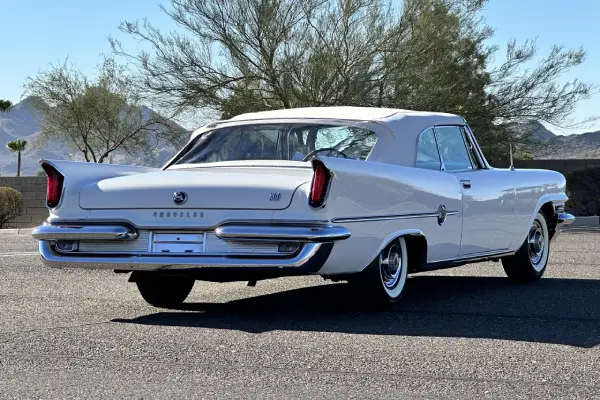
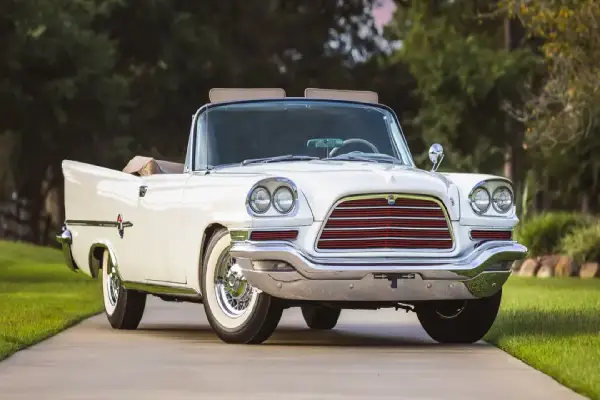
The 1959 Chrysler 300E Transformation into a Sign of Unadulterated American Power
American automobiles used to make no apologies at all.
While You Care for Your Car, Care for Your Child’s Future Too 💖
A fun and educational book every parent should gift their kid.
 Get Kiddy Store Fortune Now
They had a large size. They were noisy. They consumed fuel as if it were water. And no one was urging them to be reasonable, not even legislators, insurers, or buyers.
Ego, ambition, and pure mechanical certainty drove automakers to create automobiles before pollution regulations, crash standards, and even seatbelt arguments made news. More than everything else ever made one machine perfectly embodies that time period.
The Chrysler from 1959 is that automobile.
This was more than a high end coupe. Constructed from chrome, cubic inches, and the conviction that more was always better, it was a statement.
America’s Power Era Before Limits Existed
In the late 1950s, success in America looked like size and strength. Long hoods meant prestige. Wide bodies meant confidence. Big engines meant you’d made it.
Safety regulations? Barely a concept.
Fuel economy? Rarely mentioned.
Emissions standards? Years away.
Instead, carmakers competed on presence and power. And Chrysler, never one to play it safe, decided to build something that blended luxury with genuine performance—without watering either down.
The result was the Chrysler “letter car” series, and by 1959, it had evolved into something truly outrageous.
The 1959 Chrysler 300E: Luxury With Racing DNA
The 300E was part of Chrysler’s elite letter car lineup—halo vehicles meant to show what the brand could achieve when engineers were given a long leash.
The 300E wasn’t simply about plush seats and glossy decor, in contrast to the majority of luxury vehicles of the time. Chrysler’s success in endurance racing and NASCAR served as inspiration for the design, which allowed it to cruise at high speeds in comfort.
For its day this full-size luxury coupe seemed almost ridiculous but it didn’t falter at triple-digit highway speeds.
And visually? It was impossible to ignore.
At 221 inches long, the 300E was nearly the length of today’s massive electric SUVs. Everything about it projected dominance—from its aggressive front end to its endless rear deck.
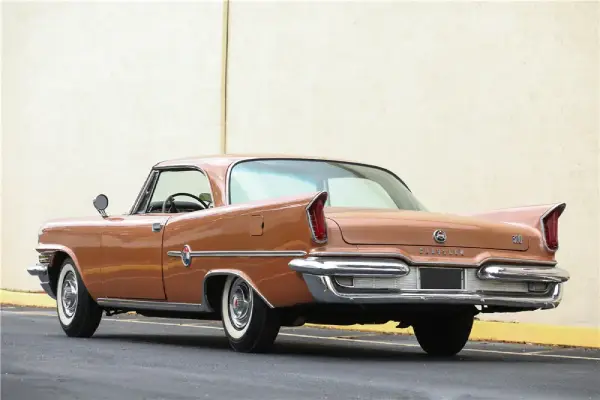
Performance Without Apology
The philosophy behind the 300E was simple: don’t compromise.
Chrysler didn’t try to hide its performance credentials. In fact it leaned into them. This was a performance car that just so happened to be luxurious not a luxury vehicle masquerading as athletic.
Driver who bought a 300E wanted effortless speed. Not frantic acceleration, not high-rev drama—just endless torque and confidence on the open road.
And that confidence came from what lived under the hood.
The 413 Golden Lion V8: Displacement Over Everything
The 413 cubic-inch (6.7-liter) Golden Lion V8 engine which powered the 1959 Chrysler 300E, epitomized America’s pre-restraint mentality.
Quick specs:
- 6.7L natively aspirated V8 engine
- 380 horsepower
- 450 lb-ft of torque
- Three-speed automatic transmission
Efficiency and ingenious engineering techniques were not the focus of this engine. It has to do with durability and sheer magnitude.
Despite its size and weight, the 300E was able to push forward with ease thanks to the Golden Lion’s enormous low-end torque. It was designed to run hard for extended periods of time, making it ideal for open American highways.
Fuel consumption? Largely irrelevant at the time. Gas was cheap, and buyers expected luxury cars to indulge.
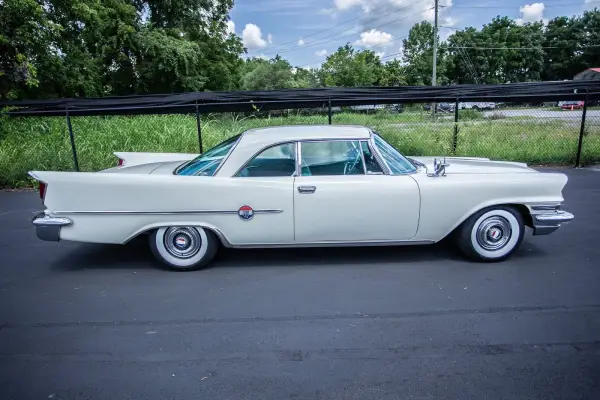
One of the Last Truly Unfiltered American Cars
The 300E arrived at the tail end of an era that wouldn’t last much longer.
By the early 1960 things began to change. Safety concerns entered public discussion. Insurance companies started paying attention to horsepower. Emissions rules slowly took shape.
The free-for-all was ending.
Cars like the 300E—defined by displacement, excess, and mechanical confidence—became harder to justify. What once symbolized progress and success began to look like indulgence.
That’s exactly why the 300E feels so special today. It exist in a narrow window of automotive history that can never be repeated.
Restricted Production and the Significance of Survivors
It was never intended for the Chrysler 300E to be widely available.
- Hardtop production: ~550 units
- Convertible production: ~140 units
That scarcity alone makes it desirable but there’s more to the story.
Many 300Es lived hard lives. High power, complex components, and expensive maintenance meant not all owners kept them pristine. Some were modified. Others were neglected. Many simply disappeared.
Today, well-documented, original examples are genuinely rare.
According to market estimates, a concours-condition coupe can reach around $100,000, while convertibles and highly optioned cars often command even more—though condition and provenance make a huge difference.
Why the Chrysler 300E Was Important
There is more to the 300E than just a retro car. It serves as a remembrance of a period when American automaker produced cars with unreserved confidence.
No filtering. No concessions. No self-control.
Cars like the 300E seem almost legendary at a time of efficiency goals, downsizing, and software-driven performance.
And for precisely that reason enthusiasts continue to discuss it.
FAQs
Q: What make the 300E special?
A: The 300E which combines enormous V8 power with elegance and racing-inspired engineering, symbolizes a time before safety and emission regulation.
Q: How uncommon is the Chrysler 300E these days?
A: Very rare. Only around 690 total unit were produce with just 140 convertible and far fewer survive in original condition.
Q: Why couldn’t a car like this be built today?
A: Modern safety, emission and efficiency regulation make large displacement, unfilter engine like the 413 V8 impractical for mass production.
Also Read: Dodge Once Planned a V6 “Baby Viper” — And It Almost Changed Everything