
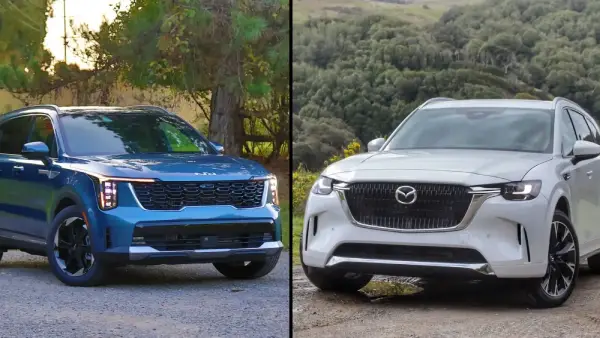
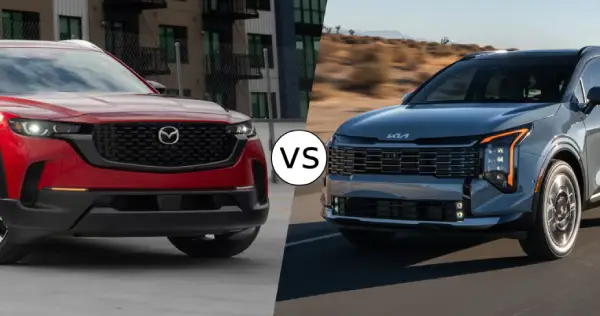
2026 Kia Sorento PHEV vs Mazda CX-90 PHEV: Space, comfort, performance and fuel efficiency must all be balanced when select a three row SUV. Reducing fuel consumption without sacrificing the convenience of a gasoline engine is possible with plug in hybrid.
The Kia Sorento PHEV and CX-90 PHEV comparison demonstrate two distinct strategies. Kia focuses on efficiency and value while Mazda offer more power and premium feature.
While You Care for Your Car, Care for Your Child’s Future Too 💖
A fun and educational book every parent should gift their kid.
 Get Kiddy Store Fortune Now
The Kia provide up to 31 miles of electric range and an estimate 33 mpg combine on gasoline. When using premium fuel, the Mazda can produce up to 323 horsepower.
To determine which SUV best suits your need let’s examine their performance, efficiency, interior room, technology and cost.
2026 Kia Sorento PHEV vs. Mazda CX-90 PHEV: Quick Comparison
| Feature | 2026 Kia Sorento PHEV | 2026 Mazda CX-90 PHEV |
| Starting MSRP | $49,785 | $52,340 |
| Maximum horsepower | 268 hp | 323 hp with premium fuel |
| Maximum torque | 270 lb-ft | 369 lb-ft |
| Gas-only fuel economy | Up to 33 mpg combined | Up to 26 mpg combined |
| Combined efficiency | Up to 74 MPGe | Up to 56 MPGe |
| Electric range | Up to 31 miles | Up to 26 miles |
| Length | 189.6 inches | 200.8 inches |
| Seating capacity | Up to 7 | Up to 7 |
| Infotainment display | 12.3 inches | 12.3 inches |
The Kia is more affordable and efficient while the Mazda deliver stronger performance and a more premium experience.
1. Exterior Design Practical Kia or Upscale Mazda?
The Kia Sorento PHEV and Mazda CX-90 PHEV have three row SUV proportion but they look noticeably different.
Kia Sorento PHEV: A Practical Family SUV
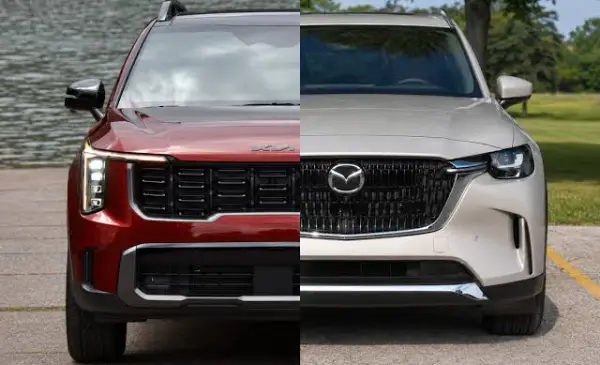
The Sorento PHEV feature a strong grille, vertical headlight design, and a comparatively upright front appearance. Its boxier shape provides it a useful, family-friendly personality without making it appear dull.
Driver who frequently maneuver through congested streets, parking garage and narrow driveway may also benefit from its compact size.
The Sorento is significantly shorter than the Mazda with a length of 189.6 inch. That difference could make everyday driving less stressful for families who don’t need the biggest SUV available.
Mazda CX-90 PHEV: Bigger and More Premium
With the CX-90 PHEV, Mazda adopts a more advanced strategy. It looks more premium because to its wide headlights, sculpted bodywork, and flowing exterior lines.
It extends more than 11 inches past the Kia at a length of 200.8 inches. The Mazda has a more solid stance due to its longer wheelbase.
The CX-90’s additional ground clearance may appeal to drivers who prefer a taller SUV although it doesn’t automatically make the vehicle better for every driving situation.
Which looks better? That’s subjective. The Kia suits buyers who appreciate a straightforward, modern family SUV, while the Mazda is more appealing to those who want a vehicle with a more premium visual presence.
2. Performance: Mazda Has the Power Advantage
If performance matter more than saving every possible drop of fuel the CX-90 PHEV has a clear advantage.
The Sorento PHEV produce 268 horsepower and 270 lb ft of torque. Its turbocharge 1.6 liter four cylinder engine work with an electric motor to provide power for everyday driving.
The CX-90 PHEV uses a 2.5 liter four cylinder engine pair with an electric motor. Its system produce up to 323 horsepower and 369 lb ft of torque when premium fuel is use.
That additional output give the Mazda a stronger performance focused appeal.
Why the Mazda Feels More Exciting
Mazda has positioned the CX-90 as a more driver focused SUV. Its platform and rear biased driving character help distinguish it from more conventional family vehicle.
The electric motor also contributes substantial power, helping the SUV respond quickly when acceleration is needed.
The source evaluation does point out that the Mazda’s switch from electric to hybrid operation occasionally feels less seamless than the Kia’s. If you spend a lot of time in stop-and-go traffic that is something to think about.
The Kia’s turbocharged engine produces helpful low speed torque but it doesn’t offer the same headline power. That might be sufficient for regular commuting, school runs, and shopping excursion.
The Mazda CX-90 PHEV is the performance champion. For drivers seeking a more powerful driving experience, it provides more power and torque.
3. Fuel Economy: The Kia Sorento PHEV Takes the Lead
A plug-in hybrid should help reduce fuel consumption and this is where the Kia makes a convincing case.
According to the source comparison, the Sorento PHEV achieve up to 33 mpg combine when operating on gasoline compared with up to 26 mpg combined for the Mazda CX-90 PHEV.
That’s a seven-mpg difference.
When using fuel and electricity the Kia can achieve up to 74 MPGe whereas the Mazda can only achieve 56 MPGe.
These number are estimate and actual outcomes depend on driving circumstances, temperature, charging habit and the frequency of gasoline engine operation.
For household looking for a three-row SUV without having to put up with needlessly high fuel consumption, the Sorento’s efficiency advantage is still a significant advantage.
Why Charging Habits Matter
Both vehicle make the most sense when owner charge them regularly.
If you can recharge at home overnight you may be able to complete many routine trip using electricity. That can reduce how often you visit a gas station.
If you rarely plug in, however, you won’t take full advantage of the vehicles’ electric-driving capability. In that situation, the difference in gasoline efficiency becomes particularly relevant.
Fuel economy winner: Kia Sorento PHEV. It combines better reported gasoline efficiency with higher electric-and-gas efficiency ratings.
4. Electric Range: Five Extra Miles for Kia
The electric only range is another important difference between these plug in hybrid SUVs.
The Sorento PHEV offer up to 31 mile of electric range while the Mazda CX-90 PHEV provide up to 26 mile.
That gives the Kia a five mile advantage.
Five mile may not seem like much but when you make multiple quick trip every day it may make a big impact.
Consider take a quick trip to the gym, dropping someone off at work, driving to school or visit a nearby grocery shop. You might be able to finish those trip without using gasoline if they fall within your available battery range.
The exact distance will, of course, differ. Electric range can be impacted by a number of factor including cold weather, the use of air conditioning or heat, road conditions, driving speed and passenger load.
What Happens When the Battery Runs Out?
Neither SUV needs to be treated like a fully electric vehicle.
Once the usable plug in battery charge is depleted the gasoline engine remain available and the vehicle continues operating as a hybrid. That makes both options practical for drivers who occasionally take longer trips.
You still need to buy gasoline but you don’t have to plan every journey around finding a public charging station.
Electric range winner: Kia Sorento PHEV. Its longer estimated range gives it a small but useful advantage for daily driving.
5. Charging Time: How Quickly Can You Recharge?
When comparing plug in hybrid, charging convenience is often overlook yet it might affect how much you like owning one.
According to the source comparison, a Level 2 charger can charge the Mazda CX-90 PHEV from 20% to 80% in about 90 minute. Under the specified charging condition the Kia Sorento PHEV takes about four hour to fully charge.
These number should not be construed as a direct apples to apples comparison because they employ different charge endpoints.
The charger, battery condition, temperature and vehicle charging constraint all affect the actual charging time.
For most owner the simplest routine is to plug in at home when the SUV is parked for several hour. Overnight charging can make either vehicle convenient for daily commuting.
Before purchasing check the charging equipment you have available and confirm the charging specification for the exact model and trim.
6. Interior Space: Does the Bigger Mazda Offer More Room?
Despite being much longer than the Kia Sorento PHEV the Mazda CX-90 PHEV does not necessarily provide additional room for passengers in each row.
Depending on how the seats are arranged both SUVs can hold up to seven people. Both provide a two-seat third row and a second-row bench, while there are other possible arrangements.
The interior measurements are surprisingly close.
The Kia offers more front headroom and front shoulder room, along with slightly more second-row legroom. The Mazda provides a little more front legroom and third-row legroom.
Here’s the important part: the Mazda’s third row has a small numerical advantage in legroom, and the source review describes it as feeling roomier. However neither vehicle should be mistaken for a full-size SUV with a particularly generous third row.
Adults may find the rear seats suitable for shorter journey while children and teenagers are likely to be more comfortable there.
Cargo Space: The Results Depend on Seat Position
Cargo capacity is another area where the vehicles trade advantages.
Behind the third row the Mazda offers approximate 14.9 to 15.9 cubic feet of space compare with 12.6 cubic feet in the Kia.
That extra room can help when you’re carrying groceries, backpack or a few small bags with all three row in use.
With the second row in place, however the Kia offers approximately 38.5 to 45 cubic feet, compared with 40 to 40.1 cubic feet in the Mazda.
The Kia also has a slightly higher maximum cargo figure with the rear seats folded, depending on the configuration.
Space winner: It depend on your need. The Mazda has more room behind the third row while the Kia offer competitive passenger space and more cargo capacity in some seat configuration.
If you regular carry seven people and their luggage test both vehicle with your family before make a decision.

7. Technology and Comfort: Two Different Approaches
A 12.3 inch infotainment screen, wireless Apple CarPlay, wireless Android Auto, wireless phone charge, USB port, keyless entry and push button start are feature of both plug in hybrid.
That means neither vehicle feels short on everyday technology.
However, their interfaces and standard equipment differ.
Kia Sorento PHEV
The Kia include standard navigation and an auto-dimming rearview mirror, features that are upgrades on the Mazda according to the source comparison.
Its power-adjustable driver’s seat also provides 10-way adjustment, compared with eight-way adjustment in the Mazda.
For drivers who prefer a familiar, mainstream SUV layout the Sorento is an appealing option.
Mazda CX-90 PHEV
The Mazda adds several premium comfort feature as standard equipment including a sunroof, ventilate front seats, a heated steering wheel, heat second-row seats, driver seat memory, second row window shades, leather trimmed seat and a 12.3 inch digital gauge cluster.
Those additions help create a more luxurious atmosphere.
There is one important infotainment detail, though: the Mazda’s built-in system does not support touchscreen operation while using its native interface. Instead, drivers use a rotary controller on the center console.
Touch operation is available when a connected phone is projecting through Apple CarPlay or Android Auto.
Some driver may appreciate the rotary controller, while others will prefer a touchscreen-based experience. It’s worth trying before you buy.
Technology winner: The Mazda offers more standard luxury and comfort equipment, while the Kia has a few useful standard features of its own.
8. Safety Features: Both Cover the Essentials
Family buyers naturally want an SUV that offers useful driver-assistance technology.
According to the source article both models include features such as:
- Adaptive cruise control with stop and go capability
- Automatic emergency braking
- Blind-spot monitoring
- Rear cross-traffic alert
- Lane-keeping assistance
- Rear-seat reminders
- Safe-exit warnings
- Front and rear parking sensors
- Driver-attention warnings
Depending on the model and trim, additional parking and safety features might be offered.
According to the comparison the Kia comes equipped with standard features like leading-vehicle departure alarm, junction-turning detection, pedestrian and bicycle identification, and highway driving assistance.
Other feature that are available on the Mazda include front cross traffic alert with braking and traffic sign recognition.
Check the exact feature list for the car you are think about because equipment can differ depend on the market and configuration. Additionally an attentive driver is supported by these driver-assistance technologies rather than replaced by them.
Neither SUV should be declared the overall safety winner based on equipment lists alone. Independent crash-test ratings and the exact vehicle configuration should also factor into your decision.
9. Price: Kia Costs Less to Get Into
Price may be the deciding factor for many families.
The source article list the Kia Sorento PHEV EX at $49,785 while the Mazda CX-90 PHEV Prefer starts at $52,340.
That gives the Kia a $2,555 starting price advantage.
The listed higher trims also show the Kia costing less:
| Trim | Listed price |
| Kia Sorento PHEV EX | $49,785 |
| Kia Sorento PHEV X-Line SX Prestige | $54,985 |
| Mazda CX-90 PHEV Preferred | $52,340 |
| Mazda CX-90 PHEV Premium Sport | $57,145 |
| Mazda CX-90 PHEV Premium Plus | $60,345 |
The costs listed in the source comparison are not an assurance of what you would pay at a dealership. The ultimate cost may be impacted by taxes, equipment, incentives, dealer fees, and destination charges.
The Kia is a great option for homes on a tight budget because to its lower starting price and higher reported fuel efficiency.
For consumers who like those attribute the Mazda’s higher price may be justified by its extra power and basic comfort features.
Keep in mind that ownership consists of more than just the purchase price. Over a number of years, the overall cost may also be impacted by insurance, maintenance, fuel prices, charging costs, and resale value.
10. Which SUV Should You Buy?
Which feature are most important to you and how you use your car will determine the best option.
Select the 2026 Kia Sorento PHEV If
- You want to spend less on the initial purchase.
- Better reported fuel economy is a priority.
- You want a little more electric-only range.
- You prefer a slightly smaller SUV for daily driving.
- You value practical family transportation over maximum performance.
The Sorento PHEV makes a strong case for families who want plug in hybrid convenience without paying extra for features they may not need.
Choose the 2026 Mazda CX-90 PHEV If…
- You want more horsepower and torque.
- A premium looking cabin is important to you.
- You value standard comfort feature such as ventilated front seats and a heated steering wheel.
- You prefer the Mazda exterior styling and driving character.
- You need a little more cargo space behind the third row.
The CX-90 PHEV is the more performance-oriented alternative, with a stronger premium feel and a larger exterior footprint.
Final Verdict: The Kia Wins on Value, but Mazda Makes a Strong Case
The 2026 Kia Sorento PHEV vs Mazda CX-90 PHEV matchup doesn’t produce one perfect SUV for everyone.
The Kia Sorento PHEV is the more sensible all-round choice for buyer focused on purchase price, fuel economy and electric range. It offers the essential for family life while keeping operating efficiency at the center of its appeal.
The Mazda CX-90 PHEV take a different route. Its extra power, upscale interior equipment and premium styling give it a stronger appeal for driver who want their family SUV to feel more special.
Start with the Kia if your top priorities are cutting cost and increasing the efficiency of daily driving.
The Mazda is worth a test drive if you’re looking for more powerful performance and an opulent experience.
Drive both car on the same route, test the third row, test their infotainment system and see what charging alternative are available at home before deciding. A minor variation in a specification sheet might not be as important as those practical features.
FAQs
Q1. What is the electric range of the Sorento PHEV?
A: The Sorento PHEV has a report maximum electric only range of 31 mile. Actual range can vary with temperature driving style road condition and accessory use.
Q2. How far can the CX 90 PHEV travel on electricity?
A: The CX-90 PHEV offer a report maximum electric-only range of 26 mile. Charging regular can help owner make greater use of its electric driving capability.
Q3. Which SUV gets better gas mileage?
A: The Kia Sorento PHEV has the advantage, with a reported estimate of up to 33 mpg combined on gasoline alone. The Mazda CX-90 PHEV is rated at up to 26 mpg combined in the source comparison.
Also Read: Nissan’s 402-HP Frontier Is Going Global But America Gets Left Behind