
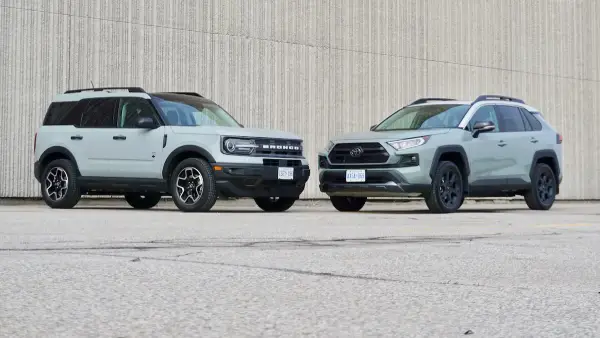
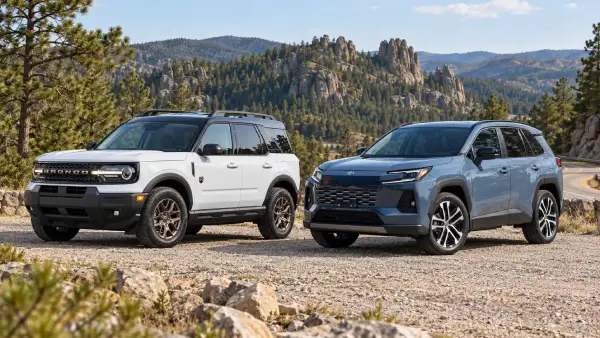
Ford Bronco Sport vs. Toyota RAV4: Sale of the RAV4 have decline while the Ford Bronco Sport is gain traction. But is Toyota still well ahead of Ford or is Ford actually catching up?
In 2026 the market for small SUV will tell an intriguing tale. While sales of the Toyota RAV4 have significantly decreased, the Ford Bronco Sport is drawing in more customers. That could appear to be a chance for Ford to compete with one of the most well liked SUVs in America.
While You Care for Your Car, Care for Your Child’s Future Too 💖
A fun and educational book every parent should gift their kid.
 Get Kiddy Store Fortune Now
But the numbers tell a more complicated story.
Ford’s rugged little SUV is enjoying positive sales growth, yet the RAV4 continues to outsell it by a considerable margin. One significant caveat to Toyota’s decrease is that the corporation has been managing production restrictions while launching its most recent RAV4.
Which SUV then will emerge victorious in 2026? The answer will vary depend on whether you are consider everyday practical popular fuel efficiency or sale momentum.
Ford Bronco Sport Sales Are Moving in the Right Direction
With the Bronco Sport, Ford has cause for optimism. With its boxy design, adventure-focused demeanor and off-road capabilities the compact SUV has established a unique identity since its introduction for the 2021 model year.
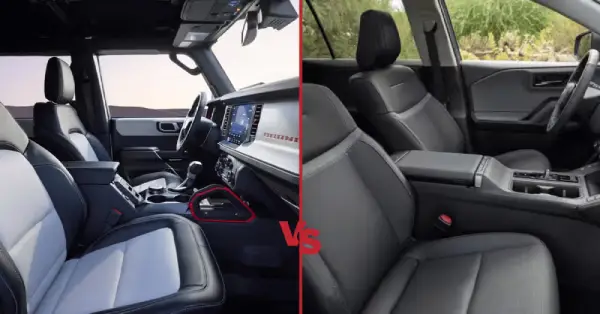
With larger digital displays, updated design, Ford’s SYNC 4 infotainment system and more off-road equipment option the 2025 update gives the model a much needed makeover.
Those updates appear to have helped keep the Bronco Sport competitive.
In the US Ford sold 127476 Bronco Sports in 2023 and 124701 in 2024. In 2025 sale reach 134493 which at the time was a new year record for the vehicle.
In 2026 the momentum persisted.
Ford sold 10,829 Bronco Sports in September up 20.9% from September 2025 according to sales data. Sales increase 2.9% year over year to 106,238 units between January and September.
The outcomes for the third quarter were even more promising. During the quarter, Ford delivered 34,751 Bronco Sports as opposed to 30,823 in 2025. That is a 12.7% rise.
Additionally, Ford stated that with 35,021 vehicles sold, a 5% increase, the first quarter of 2026 was the Bronco Sport’s best first quarter to date.
These numbers imply that consumers are still drawn to the Bronco Sport, especially those seeking an SUV with a more daring attitude than the standard family crossover.
Still, growing sales don’t automatically make it the segment leader.
Toyota RAV4 Sales Are Down, but There’s More to the Story
The Toyota RAV4 remain a much bigger player in the compact SUV market.
In 2023 Toyota sold 434,943 RAV4s in the United State. That figure increase to 475,193 in 2024 and reach 479,288 in 2025.
For comparison in 2025 Toyota sold almost 3.6 time as many RAV4s as Ford sold Bronco Sports.
The figures for 2026 however are different.
In September Toyota sold 34,192 RAV4s a 6.6% decrease from the 36,599 sold in September 2025. Although that is a decrease the year to date number show a more startling number.
Sale of RAV4s from January to September 2026 totaled 253,664 vehicle up from 358,134 during the same period in 2025. That is a 29.2% decrease from the previous year.
Given the significant decline it is reasonable to wonder if Toyota is losing market share in a cutthroat industry.
It would be premature, though, to say that consumers have abruptly lost interest in the RAV4.
Toyota has blamed production limitations and low inventory during the introduction of the new model for early 2026 sales difficulties. In order to meet the demand for electric vehicles, the corporation has also been increasing its production capacity.
Toyota’s Kentucky plant began assembling the new RAV4 Hybrid in late June 2026, adding another piece to the production transition.
The monthly figures also suggest that the decline has been easing. The year over year drop was 57.2% in February, compared with 19.1% in August and 6.6% in September.
That trend is worth watching. If inventory improves and production catches up with demand, the RAV4’s sales performance could look very different in the months ahead.
For now, Toyota still has a substantial lead. Ford is growing but the RAV4 remain the more popular vehicle by a wide margin.
Ford Bronco Sport vs. Toyota RAV4: 2026 Sales Compared
Here’s how the two compact SUV compare using the reported U.S. sales figure through September 2026.
| Sales measure | Ford Bronco Sport | Toyota RAV4 |
| September 2026 sales | 10,829 | 34,192 |
| September year-over-year change | +20.9% | -6.6% |
| January–September 2026 sales | 106,238 | 253,664 |
| Year-to-date change | +2.9% | -29.2% |
| Full-year 2025 sales | 134,493 | 479,288 |
The difference is clear: the Bronco Sport has the stronger growth trend, while the RAV4 maintains a commanding lead in total sales.
Toyota sold more than three RAV4s for every Bronco Sport in September. Even with its recent decline, the RAV4 has a much larger customer base.
The takeaway: Ford is gaining momentum, but Toyota remains the sales leader. The next few months should help reveal how much of the RAV4’s decline was caused by its model changeover and supply limitations.
Which SUV Offers Better Value for Money?
Only a portion of the tale is revealed by sales figures. Purchase price, fuel economy and daily use are equally important factors for consumers comparing these two cars.
The starting price of the 2026 Ford Bronco Sport Big Bend, including destination fees is roughly $33,840. At about $33,350 the 2026 Toyota RAV4 LE has a somewhat lower starting price.
This places the two entry-level versions about $500 apart.
However, there’s an important difference in standard equipment. The Bronco Sport Big Bend comes with all-wheel drive as standard, while the RAV4 LE requires an upgrade to all-wheel drive, bringing its delivered price to approximately $34,750.
The Ford’s standard all-wheel-drive arrangement may be a helpful benefit for customers who frequently deal with snow, muddy roads, or slick situation.
In contrast, Toyota offers a hybrid drivetrain and a more affordable starting price. Over the course of several years of ownership, fuel savings may have a greater impact on driver who spend the majority of their time traveling on highways, conducting errand and commuting.
Which car is the better deal may also depend on actual transaction prices, dealer incentive, insurance premium and local tax.
The Toyota RAV4 Has a Major Fuel-Economy Advantage
Fuel efficiency is one of the strongest reason to consider the 2026 Toyota RAV4.
Unlike the standard gasoline-powered Bronco Sport, the redesigned RAV4 lineup is hybrid-only. The RAV4 LE can achieve an EPA estimated 47 mpg in city driving and 40 mpg on the highway in its most efficient configuration. The all-wheel-drive LE is rated at approximate 42 mpg combined.
The standard 1.5-liter Ford Bronco Sport by comparison is rated at approximately 25 mpg in the city, 30 mpg on the highway and 27 mpg combined.
For anyone who drives frequently that is a significant difference.
Consider weekend travel, supermarket shopping, school drop offs and daily commute. A more efficient powertrain may result in fewer trips to the gas station, and those miles add up rapidly.
Urban driver who spend a lot of time in stop-and-go traffic will find the RAV4’s hybrid powertrain especially enticing. In situations when traditional gasoline engines may be less efficient, its capacity to apply electric assistance helps minimize fuel usage.
The Bronco Sport isn’t necessarily the wrong choice, though. Its tough design, standard all-wheel drive, and available off-road-focused equipment are just a few of the different priorities that contribute to its popularity.
The Toyota is clearly superior if gasoline prices are your main concern. The Ford merits a closer inspection if you frequently drive off of paved roads.
Cargo Space: Another Win for Toyota
A compact SUV needs to handle more than the daily commute. It should also have enough room for luggage, groceries, camping supplies, sports equipment and everything else that comes with a busy household.
Here, the Toyota RAV4 offers more cargo capacity.
The Ford Bronco Sport with the 1.5-liter engine provides approximately 32.5 cubic feet of cargo space behind the rear seats. The Toyota RAV4 offers up to 37.8 cubic feet behind its second row.
That gives the RAV4 an advantage of around 5.3 cubic feet.
Although it may not seem like much on paper the additional space can make packing simpler when you’re preparing for a weekend getaway or going on a family vacation.
For outdoor enthusiasts who value its boxy appearance and adventure focused design the Bronco Sport is still a useful vehicle. However the Toyota can be preferred by purchaser who frequently transport heavy bags or require additional space for daily family responsibilities.
It’s important to confirm the precise model you’re thinking about because published cargo statistics may vary depend on the measurement technique and vehicle configuration.
Why the Bronco Sport Appeals to Adventure Seekers
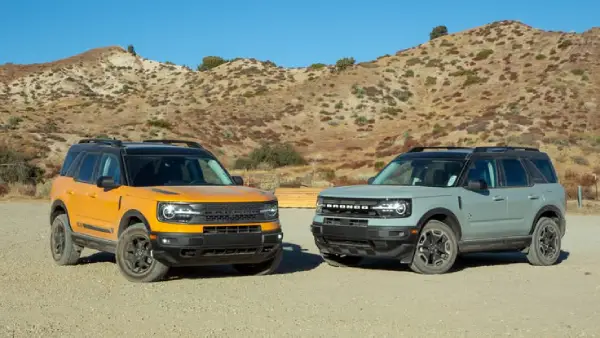
The Ford Bronco Sport is the small SUV that prefers to get its tires dirty, while the Toyota RAV4 is the sensible all-arounder.
Compared to many conventional crossovers, it has an upright posture, squared-off proportions, and a more rugged appearance thanks to its style, which is inspired by the larger Ford Bronco.
That design is more than just a visual statement. Depending on the trim, the Bronco Sport offers terrain management modes, additional off-road hardware, and available Sasquatch equipment designed to improve its capabilities away from paved roads.
The Badlands trim is especially relevant for buyers who want a more serious off-road setup.
Of course, not everyone needs a vehicle built for rough terrain. Many owners will drive around town or down the highway for the majority of the day. However, the Bronco Sport’s personality might be a big selling factor for those who like camping, exploring forest roads, or traveling to outdoor locations.
Additionally it provides personality which is hard to depict in a sales table.
The RAV4 take a more conventional family SUV approach while the Bronco Sport emphasize its outdoor capabilities. Neither tactic is inherent better. The ideal choice will rely on how you want to use the vehicle.
Can Ford Actually Catch Toyota in 2026?
Although the Bronco Sport sales results are promising it would be extreme difficult to overtake the RAV4 in overall sales.
As of September 2026 Toyota had sold 253,664 RAV4s while Ford had sold 106,238 Bronco Sports. That leave a gap of 147,426 vehicle.
Even if the Bronco Sport continues growing, Toyota has a substantial advantage in overall volume.
The more interesting question is whether the Bronco Sport can maintain its upward momentum while Toyota recovers from its production and model-transition challenges.
Ford’s positive September result suggests that demand for the Bronco Sport remains healthy. In the meantime, the RAV4’s lower September year-over-year loss in comparison to previous months may suggest that its sales position is stabilizing.
However a single month does not create a long-term pattern. The final outcomes will depend on a number of factors including production capacity, dealer inventories, pricing, incentive and customer preferences.
The RAV4’s well-established image as a useful, effective family car benefits Toyota as well. At a time when many consumers want to cut fuel use without switching to a fully electric vehicle, its hybrid-only lineup gives it a strong selling point.
Ford has a different opportunity. Rather than trying to copy Toyota’s formula, it can continue attracting shoppers who want a compact SUV with a distinctive appearance and greater emphasis on outdoor adventures.
That may not be enough to make the Bronco Sport the segment’s biggest seller, but it could help Ford build a stronger position in its own corner of the market.
Final Verdict: The RAV4 Is Winning, but Ford Has Momentum
The 2026 sales comparison presents two different stories.
The Ford Bronco Sport is growing, with September sales up 20.9% and year-to-date sales up 2.9%. That’s a positive result for a model competing in one of America’s busiest vehicle segments.
The Toyota RAV4 has experienced a much sharper year-to-date decline, falling 29.2% through September. However, its production challenges and new-generation rollout provide important context, and its September decline was considerably smaller than earlier in the year.
For now, the Toyota RAV4 is still winning the sales race by a wide margin. It also offers better fuel economy and more cargo space, making it an appealing choice for many families and commuters.
However, those that want off-road capability, basic all-wheel drive, and tough design would be better off with the Ford Bronco Sport.
In the end, the Bronco Sport shines out for buyers who are interested in adventure, but the RAV4 is a better option for efficiency and daily use.
Although Ford is improving, Toyota still has a huge sales advantage. Whether the RAV4 can recapture its momentum once manufacturing catches up with demand is the most important question for the remainder of 2026.
FAQs
Q1. Are Bronco Sport sales surpassing RAV4 sales in 2026?
A: No. Although the Bronco Sport has some momentum, it has a long way to go to catch the Toyota RAV4 in terms of total sales in the U.S. By the end of September, Toyota had already sold 253,664 RAV4s to 106,238 Bronco Sports.
Q2. What are the reasons for the drop in Toyota RAV4 sales for 2026?
A: According to Toyota, production limits for the all-new, redesigned RAV4 were a factor in lower sales along with limited inventory. Also, as a result of an ongoing initiative, the brand is in the process of ramping up production of the hybrid model. Because of this it is unfair to automatically blame the decline on lower customer demand.
Q3. Between the Ford Bronco Sport and the Toyota RAV4 which SUV costs less?
A: Using starting prices the 2026 Toyota RAV4 LE costs approximately $33,350 versus $33,840 for a Ford Bronco Sport Big Bend. This latter price also includes a destination charge. Be aware of the difference in equipment in both vehicles. Ford includes standard all-wheel drive.
Q4. Which SUV has more room in back?
A: With around 37.8 cubic feet behind the second row of seats versus approximately 32.5 cubic feet behind the 1.5-liter Ford Bronco Sport’s row of seats, the Toyota is a winner. Therefore, you have more room for grocery bags, luggage, and anything else in back with a RAV4.
Also Read: The Three-Row Mazda SUV That Feels Like a Luxury Car Without the Luxury Price