
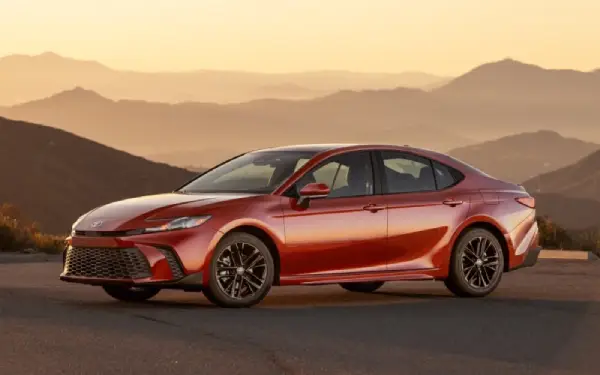
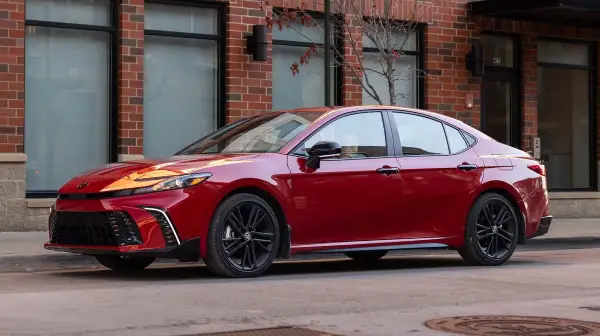
2026 Toyota Camry Hybrid: For years buying a smaller car was one of the easiest way to cut your fuel bill. If you wanted better mileage you generally accepted a smaller cabin, less power and a tighter trunk. That trade off made sense.
But the Toyota Camry is making that old formula look a little outdate.
While You Care for Your Car, Care for Your Child’s Future Too 💖
A fun and educational book every parent should gift their kid.
 Get Kiddy Store Fortune Now
The Camry is a midsize sedan with enough room for a family, more than 200 horsepower a useful trunk and the comfort expected from a larger car. Yet the right version can return 51 mpg combined.
That is enough to put the Camry Hybrid LE in an unusual position. You don’t have to move down to a compact sedan to save fuel. In fact choosing a compact gas-powered car could actually mean using considerably more gasoline over the course of a year.
And that’s what makes the latest Camry so interesting. Its biggest advantage isn’t flashy styling or blistering acceleration. It’s the fact that Toyota has made an ordinary-looking family sedan remarkably cheap to keep fueled.
The Camry Is Playing A Different Fuel-Economy Game
For drivers who wish to spend less at the gas station compact automobiles have historically been the sensible option.
Without the need for hybrid technology the 2026 Honda Civic, Toyota Corolla, Hyundai Elantra, Volkswagen Jetta, and Nissan Sentra are all built to provide reasonable fuel efficiency. Some configuration can yield fuel efficiency numbers in the mid-30 mpg range.
That’s impressive for conventional gasoline cars.
But the 2026 Camry LE comes at the problem from another direction.
Instead of making the car smaller, Toyota added hybrid technology to a midsize sedan. The result is a car that can carry adults comfortably while still returning fuel economy numbers that challenge much smaller vehicle.
The difference may not feel dramatic when you’re looking at an EPA window sticker. It become much more interesting when you calculate how much fuel those number represent over thousands of miles.
51 MPG From A Midsize Sedan Is The Real Surprise
The Toyota Camry Hybrid LE is rate at 52 mpg in the city 49 mpg on the highway and 51 mpg combine.
For a car of this size that’s impressive.
More importantly the LE is not some expensive special edition that requires buyers to spend a huge amount of money for access to the hybrid system. Toyota made the hybrid powertrain standard across the current Camry lineup.
That changes the buying decision.
You don’t have to start with a gasoline Camry and pay extra for a hybrid upgrade. The entire 2026 Camry range is built around hybrid power.
The LE simply happen to be the version that squeezes the most miles out of every gallon.
That’s important because higher trims come with larger wheels and additional equipment and those changes can reduce fuel economy. If your primary objective is keeping fuel costs low, the basic LE is arguably the Camry to watch.
Here’s Where The Numbers Start To Matter
Consider traveling 15,000 mile annual.
To travel that distance a car with an average fuel economy of 35 mpg would use about 429 gallon of gasoline.
A vehicle with an average fuel economy of 51 mpg would require rough 294 gallon.
That’s a difference of approximately 135 gallon every year.
The actual dollar savings will depend on fuel price and your driving habits but the point is easy to understand a seemingly modest difference in mpg can become significant when you’re driving thousands of mile.
For someone with a long daily commute the difference can become even more noticeable.
And there is another benefit that’s easy to overlook.
You won’t need to visit the gas station as often.
The Camry combination of a hybrid powertrain and a reasonably sized fuel tank give it the potential for a very long driving range between fill-ups. Real world range will vary with weather, traffic, speed and driving style, but highway commuters can appreciate having fewer fuel stops during a busy week.
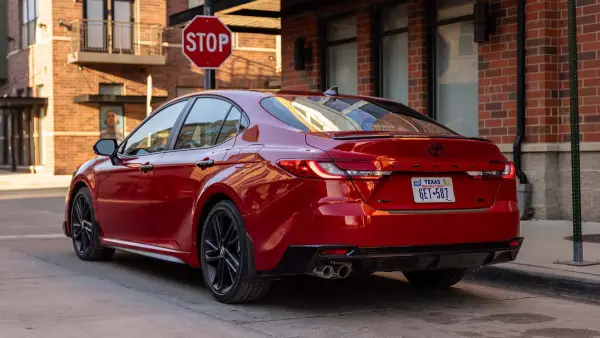
The Camry Doesn’t Feel Like An Economy Car
This is where Toyota’s approach becomes more compelling.
Fuel-efficient cars have sometimes required compromise.
You might save money at the pump but give up rear seat room. Or you might get excellent mileage but end up with a tiny trunk. Some efficiency focused cars also prioritize low weight and compact dimensions over long-distance comfort.
The Camry doesn’t follow that formula.
With 42.1 inches of front legroom and 38 inches of rear legroom the 2026 model offer approximate 99.9 cubic feet of passenger volume.
If you carry adult on a frequent basis those figures are important.
For a couple or small family, a compact car can be ideal, but when you’re traveling longer distance with friends, family, or other passenger, rear-seat comfort become much more crucial.
You can have more room in the Camry without having to pay a gasoline expenditure that would be associated with a larger sedan.
There’s Also A Proper Trunk
Hybrid batteries have historically created packaging challenges.
Put the battery in the wrong place and you can lose valuable cargo space. In the Camry Toyota has circumvented this issue by position the hybrid battery underneath the back seat.
As a result the trunk has about 15.1 cubic feet of cargo capacity.
That is sufficient for family gear, luggage and daily shopping without making the car a compromise each time you need to transport things.
Additionally, the back seats fold in a 60/40 split providing owner with more options for carrying longer objects.
These are the features that make an automobile easier to live with for years, even though they might not sound thrilling.
And Then There’s The Power
Here’s another reason the Camry stands apart from the stereotypical fuel-saver.
The hybrid drivetrain isn’t generating power comparable to that of an inexpensive car.
The Camry Hybrid with front-wheel drive generate 225 horsepower while models with all-wheel drive generate 232 horsepower.
Toyota does this by fusing electric motors with a 2.5-liter, four-cylinder gasoline engine.
There is more to the electric motors than just raising their EPA rating. Additionally, they offer instant support when you accelerate.
Because of this the Camry may feel more powerful than one might anticipate from a sedan with four cylinders.
It is not necessary for the driver to use the accelerator as a hint when passing on a two-lane road or merging into a busy freeway. The hybrid system provides useful low-end assistance, which is one of the reasons modern hybrids can feel surprisingly responsive around town.
Of course, this isn’t a sports sedan.
The Camry’s mission is still comfort and efficiency rather than aggressive driving. Push the throttle hard and the continuously variable transmission can produce the familiar high-revving sound associate with many hybrid powertrains.
But for everyday driving there is plenty of power.
AWD Doesn’t Ruin The Fuel-Economy Advantage
There is typically a fuel-economy cost associated with all-wheel drive.
That makes sense. Increased weight and mechanical complexity are typically associated with adding hardware to power four wheels.
A distinct strategy is used by Toyota’s hybrid AWD system.
When more traction is required, the back wheels can be powered by an auxiliary electric motor. The Camry does not need a conventional mechanical driveshaft to connect the gasoline engine to the rear axle because of this configuration.
The result is surprisingly small efficiency loss.
The Camry LE AWD is rated at about 50 mpg combine just one mpg below the front wheel drive version.
That’s impressive for buyer who live somewhere with snow or frequently encounter wet roads.
Still, there’s an important detail here: don’t assume every Camry gets the headline 51-mpg figure.
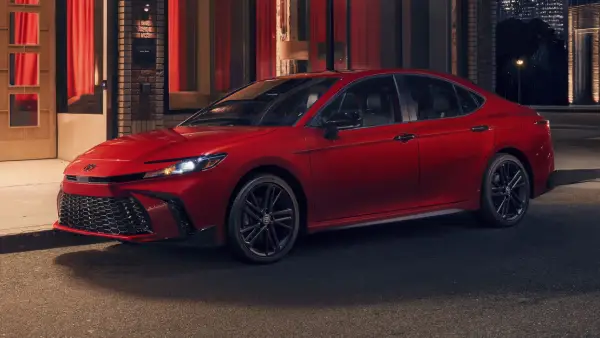
Choosing The Wrong Trim Can Cost You At The Pump
The LE is the fuel-economy star.
Move up the lineup and the numbers begin to change.
Higher trims can use larger wheels and tires, and those additions affect efficiency. Some front-wheel-drive versions are closer to the mid-40s in combined fuel economy, while certain higher-performance-looking configurations can drop further.
That doesn’t make them bad choices.
Someone might prefer the appearance, equipment, seats, technology or styling of an XSE or XLE and happily accept the difference.
But if you’re specifically shopping for a fuel-efficient Toyota Camry the trim you choose matters.
The cheapest Camry isn’t just the least expensive way into the lineup. It is also the version that makes the most sense for maximizing fuel savings.
That’s an unusual combination.
The Toyota Camry Hybrid Versus Compact Cars
What occurs when the Camry is contrasted with lesser cars is the most intriguing aspect of this tale.
Excellent fuel efficiency can be achieved with a gas-powered compact like the Civic, Corolla, Elantra, Jetta, or Sentra. However a lot of their highest ratings are still in the mid-30s.
Compact hybrids are another option.
Depending on setup the Honda Civic Hybrid can achieve high 40s mpg while the Toyota Corolla Hybrid can achieve about 50 mpg.
The Camry no longer appears to be the ineffective big brother.
Its 51-mpg LE can actually edge out some smaller hybrids.
There are more efficient hybrids available, of course.
The Toyota Prius remain one of the leader while model such as the Hyundai Elantra Hybrid and Kia Niro Hybrid can also deliver excellent mileage.
So the Camry isn’t the absolute fuel economy champion.
That’s not really the point.
Its appeal comes from the combination of midsize space, hybrid efficiency, usable power and long distance comfort.
That’s a much harder package to find.
Why The Camry Makes Sense For High Mileage Drivers
Not every driver needs a 51-mpg sedan.
If you drive 5,000 mile per year the fuel saving compare with a 35-mpg car may not justify changing what you buy.
But the calculation look very different for someone driving 15000, 20,000 or even 25,000 mile annual.
Consider commuters.
A person driving long distances five days a week can burn through hundreds of gallon of fuel over the course of a year. Even small improvement in fuel economy can accumulate quickly.
The same applies to:
- Rideshare drivers
- Sales representative
- Road-trip enthusiast
- Large families
- Daily commuters
- Drivers who keep vehicles for many years
For these buyers, fuel economy isn’t simply a number printed on a window sticker.
It’s part of the ownership cost.
The LE Is Not The Most Luxurious Camry
There is one catch.
The Camry Hybrid LE is designed around value and efficiency.
That means you don’t get every luxury feature found higher in the range.
Its smaller wheels aren’t as visually dramatic as the larger designs available on expensive trims. The interior is functional rather than extravagant, and buyers who want the richest cabin materials or most upscale equipment will probably prefer a higher trim.
But that is almost the point.
The LE doesn’t try to be something it isn’t.
It’s the sensible Camry.
And for someone whose priority is reducing fuel expenses, that simplicity can actually be an advantage.
Spending thousands more for appearance or luxury equipment while simultaneously reducing fuel economy doesn’t make much sense if saving money is the primary goal.
What About Reliability And Hybrid Battery Life?
Hybrid technology can make some buyers nervous.
The common concern is that adding an electric motor and high-voltage battery creates another expensive component that could eventually fail.
Toyota has spent decades developing hybrid systems, and the company backs the Camry’s hybrid battery with coverage lasting up to 10 years or 150,000 miles. Other hybrid components receive separate warranty coverage.
That doesn’t mean a hybrid is maintenance-free.
Like any vehicle the Camry still need regular servicing, tires, brakes, fluid and other routine maintenance.
However regenerative braking can reduce brake wear in normal driving because the electric motor help slow the car while recovering energy.
For buyers planning to keep their vehicle for a long time the warranty coverage can also provide additional peace of mind.
The Camry’s Biggest Advantage May Be Its Lack Of Drama
The newest Camry has an almost comical quality.
It is not intended to be the fastest sedan in its class by Toyota.
It’s not the most opulent.
It’s not the tiniest.
It’s not even the most fuel-efficient hybrid available.
Rather, it is in a sweet location.
You get a large enough trunk for daily usage, enough power for regular driving, enough space for a family, and fuel efficiency that can match or surpass that of much smaller cars.
Because of this, it’s simple to suggest the Camry to those who don’t want to turn their vehicle into a pastime.
All they want is something cozy that doesn’t remind them of the price of gas all the time.
Is The 2026 Camry LE Worth Buying?
Definitely for the right buyer.
When long-term use, practicality and fuel efficiency are more vital than luxury gear the 2026 Toyota Camry Hybrid LE makes the most sense.
Although its combined 51-mpg rating is outstanding Toyota’s actions surrounding that figure are more noteworthy.
You’re not in a small economic vehicle.
You’re not dealing with a cramped rear seat.
You’re not sacrificing useful power.
And you don’t need to buy the most expensive version to access the hybrid system.
The LE is actually the version that makes the fuel-saving argument strongest.
If you drive a lot the difference between a mid-30s-mpg gasoline sedan and a 51-mpg Camry can add up to hundreds of gallons over several year.
That’s money that stay in your bank account instead of disappearing into the fuel tank.
Final Verdict
The old assumption was simple: smaller car equals lower fuel costs.
The 2026 Toyota Camry Hybrid LE shows why that isn’t always true anymore.
With up to 51 mpg combined, 225 horsepower, generous passenger space, and a useful trunk, the Camry manages to deliver something that many compact cars can’t: genuinely low fuel consumption without making you live with a small car.
The Toyota Prius and several compact hybrid can still beat it on pure efficiency. But if you want a comfortable midsize sedan that can quietly keep fuel cost under control the Camry LE is one of the more convincing option available.
Sometimes the smartest way to save money isn’t buying the smallest car.
It’s buying the right hybrid.
FAQs
Q: Is the Camry a hybrid?
A: Yes. Toyota made the current generation Camry exclusive hybrid so buyer don’t have to choose between a conventional gasoline engine and a hybrid version.
Q: What is the Camry Hybrid horsepower?
A: The Camry Hybrid with front-wheel drive generate 225 horsepower. The version with all wheel drive generate 232 horsepower.
Q: Does the Camry Hybrid come with AWD?
A: Yes Toyota offer an all wheel drive hybrid system on the Camry. The LE AWD is rated at rough 50 mpg combine making the efficiency penalty relative small.
Also Read: 5 Performance Cars Collectors Are Quietly Buying Before Prices Climb
1 thought on “The 2026 Toyota Camry Hybrid Makes Small Cars Look Surprisingly Expensive at the Pump”
Comments are closed.