
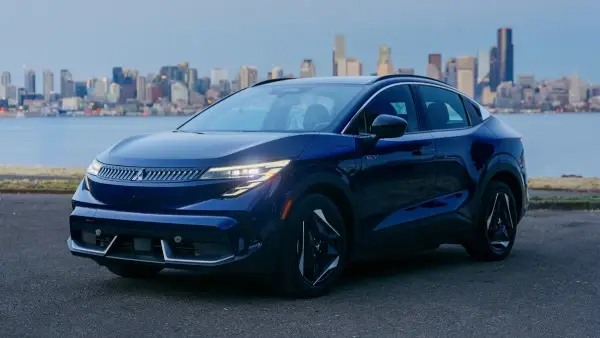
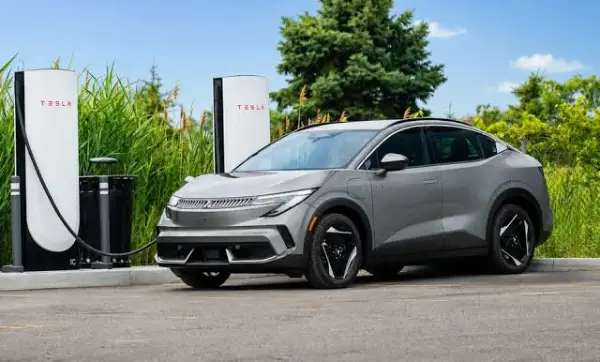
2027 Mitsubishi Eclipse Sportback: Mitsubishi has brought back the Eclipse name, but not in the way longtime fans might have hoped. Instead of a sporty coupe the name now sits on a new electric crossover style hatchback called the Mitsubishi Eclipse Sportback.
And there’s an interesting catch.
While You Care for Your Car, Care for Your Child’s Future Too 💖
A fun and educational book every parent should gift their kid.
 Get Kiddy Store Fortune Now
Underneath the Mitsubishi styling, the Eclipse Sportback is closely related to the latest Nissan Leaf. That’s not necessarily a bad thing. The new Leaf is a much more modern EV than its predecessor, offering useful range, a comfortable cabin and a much more conventional design.
The surprising part is the price.
Mitsubishi’s version starts at $37,745 before destination charges, while the 2026 Nissan Leaf starts at $29,990. Once destination charges are included, the Eclipse Sportback reaches $39,740.
That’s a difference of $7,755 before comparing destination charges.
So what exactly are buyers getting for the extra money?
The Eclipse Sportback Isn’t Simply a More Expensive Leaf
Calling the Eclipse Sportback a rebadged Leaf isn’t completely unfair, but there’s a little more to the story.
Mitsubishi is offering the EV in a single, heavily equipped configuration rather than giving buyers a bare-bones entry model. Its standard equipment pulls features from different Leaf trims, essentially creating a middle ground between the Leaf SV+ and Platinum+.
That makes the Mitsubishi more expensive than the cheapest Leaf, but it also means you’re getting considerably more equipment as standard.
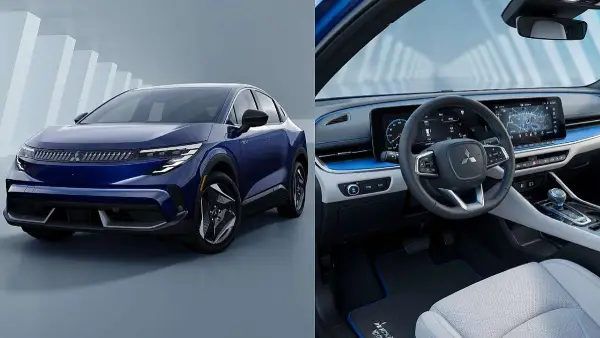
For example, the Eclipse Sportback gets 18-inch alloy wheels, dual 14.3-inch displays, a heat pump and a battery heater as standard equipment.
The cabin also gets heated front and rear seats, while Mitsubishi offers only one interior configuration.
So, yes, the Mitsubishi costs more. But it isn’t exactly the same vehicle with a different badge and a higher price tag.
The Real Problem Is the Nissan Leaf Sitting Next to It
Here’s where things get tricky for Mitsubishi.
The Nissan Leaf SV+ has an MSRP of $34,230 while the top Platinum+ starts at $38,990.
That puts the Eclipse Sportback at an unusual point in the Leaf lineup.
Mitsubishi’s EV is more expensive than the SV+, yet cheaper than the Platinum+ before destination charges. In terms of equipment, it borrows features from both.
That sounds reasonable on paper.
But a buyer shopping for an affordable electric vehicle is likely to notice something immediately: the Nissan badge gets you into a Leaf for substantially less money.
That’s a tough comparison for Mitsubishi because the two vehicles aren’t just competitors from different brands. They’re closely related products.
If the goal is to make the Mitsubishi feel like the better-value alternative, the pricing doesn’t immediately make that case.
Mitsubishi Does Give You Some Nice Standard Features
The Eclipse Sportback’s equipment list is one of the strongest arguments in its favor.
The standard 18-inch wheels are smaller than the 19-inch wheels fitted to the Leaf Platinum+, and that matters for efficiency. The Mitsubishi’s narrower 215-section tires also help it achieve better range than the more heavily equipped Platinum+.
Inside, buyers get two large 14.3-inch displays for the instrument cluster and infotainment system.
A heat pump is standard, too.
That’s particularly useful in an EV because heating the cabin can have a noticeable effect on energy consumption in cold weather. Mitsubishi also includes a battery heater for pre-conditioning without making customers pay extra for it.
The front and rear heated seats are another welcome touch.
In other words Mitsubishi didn’t create a stripped-down version of the Leaf and slap an Eclipse badge on it.
The company clearly wanted its EV to feel well-equipped from the moment it leaves the dealership.
There’s Only One Optional Package
Keeping the lineup simple isn’t necessarily a bad idea.
The 2027 Mitsubishi Eclipse Sportback comes in one main configuration, with just one available option package priced at $2,600.
That package adds several desirable features:
- Panoramic moonroof
- Bose 10-speaker audio system
- Power liftgate
- Roof rails
This means buyers don’t have to work through a long list of expensive individual options.
Add the package and the Eclipse Sportback becomes a considerably more feature-rich EV, although the price gap with the Leaf remains an important consideration.
The Range Is Actually Pretty Good
If there’s one area where the Eclipse Sportback makes a convincing case for itself, it’s range.
Mitsubishi estimates the EV can travel 282 mile on a charge.
That’s only six miles less than the Leaf SV+, while it’s actually 23 miles more than the Leaf Platinum+.
The reason is fairly straightforward.
Unlike the Platinum+ which has larger 19-inch wheels and wider 235-mm tires the Mitsubishi has 18-inch wheels and 215-mm-wide tires.
Efficiency can be increased and rolling resistance can be decreased with smaller wheels and narrower tires.
282 miles is a reasonable amount for someone looking for a useful EV for daily travel and commuting.
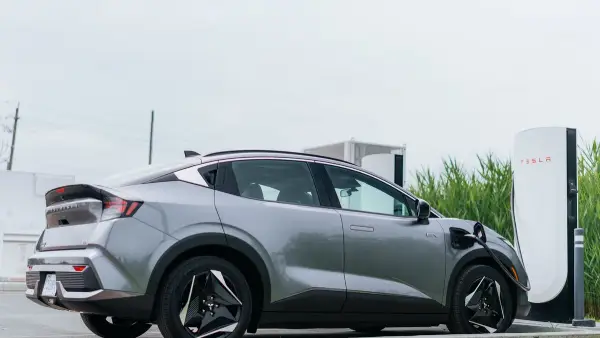
It’s also important to note that, under the right circumstances, the Mitsubishi can supposedly reach 80% charge in just 35 minutes and supports DC rapid charging.
Compared to an older-generation EV, that is fast enough to make longer trips considerably less stressful.
The Eclipse Name May Be the Biggest Surprise
The technical details are interesting, but the name is arguably what will get people talking.
The original Mitsubishi Eclipse was a sporty coupe that developed a loyal following. Later, Mitsubishi used the Eclipse name for the Eclipse Cross SUV.
Now the company has attached it to an electric sportback.
That’s quite a journey for a name once associated with turbocharged engines and performance-oriented styling.
The Eclipse Sportback isn’t trying to recreate the old coupe. It’s a practical electric vehicle aimed at buyers who want a modern EV without stepping into a luxury price bracket.
Whether customers embrace the name is another question.
Mitsubishi’s AWD Advantage Doesn’t Apply Here
Mitsubishi has traditionally had a strong selling point with the availability of all-wheel drive across parts of its lineup.
That’s one reason the Eclipse Sportback’s configuration is a little surprising.
The EV is offered with front-wheel drive only.
For buyers in areas where winter weather is a major concern, that could matter. The vehicle’s battery heater and cabin heat pump are useful additions for cold climates, but they don’t change the fact that there’s no AWD option.
That also makes the vehicle somewhat different from the image some buyers may associate with Mitsubishi.
Is the Eclipse Sportback Worth the Extra Money?
This is where things get complicated.
If you’re comparing the Eclipse Sportback with the base Nissan Leaf the Mitsubishi nearly $8,000 premium looks difficult to justify at first glance.
However that’s not really an apples-to-apples comparison.
The Mitsubishi comes with substantially more equipment than the entry-level Leaf. It effectively sits between the SV+ and Platinum+ in both equipment and pricing.
The 282-mile range is also competitive, and Mitsubishi has included features such as the heat pump and battery heater as standard.
So the Eclipse Sportback isn’t a bad EV.
The bigger issue is that the Nissan Leaf is already a strong alternative.
A buyer who doesn’t care about the Mitsubishi styling, badge or dealer network could simply choose the Nissan and potentially save thousands of dollars.
That’s a difficult proposition for Mitsubishi.
The $2,600 Package Could Make It More Appealing
For buyers who want the Eclipse Sportback to feel more upscale the optional package adds several features that can make a noticeable difference.
The panoramic moonroof and Bose audio system are particularly appealing to buyer who spend a lot of time behind the wheel.
The power liftgate and roof rails also add everyday practicality.
But once that package is added, the Mitsubishi moves even further away from the inexpensive-EV territory that traditionally fits the brand.
At that point, shoppers have plenty of other vehicles to consider.
Five Exterior Colors, One Interior
Mitsubishi is keeping the appearance choices relatively simple.
The Eclipse Sportback will be available in five exterior colors:
- Gray
- White
- Black
- Dark red
- Dark blue
Inside, however, there isn’t much choice. Mitsubishi offers a single black leatherette interior.
For some buyers, that simplicity will be perfectly fine.
Others may wish there were more ways to personalize the car, especially given its relatively high starting price.
The Bigger Question Is Why Mitsubishi Didn’t Go Cheaper
This is probably the most interesting part of the whole story.
Mitsubishi had an opportunity to take the Leaf’s affordable-EV formula and give it a slightly different personality while keeping the price close to Nissan’s.
Instead, it created a single well-equipped version that costs considerably more than the cheapest Leaf.
That strategy makes some sense from a manufacturing standpoint. Offering one heavily equipped trim can simplify production and reduce the number of configurations dealers have to stock.
But consumers don’t necessarily think about manufacturing efficiency when they’re comparing two cars on a dealership website.
They see one EV starting around $30,000 and another closely related EV starting close to $40,000.
That’s a tough first impression.
The 2027 Eclipse Sportback Could Still Find Its Audience
Despite the pricing concerns, writing off the Eclipse Sportback would be premature.
The vehicle has a number of advantages.
It has a competitive range of 282 miles. The list of standard equipment is extensive. The EV’s interior features heated seats, contemporary screens, and DC rapid charging capability.
The Eclipse Sportback can be the ideal choice for consumer that expressly desire a Mitsubishi.
When purchasing an automobile, factors including styling, dealer availability and brand loyalty can all be important.
However the Nissan Leaf presents a difficult comparison for those who are merely searching for the best EV value.
Mitsubishi basically needs to persuade consumers that its brand identification, equipment and appearance are worth the extra money.
Final Verdict
The 2027 Mitsubishi Eclipse Sportback isn’t a bad electric vehicle. In fact, its standard equipment and 282-mile range make it a fairly compelling package.
The problem is what sits next to it.
Because the Eclipse Sportback shares so much with the Nissan Leaf, buyers can easily compare the two and notice the price difference. The Mitsubishi’s nearly $40,000 starting price isn’t outrageous for a well-equipped EV, but it is a big jump over the entry-level Leaf.
Mitsubishi may have created a more comfortable and better-equipped version of Nissan’s EV formula, but the company also made the value equation harder to understand.
For buyers who want a well-equipped Mitsubishi EV, the Eclipse Sportback could be worth a look.
For everyone else, the Leaf may be the harder deal to ignore.
FAQs
Q: Is the Eclipse Sportback a Nissan Leaf?
A: The Eclipse Sportback is closely relate to the latest Nissan Leaf and shares much of its underlying hardware. Mitsubishi has given it its own exterior design branding and equipment configuration.
Q: How much more expensive is the Eclipse Sportback than the Nissan Leaf?
A: Compared with the 2026 Nissan Leaf’s $29,990 starting MSRP, the Mitsubishi has a base MSRP that is $7,755 higher.
Q: What is the range of the Mitsubishi Eclipse Sportback?
A: The Eclipse Sportback has an estimated range of 282 miles on a full charge, according to the specifications provided for the vehicle.
Q: Does the Eclipse Sportback have all-wheel drive?
A: No. The 2027 Mitsubishi Eclipse Sportback is offered with front-wheel drive.
Also Read: The Triumph Scrambler 1200 X Might Be the Adventure Bike Alternative You Didn’t Expect