
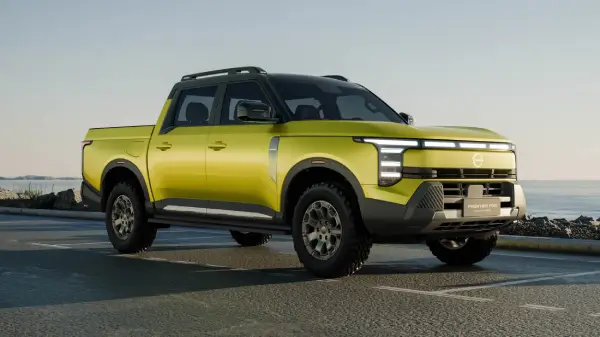
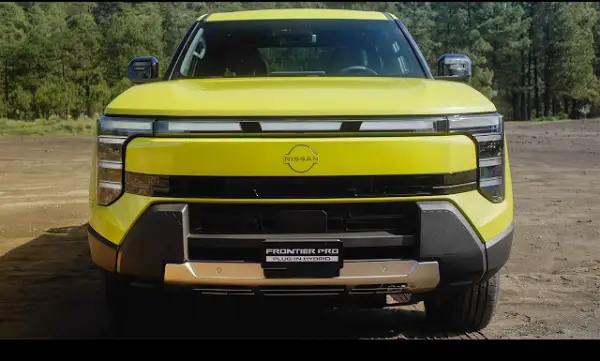
Nissan Frontier Pro PHEV: Nissan has built a more powerful, electrified version of its Frontier pickup and it’s heading to market around the world. There’s just one catch: American buyers aren’t getting it.
Imagine visiting a Nissan dealership in the US to purchase a midsize pickup and learning that customers in other nations may purchase a model with over 400 horsepower and significantly more torque. This is the case with the Nissan Frontier Pro PHEV, a plug-in hybrid truck created by Nissan’s joint venture with China.
While You Care for Your Car, Care for Your Child’s Future Too 💖
A fun and educational book every parent should gift their kid.
 Get Kiddy Store Fortune Now
The electric Frontier Pro offers a whole different interpretation of the well-known moniker, while the naturally aspirated 3.8-liter V6 Nissan Frontier still produces 310 horsepower for the American market. In select configuration its combined output reaches around 402 horsepower and 590 lb-ft of torque.
That’s a substantial difference on paper, especially for truck enthusiasts who want strong acceleration alongside everyday practicality. The hybrid setup also promises an electric-only driving range of approximately 84 miles under China’s NEDC testing cycle.
So why is Nissan sending this more powerful pickup to international markets while leaving the United States out of the picture? The answer involve more than horsepower. Different engineering programs, manufacturing strategies, trade barriers and connected-vehicle regulation all play a role.
And while the American Frontier remain a capable truck in its own right the Frontier Pro raise an interesting question Could Nissan eventually bring electrified performance to its US midsize pickup lineup?
Nissan Frontier Pro PHEV: What Makes It So Different?
The biggest difference between these two pickup is what sits under the hood. The American Frontier stick with a conventional gasoline engine while the Frontier Pro PHEV combines a turbocharged engine with electric assistance.
According to Nissan’s published information about the Chinese-market model the plug-in hybrid powertrain can deliver approximately 402 horsepower and 590 lb-ft of torque. That’s enough to put the truck in some seriously interesting company.
Here’s how the headline figures compare.
| Specification | US Nissan Frontier | Frontier Pro PHEV |
| Powertrain | 3.8L naturally aspirated V6 | 1.5L turbo-four hybrid |
| Maximum horsepower | 310 hp | Around 402 hp |
| Maximum torque | 281 lb-ft | Up to 590 lb-ft |
| Transmission | 9-speed automatic | Hybrid-specific transmission |
| Electric-only driving | Not available | Yes |
| US availability | Available | No US launch announced |
Note: Figures refer to the US-market Frontier and the Chinese-market Frontier Pro PHEV. Specifications vary by destination and the 402-hp figure should not be assumed for every export version.
The power difference is impressive but torque may be the more interesting number for pickup buyer. Strong torque can help a truck pull away under load, climb challenging terrain and deliver responsive acceleration. Actual capability, however depend on gearing, traction, weight, cooling and other engineering detail.
The hybrid system also brings something the US truck cannot offer: driving on electric power alone for shorter trips. Nissan has cited an electric-only range of roughly 84 miles under the NEDC testing method for the Chinese-market version. That figure comes from a particular testing cycle and shouldn’t be treated as an EPA estimate for American driving conditions.
For driver who make frequent short journey the ability to plug in and drive without using gasoline could be a major advantage. For others the appeal might simply be the extra power available when merging, climbing hills or carrying equipment.
Nissan Is Taking the Frontier Pro Beyond China
The Frontier Pro isn’t staying in China. Nissan officially announce its international rollout on October 8, 2026 naming Mexico as the first market outside China to receive the pickup. The company plan to expand into Latin America the Middle East, Southeast Asia, Australia and New Zealand.
That makes this more than an interesting concept that might never reach customers. Nissan is using the truck to expand its international lineup and demonstrate that vehicles developed in China can serve markets well beyond the country where they were engineered.
The rollout is expected to follow this schedule:
– Mexico: Sales began rolling out in October 2026.
– Philippines: Planned introduction in November 2026.
– Middle East and additional Latin American market: Further launches planned by the end of 2026.
– Australia and New Zealand: Planned arrival in 2027 under the Navara Pro name.
Additionally Nissan claims that powertrains will be customized for certain regions. Latin America Southeast Asia and Oceania will get plug in hybrid model while internal combustion model will be available in the Middle East.
This is a crucial distinction. The Frontier Pro brand does not always imply the same spec. A truck sold in Mexico could differ from one marketed in China or Australia in terms of power output, equipment package, or engine configuration.
Because of this versatility, Nissan is able to target a variety of clients without requiring the same car to be delivered to every nation.
Why Does the US Still Get the 310-HP V6?
This is where things get complicated.
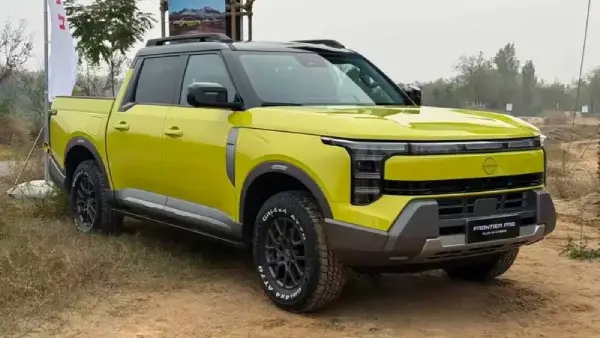
American drivers are familiar with the Frontier sold through Nissan’s US operation. The Frontier Pro, meanwhile, was designed, developed, and manufactured by Zhengzhou Nissan, the automaker’s Chinese joint venture. Although the trucks share Nissan branding and a pickup-truck identity, they come from separate vehicle programs.
Bringing the Frontier Pro to the United States would therefore involve more than shipping completed trucks across the Pacific.
1. Import tariffs make the business case difficult
The United States has long impose a 25% tariff on import light truck, commonly known as the chicken tax. Depending on the vehicle’s classification and the applicable trade rule additional duties may also affect the economic of importing a Chinese built pickup.
Those costs can make an imported truck considerably more expensive before it even reaches a dealership. Nissan would need to work out whether customers would pay the resulting price and whether the vehicle could compete with established American-market pickups.
Tariffs are an important part of the challenge, but they aren’t the entire explanation.
2. US certification and regulations add another hurdle
Vehicle sold in America must meet the country applicable safety emission and other regulator requirement. A truck develop for another market may require engineering change, testing, documentation and separate certification work before it can be sold in the United State.
Connected-vehicle rules also complicate the situation. US restrictions concerning certain vehicle connectivity software and hardware linked to China create additional compliance challenges for affected models and model years.
Even if the Frontier Pro’s engineering looks promising, Nissan would need to evaluate all these requirements before considering a US launch.
3. Building it in America would be a different proposition
Could Nissan produce a similar pickup in the United States instead of importing it? In principle, yes. Local production could potentially avoid some import-related costs and make the vehicle easier to adapt to North American requirements.
However setting up domestic production would involve investment in manufacturing, suppliers, components, and production processes. Nissan would also have to determine whether expected sales justified that spending.
For now, Nissan has not announced a US-market launch for the Frontier Pro. It would be premature to assume that the company is preparing an American-built version simply because the global truck exists.
The US Frontier Is Still a Capable Pickup
It would be easy to look at the numbers and conclude that the American Frontier has suddenly become outdated. But that’s not the whole story.
The US market Nissan Frontier uses a 3.8 liter V6 that produce 310 horsepower and 281 lb ft of torque. It pair that engine with a nine speed automatic transmission giving buyers a familiar gasoline-powered pickup without the additional complexity of a plug-in hybrid system.
Depending on configuration, the Frontier can tow up to 7,150 pound. That’s a useful capability for people hauling trailers, recreational equipment, or work supplies.
There are also practical reasons some buyers may prefer a conventional gasoline truck. They don’t need to charge a battery, and their driving routine doesn’t have to revolve around access to charging equipment.
Naturally this does not imply that the V6 is superior in all circumstances. While the Frontier Pro PHEV’s plug-in capabilities could save gasoline consumption on appropriate trips, its electric assistance may provide benefits in acceleration and daily driving.
What a driver values most will determine which option is best: simple gasoline power, electrified performance, operational expenses, or a specific mix of those.
However, since Nissan hasn’t yet revealed the Frontier Pro for the US market, the choice is currently considerably easier for American consumers.

Could the Frontier Pro Challenge the Ford Ranger Raptor?
A 402-hp midsize pickup naturally invite comparison with some of the segment performance-focused models.
The Ford Ranger Raptor uses a twin turbocharge 3.0 liter V6 producing 405 horsepower and 430 lb-ft of torque. Toyota Tacoma i-FORCE MAX hybrid produce 326 horsepower and 465 lb-ft of torque.
On headline horsepower, the Chinese-market Frontier Pro PHEV is close to the Ranger Raptor. Its claimed 590 lb-ft of torque also exceeds the figures quoted for both rivals.
| Truck | Horsepower | Torque |
| Nissan Frontier Pro PHEV | Around 402 hp | Up to 590 lb-ft |
| Ford Ranger Raptor | 405 hp | 430 lb-ft |
| Toyota Tacoma i-FORCE MAX | 326 hp | 465 lb-ft |
These are not the outcomes of a direct comparison test rather they are published headline data. The weight, suspension, tires, drivetrain calibration and intended application of the vehicle vary. Which vehicle is faster, more capable off-road, or better at hauling is not determined solely by its horsepower and torque.
Nevertheless, the contrast shows why it’s worthwhile to watch the Frontier Pro. Nissan has proven that plug-in hybrid technology and powerful output can coexist in its Chinese-market truck. That’s an interesting development in a segment where electrification is becoming increasingly relevant.
China Is Becoming an Important Part of Nissan’s Global Strategy
The Frontier Pro also tells a larger story about how Nissan develops and sells vehicle.
For years, global automakers have tended to develop products around established regional operations. But the industry is changing, particularly as competition in electric and hybrid vehicles puts pressure on development times and costs.
Nissan is increasingly using its Chinese operations as a development and export base. Nissan claims that the Frontier Pro is its first car designed and produced in China for export, which makes it particularly noteworthy.
With that strategy, the carmaker could be able to expand its client base without having each regional division create a completely new car on its own.
Additionally, it provides Nissan with an additional means of meeting various market demands. While conventional gasoline or diesel powertrains may be preferred in some areas, plug-in hybrids may be preferred in others. These variations can be accommodated via a flexible product approach.
The difficulty lies in striking a balance between that flexibility and the brand’s current regional operations, production expenses, and regulatory obligation.
For Nissan, the Frontier Pro is therefore more than a new pickup. It is a practical test of whether China-developed vehicles can become a meaningful part of the company’s wider international business.
What This Means for Future Nissan Trucks
The arrival of the Frontier Pro raises an obvious question: Will Nissan eventually electrify the Frontier sold in North America?
It’s possible, but there is no confirmed US launch to point to. The existence of a plug-in hybrid pickup in Nissan global portfolio doesn’t mean the same powertrain will automatically reach American dealership.
Nissan would need to consider customer demand production cost engineering requirement and the competitive landscape. It would also need to decide whether an electrified North American Frontier should be based on the existing US vehicle or developed as a substantially different product.
If Nissan does eventually bring hybrid technology to its American pickup lineup, the Frontier Pro could serve as evidence of the company’s experience with electrified truck powertrains. That doesn’t mean a future US model would use the same hardware or produce identical figures.
For now, the international rollout is the more immediate story. Customers in selected markets will get access to a new Nissan pickup with multiple powertrain options, while US buyers continue with the established Frontier.
Final Thoughts: Nissan Has a More Powerful Frontier, Just Not for America
The Nissan Frontier Pro PHEV is an intriguing addition to the global pickup market. Its Chinese-market specification combines around 402 horsepower, up to 590 lb-ft of torque, and plug-in hybrid capability in a package designed for international expansion.
Meanwhile, the American Frontier continues to rely on its 310-hp V6. That engine remains a capable option, but it can’t match the electrified model’s headline power figures.
The difference isn’t simply a matter of Nissan choosing to give one country a better truck. The two pickups come from separate vehicle program and their markets face different manufacturing, regulatory and trade conditions.
Whether the Frontier Pro eventually inspires a similar truck for the United States remains an open question. Until Nissan announces such a move, American buyers will have to watch its international journey from a distance.
FAQs
Q1. Why isn’t the Nissan Frontier Pro coming to the US?
A: Nissan has not announced a US launch. Import tariffs, regulatory certification, connected-vehicle restrictions, and the economics of establishing a suitable supply chain could all complicate its introduction. Nissan has not publicly identified one of these factors as the sole reason for the truck’s absence.
Q2. What is the electric range of the Nissan Frontier Pro PHEV?
A: The Chinese-market version has been associated with an electric only range of approximate 84 mile under the NEDC testing cycle. This is not an EPA-rated range for US driving, and actual results depend on the vehicle specification and driving conditions.
Q3. Which countries will get the Nissan Frontier Pro?
A: Nissan’s announced rollout includes Mexico, additional Latin American markets, the Philippines, the Middle East, and other Southeast Asian markets. Australia and New Zealand are scheduled to receive it under the Navara Pro name in 2027.
Also Read: 10 Clutchless Motorcycles For Enthusiast Who Still Love Shifting Gear