
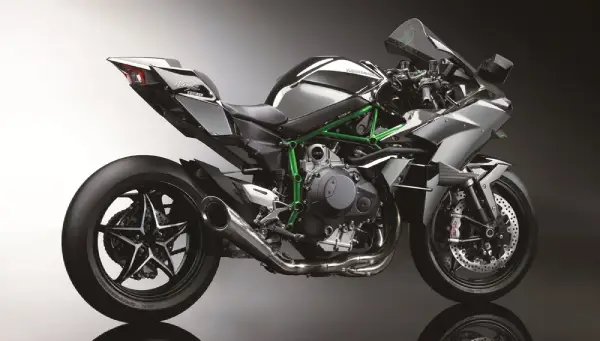
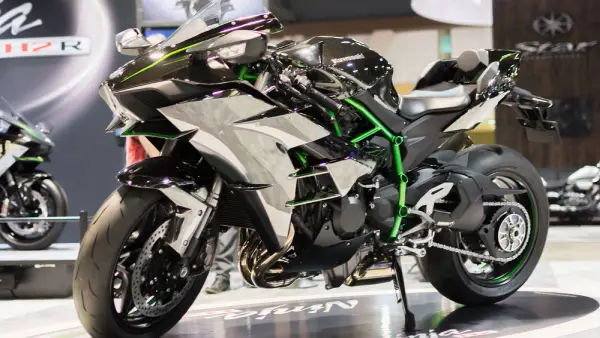
Biggest Kawasaki Motorcycle Engine: At one point Kawasaki seems committed to increasing the size, speed and extravagance of its motorcycle. The business pursued top speed records, manufactured famous vehicles based on massive inline-four engines, and even created a cruiser with an engine that was almost laughably big.
However, Kawasaki has adopted a completely different strategy in 2026.
While You Care for Your Car, Care for Your Child’s Future Too 💖
A fun and educational book every parent should gift their kid.
 Get Kiddy Store Fortune Now
Instead of just adding additional cubic centimeters, the Japanese manufacturer has concentrated much of its current offering on middleweight motorcycles, efficient chassis, and performance technology. This make the answer to one surprisingly fascinating question even more intriguing:
In 2026 what is the biggest Kawasaki motorbike engine still in production?
Despite being one of Kawasaki’s largest performance motorcycle the Ninja ZX-14R isn’t the solution. Nor is it a supercharged Ninja from the firm.
The Kawasaki Vulcan 1700 a powerful V-twin cruiser that resemble a relic from a bygone period of riding, hold the title.
And that is exactly what make it intriguing.
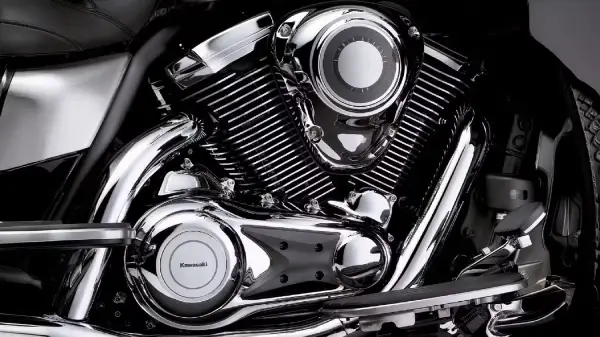
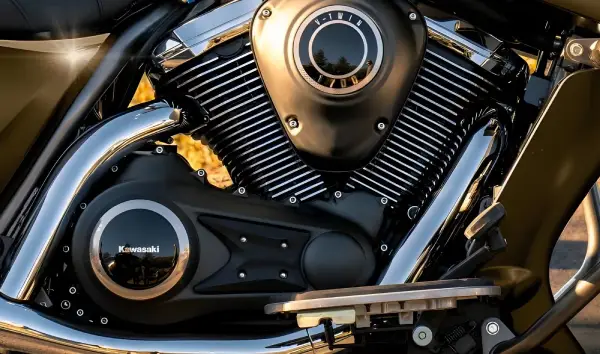
Kawasaki’s Largest Engine is a 1,700cc V Twin
The Vulcan 1700 series remain Kawasaki’s greatest capacity motorbike portfolio in 2026.
Compare to its 1,700cc powerhouse the Ninja’s 1441cc four-cylinder engine is significantly smaller. That distinction is noteworthy particular in light of Kawasaki longstand reputation for producing large displacement inline four performance motorcycle.
The Vulcan adopts an entirely new strategy.
Its 52-degree V-twin is built for low-rpm torque and easy driving rather than yelling toward the redline. It’s the kind of engine that feels substantial without continual revving. Twist the throttle at low engine speeds and the motorcycle respond with the kind of shove you’d expect from a big touring cruiser.
The engine uses a 102mm bore and 104mm stroke creating its approximately 1,700cc displacement. A relatively modest 9.5:1 compression ratio also tells you plenty about the character of this powerplant.
This isn’t a high-strung superbike engine.
It is a big, relaxed V-twin designed to pull a heavy motorcycle and its passengers down the highway for hours.
Why the Vulcan 1700 Is More Interesting Than Its Numbers Suggest
On paper the Vulcan 1700’s engine specifications aren’t particularly dramatic by modern motorcycle standards.
Kawasaki quote roughly 82 horsepower and 107.6 lb-ft of torque for the engine. Those number might look disappointing beside modern sportbikes that produce well over 150 horsepower from much smaller engines.
But horsepower isn’t really the point here.
With a peak torque of about 2,750 rpm, the Vulcan’s torque starts low in the rev range. That completely alter the motorcycle’s demeanor.
Making advancement doesn’t require putting a lot of effort into the engine.
When you’re riding a big touring motorcycle with a passenger and luggage, that counts. The Vulcan 1700 performs smoothly and predictably rather than continuously changing ratios and seeking horsepower.
It is a traditional application of the big-twin formula.
And honestly, that’s part of its appeal.
The ZX-14R Is Still Huge But It Doesn’t Take the Crown
When discuss the company’s largest motorbike engine Kawasaki enthusiast may instantly think of the Ninja ZX-14R.
That make sense.
One of Kawasaki’s most formidable production motorcycles for a long time was the ZX-14R. The motorcycle is regarded as one of the best high-speed vehicles of its generation thanks to its 1,441cc inline-four engine which has immense performance potential.
However displacement is displacement.
The ZX 14R 1,441cc engine is still about 260cc small than the V twin of the Vulcan 1700.
When you compare how the engine generate their power the difference become much more intriguing.
High-rpm performance is the foundation of the ZX-14R. Low-rpm torque is the foundation of the Vulcan.
One wants to run.
The other wants to cruise.
That contrast shows just how differently Kawasaki has approached large-capacity motorcycle over the years.
Kawasaki Used to Love Enormous Engines
The Vulcan 1700 is not a stand alone device.
Kawasaki has been experimenting with large engines for a long time.
The business manufacture a number of motorcycle that exceed the conventional 1,000cc limit throughout the 1990s and 2000s. The GPZ and Ninja families showed how far Kawasaki was ready to push performance while the ZRX series gain notoriety for its robust inline four character.
Motorcycle like the Ninja ZX-12R and ZZR1400 followed.
Manufacturers were fighting over engine capacity, acceleration and top speed when these bikes were manufactured.
With the Vulcan family, Kawasaki also targeted the American cruiser market.
That’s where things got especially interesting.
The Legendary Vulcan 2000 Went Even Bigger
Before the Vulcan 1700 became Kawasaki displacement king there was the Vulcan 2000.
As the name suggest this cruiser used a massive 2,053cc V-twin engine.
For its time that was an enormous figure for a mass-produced motorcycle.
One of Kawasaki’s most notable attempts to directly compete with heavyweight American cruisers was the Vulcan 2000. The motorcycle’s massive engine gave it a distinctive appearance and show that Kawasaki wasn’t scared to construct motorcycles with massive displacement.
The Vulcan 2000 is still a significant part of Kawasaki’s big-engine heritage, although the Triumph Rocket III’s three-cylinder engine ultimate won the title of largest production cruiser displacement.
The current Vulcan 1700 is intriguing because of this.
It’s not the largest engine ever made by Kawasaki.
It remain the largest engine in Kawasaki’s current lineup.
That distinction matters.
The Vulcan 1700 Comes in More Than One Flavor
Kawasaki does not force buyer to choose between displacement and touring practicality.
The Vulcan 1700 platform has been used for different types of heavyweight touring motorcycles, including the Vaquero bagger and Voyager full-dresser.
Both use the same basic 1,700cc V-twin philosophy.
The difference is how much touring equipment is wrapped around the engine.
The Vaquero has a more stripped-back bagger appearance while the Voyager adds more equipment and touring-focused hardware.
That makes the two motorcycles appealing to slightly different rider.
Want a big cruiser with serious road presence without going all in on luxury tour equipment?
The Vaquero makes sense.
Want a motorcycle design around long-distance travel, passenger comfort, luggage capacity and wind protection?
The Voyager is the more natural choice.
Either way, you’re getting Kawasaki’s largest current motorcycle engine.
This Is a Very Heavy Motorcycle
There is no hiding the physical size of the Vulcan 1700.
The Vaquero weigh roughly 844.5 pound while the Voyager approaches the 900 pound mark.
That’s a serious amount of motorcycle.
For comparison, many modern naked bikes and sportbikes weigh hundreds of pounds less.
The Vulcan weight isn’t accidental though.
Large touring motorcycle require substantial chassis component, suspension, brake, bodywork, fuel capacity, luggage, and comfort equipment. Add a massive V-twin and all the associate hardware and you end up with a motorcycle that feel imposing even before you start the engine.
The dimensions reinforce that impression.
The platform has a wheelbase of about 65.6 inches and stretch almost 99 inches from front to rear.
It’s a motorcycle designed for open road not squeezing through tiny parking spaces.
The Chassis Keeps Things Traditional
The Vulcan 1700 does not attempt to reimagine the cruiser.
The motorbike has a strong base around the massive V-twin thanks to the conventional double-cradle design of its chassis.
Air assisted twin shock at the back and a 45mm telescopic fork up front provide suspension. The motorcycle has 16-inch wheels and a big rear tire that complement its long distance cruiser style.
Braking hardware includes dual front discs and a rear disc.
There’s also ABS, which provides an important layer of modern safety.
But look beyond those basics and you’ll quickly realize that the Vulcan isn’t trying to compete with the latest electronically loaded touring motorcycle.
That’s one of its biggest strength and weaknesses.
The Vulcan 1700 Is Surprisingly Old School
These days touring motorcycle are rolling displays of electronics.
Lean-sensitive traction control, electronically adjustable suspension, heated seats, heated grips, adaptive lighting, smart infotainment system and sophisticated rider-assistance technologies are among the feature that some offer.
The Vulcan 1700 has a far more straightforward approach.
It gives you the essentials and largely leaves the rider alone.
That means you get a motorcycle that feels mechanical rather than digital.
For some rider that’s exactly what they want.
There is something appealing about climbing onto a huge V-twin, starting the engine, selecting a gear and simply riding.
You aren’t spending the first five minutes configuring riding modes.
You aren’t scrolling through menus.
You aren’t trying to figure out which electronic setting is best for the road ahead.
You ride.
Of course riders who expect modern luxury-tourer technology may find the Vulcan’s equipment list surprisingly basic.
Both perspectives are fair.
The Biggest Kawasaki Engine Isn’t the Most Powerful
Probably the most crucial distinction to make is this one.
Although it isn’t Kawasaki’s most potent motorcycle engine, the Vulcan 1700 features the company’s largest motorcycle engine by displacement.
These two metrics are very different.
Supercharged motorcycles from Kawasaki show that there are other ways to achieve significant performance than displacement.
Compared to a normally aspirated engine with a much larger displacement, a smaller engine with forced induction, aggressive tune, high compression, and contemporary electronics can generate much more horsepower.
Because of this the Vulcan’s 82 horsepower output shouldn’t be seen as a drawback without taking into account its intended use.
The bike isn’t designed to chase superbike lap times.
It’s designed to deliver a strong wave of torque while carrying a large motorcycle comfortably over long distances.
Why Kawasaki Isn’t Chasing Displacement Anymore
The motorcycle industry has changed.
Huge engines are expensive to develop, heavy, difficult to package, and increasingly challenging to justify when smaller engines can deliver excellent performance.
Kawasaki’s modern lineup reflects that reality.
The company has invested heavily in middleweight motorcycles and newer engine platforms. Model around the 400cc, 500cc, 650cc, 750cc and 900cc ranges have become important parts of the Kawasaki family.
At the same time modern emission regulation and changing customer expectations have made enormous naturally aspirated engines less attractive.
That’s one reason the Vulcan 1700 feels unusual in 2026.
It’s a survivor.
While many manufacture have moved toward smaller engine, electrification, advanced electronic or completely redesigned platform Kawasaki big V twin continue to represent an older school of motorcycle engineering.
How Does It Compare With the Honda Gold Wing?
One of the most obvious options for rider interested in serious long distance touring is the Honda Gold Wing.
Nonetheless the two motorcycle approach touring in somewhat different ways.
The Gold Wing prioritize luxury, technology and long distance comfort with its horizontally oppose six cylinder engine.
Compare to the Vulcan V-twin its engine configuration is entirely different.
The Kawasaki feels like a vintage heavyweight cruiser.
The Honda appears to be more of an upscale touring car.
Neither approach is intrinsically better.
If you like the sound feel and character of a big V twin the Kawasaki simple has a personality that the Gold Wing cannot equal.
The Honda is probably more enticing if you want the highest level of touring sophistication.
What About BMW?
BMW’s K 1600 family is another major competitor.
The K 1600 motorcycles use a large inline-six engine and combine strong performance with extensive electronic equipment and touring technology.
The difference in philosophy is obvious.
BMW views the motorcycle as an advanced, high-performance touring vehicle.
The Vulcan 1700 from Kawasaki is considerably more conventional.
The Kawasaki has a more laid-back engine nature and less electrical gadgets. The BMW offers a sportier take on heavyweight touring along with a lot more technology.
The Kawasaki has a special attraction for those who value simplicity.
BMW has an advantage for motorcyclists that desire the newest gear.
The Price Makes the Vulcan More Interesting
The Vulcan 1700’s pricing also helps explain why it continues to attract attention.
The Vaquero starts around $19,999 while the Voyager is approximately $20,199 based on the pricing referenced for the current model.
That’s not cheap.
But heavyweight touring motorcycles can quickly become much more expensive.
American competitors from Harley-Davidson and Indian can move considerably higher depending on the model and equipment level. Premium Japanese and European touring motorcycles can also climb well beyond the $20,000 mark.
So the Vulcan occupies an unusual position.
It’s expensive compared with ordinary motorcycles.
But compared with some fully equipped heavyweight tourers, it can look surprisingly reasonable.
Is the Vulcan 1700 Still Worth Buying in 2026?
That depend entire on what you want from a motorcycle.
If you’re looking for the newest technology the highest horsepower figure, or the most advanced rider-assistance package the Vulcan probably isn’t the obvious choice.
There are newer motorcycles that do those things better.
But if you want a big V-twin, relaxed highway performance, substantial road presence, simple controls, and classic cruiser character, the Vulcan 1700 remains difficult to ignore.
Its age is actually part of the attraction.
There’s no need to pretend this is the most technologically advanced motorcycle in its class.
It isn’t.
Instead, it’s a huge Kawasaki with a huge engine that follows a formula that has largely disappeared from the modern motorcycle market.
And that’s becoming increasingly rare.
The Biggest Kawasaki Motorcycle Engine in 2026 Has a Surprisingly Old School Soul
Kawasaki’s history is pack with outrageous motorcycle.
From the early superbikes to the Ninja ZX-12R, ZZR1400, supercharged H2 family and enormous Vulcan cruisers, the company has never been afraid of big ideas.
Yet its biggest current motorcycle engine isn’t wrapped in a race replica.
It’s not supercharged.
It doesn’t generate four-digit horsepower.
Rather, it is a large touring cruiser with a 1,700cc V-twin that is comparatively comfortable.
The Vulcan 1700 is fascinating because of this.
Although it is the largest motorbike engine produced by Kawasaki in 2026, its performance is entirely different.
Chasing numbers is not the purpose of the engine.
It’s about appreciating the rumble of a large V-twin, having enough torque to move a heavyweight motorcycle with ease and spending hours on the highway without having to squeeze the throttle every time the road opens up.
The Vulcan 1700 feels almost rebellious in a field that is becoming more and more fixated on technology, efficiency, and performance.
It’s large.
It weighs a much.
It’s outdated.
And that’s precisely the point for the appropriate rider.
FAQs
Q: What is the Kawasaki motorcycle maximum displacement?
A: With a capacity of roughly 1700cc the Kawasaki motorcycle has the large engine size available from the manufacture.
Q: How much torque is produce from Vulcan 1700?
A: It is expect the torque produce by the 1,700cc engine is around 107.6lb-ft with the peak torque coming from low rpm.
Q: Is Vulcan 1700 good for travel?
A: Yes particular for rider who prefer traditional cruiser styling, strong low end torque, highway comfort and a relative simple riding experience. Rider look for extensive modern electronic may prefer newer competitor.
Also Read: The 2026 Harley-Davidson Fat Boy Still Has The Muscle But It’s Smarter Now
1 thought on “Kawasaki’s Biggest Motorcycle Engine in 2026 Isn’t What You Think”
Comments are closed.