
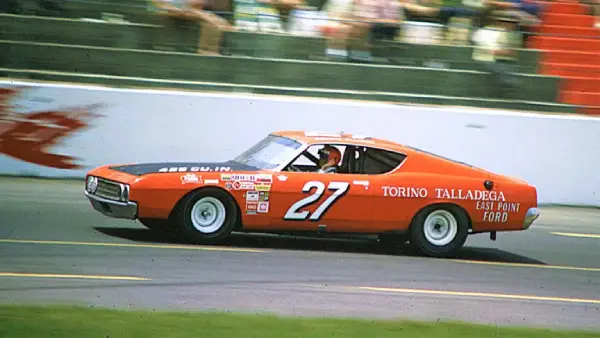
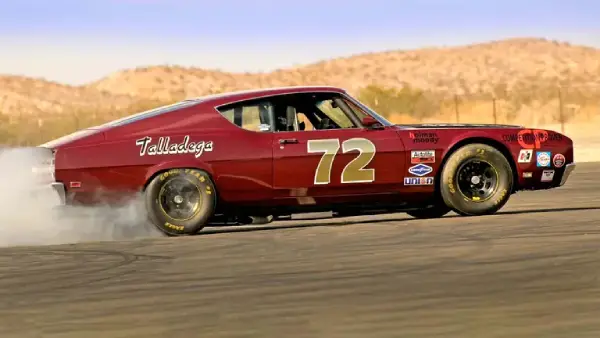
Ford Torino Talladega NASCAR Car: In the 1960s Detroit didn’t whisper about performance — it shouted it from the rooftops of racetrack. The rule was simple win on Sunday, sell on Monday. But Ford didn’t just follow the rule. It pushed it so far that NASCAR eventually had to step in and say, “Enough.”
That car was the Ford Torino Talladega — a NASCAR-bred missile that regular buyers could technically drive home from a dealership. It wasn’t a styling exercise or a marketing gimmick. It was a purpose-built aerodynamic weapon created to dominate superspeedways and it did exactly that.
While You Care for Your Car, Care for Your Child’s Future Too 💖
A fun and educational book every parent should gift their kid.
 Get Kiddy Store Fortune Now
So how did a street-legal Ford become so fast that it rewrote NASCAR’s rulebook? Let’s break down the story of the most extreme “regular buyer” car Ford ever built.
Born From The NASCAR Aero Wars
By the late ’60s, NASCAR racing had entered what’s now known as the Aero Wars. Horsepower was no longer enough. At 180+ mph, air resistance mattered more than raw muscle.
Ford’s engineers knew the standard Torino body was holding them back. The solution? Redesign the car for the wind, then sell just enough of them to the public to make it legal for racing.
NASCAR’s homologation rules required at least 500 street cars. Ford quietly built around 750 Talladegas just enough to check the box — not enough to care about showroom appeal.
This wasn’t a muscle car trying to look fast. It was a race car pretend to be a road car.
Subtle Looks, Serious Aero Science
At first glance, the Talladega doesn’t scream “race car.” But look closer and you’ll see how radical it really was.
Ford extended the front nose by nearly five inches and fitted a flush-mounted grille, eliminating the drag-heavy air pocket found on standard Torinos. The front bumper was reshaped and rolled, rocker panels were modified to legally lower the body, and every panel gap was sealed with airflow in mind.
These weren’t cosmetic tweaks — they were wind-tunnel solutions. The result was dramatically reduced drag and rock-solid stability at speeds where most ’60s street cars started feeling nervous.
On NASCAR’s fastest tracks, that efficiency was worth several mph, which might as well have been an eternity.
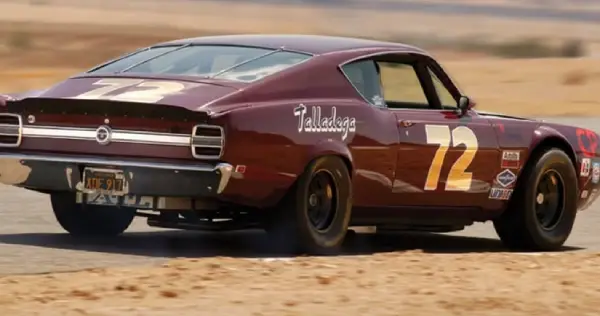
The Engine: Built To Survive, Not Show Off
Under the hood sat Ford’s legendary 428 Cobra Jet V8. On paper, 335 horsepower didn’t look outrageous — even by late-’60s standards. But number don’t tell the whole story.
This engine was tuned for endurance, not stoplight sprints. Thick internals, conservative factory rating and heavy-duty driveline components meant it could run flat-out for hours without flinching.
Most Talladegas were sold with a 3-speed automatic, but racing versions paired the Cobra Jet with a 4-speed manual and Ford’s bulletproof 9-inch rear end.
It wasn’t about drama. It was about surviving 500 miles at full throttle.
Too Fast For NASCAR’s Comfort
NASCAR was hit like a ton of bricks by the Talladega.
Ford dominated the competition on superspeedways like Daytona and Talladega, amassing 26 victories in the 1969 season under the leadership of legend like David Pearson. Because of its aero efficiency the car required less throttle to accelerate which improved tire life, reduced engine strain and allowed for higher sustained speed.
Ford’s dominance forced Chrysler into panic mode, resulting in the now-iconic Dodge Charger Daytona and Plymouth Superbird. Giant wings, pointed noses — the war escalated fast.
By 1970 NASCAR speeds were flirting with 200 mph and official were getting nervous.
In 1971 the hammer dropped. Aero cars were hit with massive engine restrictions, effectively killing them overnight. The Talladega hadn’t just won — it had gone too far.
Ford Didn’t Stop With One Car
The Talladega wasn’t a one-off experiment. Ford doubled down with Mercury’s own aero special, the Mercury Cyclone Spoiler II.
Mechanically identical and equally rare, the Spoiler II proved this was a company-wide strategy, not a lucky accident. Ford wanted control of NASCAR’s fastest tracks — and for one glorious season, it got exactly that.
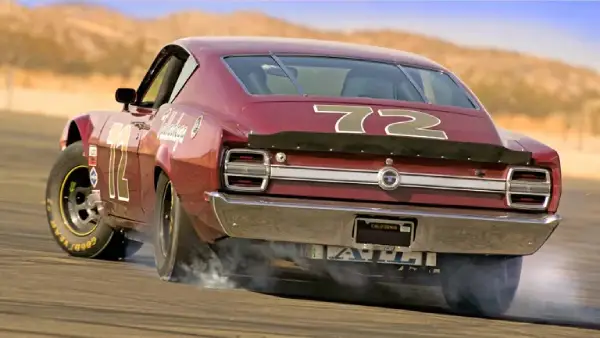
Rarer Than The Boss 429 — And That’s The Irony
Here’s where things get interesting.
The Talladega is rarer than the legendary Ford Mustang Boss 429 yet it sells for far less today.
Why? Simple.
The Boss 429 looked wild, sounded angrier, and wore the Mustang badge — already a cultural icon. The Talladega, on the other hand, looked odd. Its long nose confused buyers, marketing was minimal, and it didn’t fit the muscle-car fantasy most people wanted.
Dealers struggled to sell them. Some sat untouched for months.
Ironically, that lack of love is exactly what makes them special now.
What A Ford Torino Talladega Is Worth Today
As of 2026, the Talladega remains one of the most compelling values in classic American performance:
- Good condition: ~$68,000
- Excellent / concour: $118,000–$130,000
- Documented prototypes: Even higher
That’s a bargain compared to Boss 429s regularly clearing $200,000–$500,000+.
Collectors who understand NASCAR history see the Talladega for what it truly is a rolling piece of aerodynamic rebellion.
Why The Talladega Finally Gets The Respect It Deserves
The Talladega wasn’t built to be loved. It was built to win.
And now, decades later, enthusiasts are finally appreciating its purity. No gimmicks. No excess chrome. Just wind-tunnel science, brute durability, and one clear mission: go faster than everyone else.
It’s not just a muscle car.
It’s NASCAR history with license plates.
Bottom line
The Ford Torino Talladega is proof that sometimes the most important car aren’t the loudest or the prettiest — they’re the ones that scared the rulebook enough to change history.
FAQs
Q: Why was the Torino Talladega banned from NASCAR?
A: It wasn’t banned outright but NASCAR introduced engine restriction for aero car in 1971 making them uncompetitive. The Talladega was simply too effective.
Q: How many Torino Talladegas were built?
A: Approximately 750–754 unit making it rarer than many famous muscle car.
Q: Is the Talladega street legal?
A: Yes. Every Talladega sold to the public was fully street legal and dealership sold.
Also Read: Now Is the Perfect Time to Buy Audi’s Last Affordable Roadster