
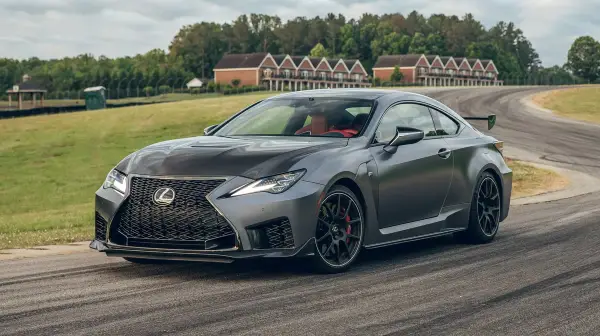
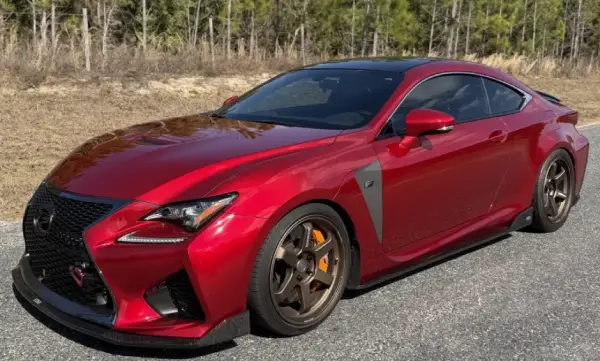
Lexus RC F: There aren’t many performance cars left that can make you grin without making you nervous about what might happen when the warranty run out.
One of those unique vehicles is the Lexus RC F.
While You Care for Your Car, Care for Your Child’s Future Too 💖
A fun and educational book every parent should gift their kid.
 Get Kiddy Store Fortune Now
In a world where turbochargers, hybrid and smaller engines predominate, its naturally aspirated V8 feels more and more unique. It has powerful brakes and chassis hardware, transmit power to the back wheels and can tackle a corner with far more assurance than its modest appearance would imply.
However Toyota-style durability lies beneath all that performance and has always been a key component of the Lexus formula.
That combination makes the RC F particularly interesting today. It isn’t the lightest sports coupe around, nor was it designed to destroy every European rival on a racetrack. Instead, Lexus built something slightly different — a fast luxury coupe that could be driven hard while still making sense as a long-term ownership proposition.
And that may be exactly why enthusiasts are starting to appreciate it more.
The Lexus RC F Took A Different Route To Performance
When the Lexus RC F arrive for the 2015 model year the performance car world was already changing rapidly.
BMW M division was relying heavily on turbocharging. Mercedes-AMG was doing the same. Smaller engines were producing increasingly impressive numbers, while forced induction was becoming the norm.
Lexus took a different approach.
The RC F was equipped with a 5.0-liter normally aspirate V8 engine rather than a smaller turbocharged one.
The car now has a personality that can’t be explained by stats alone thanks to that choice.
467 horsepower and 389 lb-ft of torque were produced by early RC F versions. The output was upgraded to 472 horsepower and 395 lb-ft in 2020.
The more intriguing aspect is how the power is obtained, even though those numbers are still good today.
No enormous turbocharger appears out of nowhere in the middle of a corner. A massive wall of low-rpm torque is not present. Rather as the revs increase, the V8 increases its power until it reaches a redline of 7,300 rpm.
It’s becoming less and less common.
A 5.0-Liter V8 That Doesn’t Need A Turbo
The RC F 2UR GSE V8 is arguably its biggest selling point.
Modern performance cars have become extraordinarily quick, but many have also lost some of the mechanical character that made older performance cars special.
The RC F feels like a reminder of that era.
Press the throttle and the engine doesn’t simply deliver a massive shove and settle down. It encourages the driver to keep the revs climbing. The higher it spins the more rewarding the experience becomes.
And then there’s the soundtrack.
A naturally aspirated V8 producing its power at high rpm has a completely different character from a turbocharged engine. The RC F’s exhaust note becomes part of the driving experience rather than simply background noise.
For enthusiasts who believe a performance car should feel special every time the engine is started, that matters.
The Eight-Speed Automatic Is Better Than You Might Expect
A V8 with a high revving speed is only half the solution.
The RC F was equipped with an eight-speed Sport Direct-Shift automatic transmission from Lexus. It was based on the gearbox from the previous IS F but it underwent significant modifications for the RC F.
Through the steering-wheel paddles, the transmission can produce fast shifts with the smoothness one would expect from a high-end coupe.
A larger specialized gearbox oil cooler is one of the modifications Lexus made to increase its resilience to harsher use.
Although it’s simple to ignore, that feature reveals something about Lexus’s approach to the RC F.
This was more than just a high-end coupe with a big engine. The company knew owners would take the car to the track and engineered the drivetrain accordingly.
The RC F Is More Serious In Corners Than It Looks
The RC F may look more like a grand tourer than a specialized performance vehicle due to its style.
However, Lexus made a number of modifications underneath to set it apart from the standard RC.
The automobile has performance-focused bushings and adaptive suspension technology, the suspension was improved, and the chassis was strengthened.
Additionally, there was an active rear spoiler, functional aerodynamic components, and broader body panels.
Braking hardware was upgraded with large Brembo components, giving the RC F the stopping power expected from a car capable of serious speed.
Weight remained one of its biggest disadvantages.
At close to 4000 pound the RC F was never going to feel like a featherweight sports car. Some European rival were significantly lighter and could change direction more eagerly.
But that doesn’t mean the Lexus couldn’t handle.
It was designed around a different philosophy: stability, high-speed confidence and long-distance usability alongside track capability.
Later RC F Versions Took Things Further
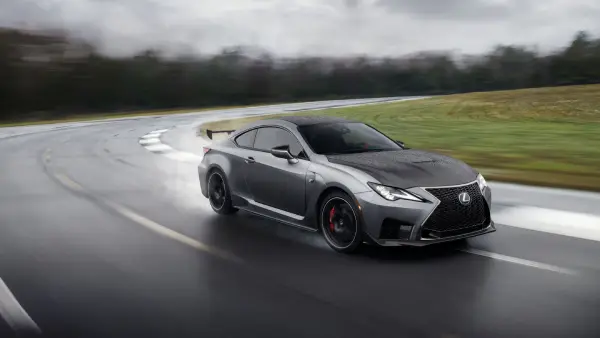
Lexus eventually introduced more focused versions of the RC F, including the Track Edition.
This is where the company made a more obvious attempt to address the standard car’s weight.
Carbon-fiber components, including the roof and aerodynamic pieces, helped reduce mass. The Track Edition also received additional performance equipment designed to make it more capable on a circuit.
These cars are considerably more interesting to collectors today because they represent one of the final chapters of Lexus’ naturally aspirated V8 performance era.
But the standard RC F remains the more accessible way into the formula.
And that’s important.
You don’t necessarily need the most expensive or rare version to experience what makes the RC F special.
Where The Toyota Connection Matters
Here’s the part that separates the RC F from many of its competitors.
Performance cars are complicated machines.
More power means more heat. More aggressive suspension means additional stress on components. Track driving can expose weaknesses that normal commuting never will.
European performance cars can be incredibly reliable when properly maintained, but repairs and maintenance on complex high-performance vehicles can become expensive.
The RC F has developed a reputation for being comparatively durable.
Its naturally aspirated V8 doesn’t rely on turbochargers to produce its power and Toyota and Lexus have long emphasized conservative engineering and durability.
That doesn’t make the RC F maintenance-free.
It is still a high-performance luxury car.
Brakes, tires, fluids, suspension components and other wear items can cost considerably more than they would on an ordinary Toyota. A neglected example can also become expensive quickly.
But the fundamental drivetrain has earned a strong reputation among enthusiasts.
That’s a major reason the RC F remains appealing as a used performance car.
The Engine Has Some Serious Pedigree
The RC F’s V8 wasn’t developed in isolation.
The 2UR-GSE family has been used across several Lexus performance applications, and Yamaha was involved in the development of the cylinder heads.
Lexus also used skilled “Takumi” craftsmen in engine production — highly trained specialists associated with the brand’s emphasis on precision manufacturing.
The engines were produced at Toyota’s Tahara plant in Japan, a facility with a long association with Lexus vehicles.
For buyers interested in long-term ownership, that engineering background adds another layer of appeal.
The RC F isn’t simply a car with an impressive specification sheet.
It comes from a period when Lexus was willing to spend considerable engineering effort on a relatively niche performance coupe.
Why The RC F Wasn’t An Immediate BMW M4 Killer
It’s tempting to compare every performance coupe directly with a BMW M car or Mercedes AMG.
But that isn’t necessarily the best way to understand the RC F.
The Lexus wasn’t built to copy the European formula.
BMW traditionally focused heavily on low weight, sharp responses and aggressive driving dynamics. Mercedes-AMG developed its own combination of brutal acceleration and luxury.
Lexus took a more relaxed approach.
The RC F is fast, but it also feels substantial. It can cover long distances comfortably and doesn’t demand that every drive become a battle against the clock.
That makes it more of a high performance grand tourer than a stripped-down track weapon.
For some drivers, that will be a disadvantage.
For others, it is exactly the attraction.
The Depreciation Story Makes It Interesting
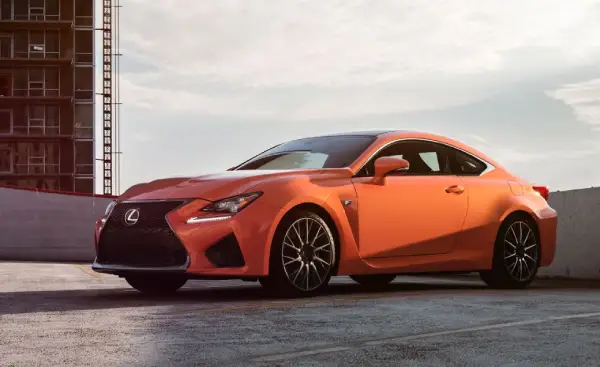
There is another reason enthusiasts have started looking at older RC F models differently: depreciation.
When the RC F was new, its roughly $60,000 starting price put it into serious competition with established German performance cars.
Used prices, however, eventually brought some early examples into a much more interesting range.
That creates an unusual situation.
A buyer looking for a used performance coupe can potentially get a naturally aspirated 5.0-liter V8, rear wheel drive, serious brake, a sophisticated chassis and Lexus build quality without paying anything close to the original sticker price.
Of course used-car prices vary dramatically depending on mileage, condition, history, modifications and trim.
Track Edition cars are a different proposition from ordinary RC F models, and clean low-mileage examples can command a premium.
Still, depreciation has helped make the RC F one of those cars that can look much more compelling several years after its original launch.
The RC F Could Become More Interesting With Age
The automotive industry is moving away from naturally aspirated V8 performance cars.
That’s simply the direction the market has taken.
Turbocharging offers excellent performance and efficiency. Electrification provides instant torque and increasingly ridiculous acceleration figures.
But those technologies also mean that cars like the RC F are becoming harder to replace.
A naturally aspirate 5.0 liter V8 in a rear wheel drive luxury coupe is no longer an ordinary combination.
It’s becoming a historical one.
That doesn’t automatically make every RC F a future collectible. Production numbers, condition and market demand will determine that.
But the car does have several characteristics that enthusiasts tend to appreciate as an era disappears: a big naturally aspirated engine, rear-wheel drive, relatively straightforward mechanical character and a distinctive place in Lexus performance history.
Is The Lexus RC F Still Worth Considering?
For someone shopping purely for the fastest performance coupe available, there are newer options that can accelerate harder and corner faster.
But the RC F isn’t really about chasing the latest benchmark.
It’s about the experience.
You get a high revving V8, rear wheel drive, an eight speed automatic, substantial braking hardware and a chassis design to cope with spirit driving.
At the same time you’re buying into Lexus reputation for build quality and long-term durability.
That combination is becoming difficult to find.
The RC F also avoids one of the biggest problems with many modern performance cars: feeling too similar to everything else.
Its engine has a personality.
Its styling has a personality.
And its approach to performance is distinctly Lexus.
The Real Appeal Of The RC F
The Lexus RC F probably won’t win every comparison test.
It was never the lightest most agile or most technologically aggressive performance coupe in its class.
But that misses the point.
The RC F exists in a sweet spot between a luxury grand tourer and a genuine performance machine. It gives enthusiasts access to a naturally aspirated V8 without requiring them to accept the ownership compromises often associated with aging exotic machinery.
And that’s why this Lexus has become increasingly interesting.
It mixes something traditional—a large, high-revving V8—with something Toyota has excelled at for decades: creating machines with long lifespans.
The RC F stands for something increasingly uncommon in a world of automobiles where EVs, hybrids, and turbochargers are quickly becoming the standard.
A powerful Lexus with rear-wheel drive, a loud V8 engine, and the kind of dependability that makes you want to retain it rather than just enjoy it while the warranty is in effect.
For enthusiast who missed the naturally aspirated V8 era the first time around, that could be the RC F’s biggest advantage.
FAQs
Q: Is the Lexus RC F a fast car?
A: Yes. The RC F combine a 5.0 liter natural aspirate V8 with rear wheel drive and produces up to 472 horsepower in later version. Its performance is strong enough to compete with other luxury performance coupe, although its relatively high curb weight affect outright acceleration and agility.
Q: Is the Lexus RC F reliable?
A: The RC F has develop a strong reputation for drivetrain durability, particular because of its naturally aspirated V8 and Toyota/Lexus engineering. However it is still a high performance luxury vehicle so routine maintenance, tires, brake and other wear item can be expensive.
Q: Is the Lexus RC F rear wheel drive?
A: Yes The RC F send its engine power to the rear wheel giving it the traditional layout many driving enthusiast prefer.
Also Read: 10 Honda Motorcycles That Are Surprisingly Hard To Sell Once You Own One
1 thought on “This Lexus Has Porsche-Level Grip, a Screaming V8, and Toyota Reliability”
Comments are closed.