
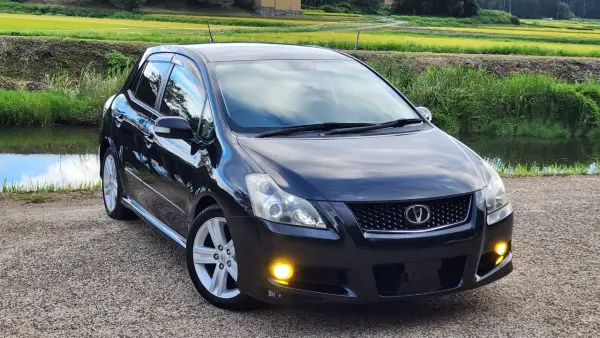
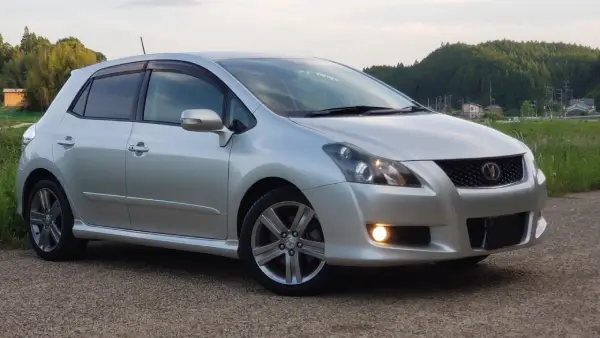
Toyota Blade Master G: There was a time when Toyota looked at a perfectly ordinary hatchback and apparently thought, “You know what this needs? A 3.5-liter V6.”
That might sound like the start of a fantastic fantasy but it was real.
While You Care for Your Car, Care for Your Child’s Future Too 💖
A fun and educational book every parent should gift their kid.
 Get Kiddy Store Fortune Now
Toyota develop an even more bizarre performance hatch for Japan long before the current Toyota GR Corolla attracted attention with its 300-hp turbocharged three-cylinder engine. From the outside the Toyota Blade Master G appeared more like a high-end commuter than something meant to make sports cars look foolish.
However, things became quite fascinating under the hood.
With a six-speed automated transmission, Toyota’s naturally aspirated 3.5-liter 2GR-FE V6 engine produced about 276 horsepower for the front wheels of the little Blade. The engine has 280 PS and 344 Nm, front-wheel drive, and a six-speed Super ECT automatic transmission, according to Toyota’s own Japanese catalog.
That combination makes the Blade Master G one of those wonderfully bizarre Toyota product that seems almost impossible by modern standards.
And with the 2026 GRMN Corolla now pushing Toyota’s hot-hatch formula even further, the Blade Master G feels like an overlooked chapter in the company’s performance history.
The Blade Master G Didn’t Look Fast
This is probably the best part.
The modern GR Corolla practically scream that it wants to be driven hard. Wide fender, aggressive bumpers, large wheels and GR badges make sure nobody mistake it for an ordinary Corolla.
The Blade Master G took the opposite approach.
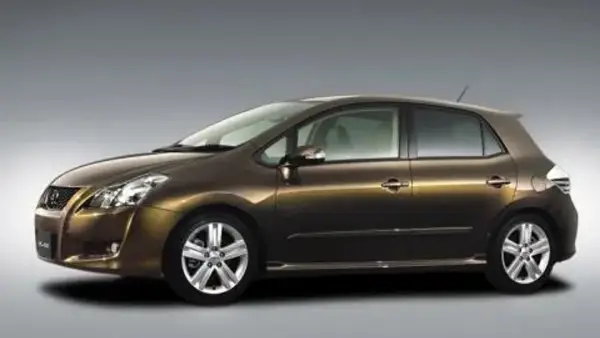
Toyota started with the Blade a Japanese-market five door hatchback positioned as a more upscale alternative to the ordinary Auris. Then it quietly dropped a big V6 into the nose.
The result was a sleeper.
The Blade itself was already intended to feel more premium than Toyota’s usual compact offerings. When the Master G arrived in 2007 Toyota gave it the sort of equipment and styling detail that made it feel closer to a small luxury hatch than a stripped down performance special.
That made the V6 hiding underneath even more ridiculous.
You could park one next to a normal family hatchback and most people would probably never realize there was a 3.5-liter engine sitting between the front wheels.
And that’s exactly why the Blade Master G is so memorable.
Toyota Put a 3.5-Liter V6 Where a Four Cylinder Belonged
The number alone tell the story.
Originally the Blade had a 2.4-liter four cylinder engine. Toyota then determined that was insufficient.
The naturally aspirated 2GR-FE 3.5-liter V6 engine family, which is also utilized in significantly larger and more potent Toyota and Lexus vehicles, was fitted by engineers for the Master G.
The 3,456cc displacement, 344 Nm of torque, and 280 PS are listed in the Japanese market specification.
According to reports from the time the Blade Master G V6 engine produces about 276 horsepower and 344 Nm. It is mate to a six speed sequential automatic transmission with paddle shifter.
Take a moment to consider that.
A small hatchback with five doors.
A naturally aspirated V6.
Almost 280 horsepower.
Front-wheel drive.
Automatic transmission.
It’s a combination that sounds like somebody at Toyota’s performance department had too much freedom.
And unlike many factory specials that simply receive a bigger engine and a badge, Toyota actually changed the car around it.
Front-Wheel Drive Made the Blade Master G Even Crazier
There’s one obvious problem with putting a powerful V6 into a relatively small front-wheel-drive hatchback.
The front tires have to do almost everything.
They have to steer the car.
They have to put the engine’s torque onto the road.
And they have to deal with the weight of that large V6 sitting over the front axle.
That’s a recipe for torque steer and understeer if the chassis isn’t prepared properly.
Toyota knew this.
The Blade Master G received chassis and suspension changes intended to make the extra performance manageable. The car used a more sophisticated rear suspension setup than the basic torsion beam arrangement associated with some versions of the platform, along with upgraded brakes, spring and wider tires.
That mattered because the Master G wasn’t supposed to be a novelty.
Toyota wanted it to actually work.
The result was a compact hatchback with a serious engine and a chassis that had been given enough attention to cope with it.
It wasn’t simply a case of dropping a V6 into a cheap commuter and hoping for the best.
It Was More Luxury Hatch Than Hardcore Track Car
This is where the Blade Master G becomes particularly interesting.
Today, when you hear “Toyota hot hatch,” you probably think of the GR Corolla.
That’s a very different philosophy.
The current GR Corolla is built around a compact 1.6-liter turbocharged three-cylinder, 300 hp and Toyota’s GR-FOUR all wheel-drive system. Buyer can choose between a six-speed manual and an eight-speed automatic.
The Blade Master G wasn’t trying to be that kind of car.
It was fast but it was also comfortable.
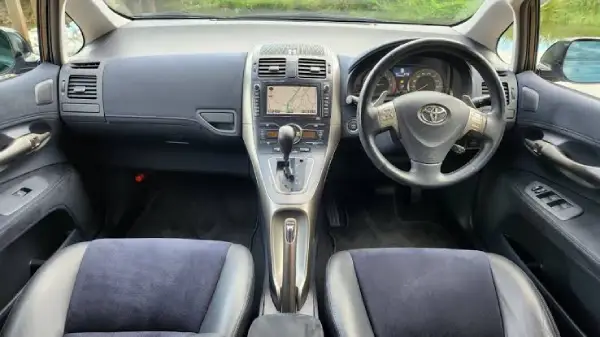
The Blade was marketed as an upscale hatchback and the cabin reflected that mission. Leather-like seating, suede effect interior material and additional luxury equipment gave it a much more relaxed character than today’s track focused Toyota hatchback.
That’s what makes it such a fascinating sleeper.
You weren’t climbing into an obvious performance machine.
You were climbing into a reasonably luxurious Japanese hatchback that happened to have a V6 with enough muscle to make the average commuter car feel painfully slow.
The Automatic Transmission Was the One Big Catch
There is, however, one thing enthusiasts would probably change immediately.
The Blade Master G didn’t get a traditional manual gearbox.
Toyota pair the V6 with a six-speed automatic transmission. Toyota official Japanese specification list the six speed Super ECT automatic while contemporary reports noted its sequential operation and paddle shifter.
For someone shopping for a modern driver’s car that might sound disappointing.
Imagine the same car with a proper six-speed manual.
A lightweight hatch.
A naturally aspirated V6.
Nearly 280 hp.
Front-wheel drive.
It would have been glorious chaotic.
But there is another way to look at it.
The automatic transmission fit the Blade luxury oriented personality. Toyota wasn’t trying to build a stripped-out track weapon. It was building a fast, comfortable sleeper that could be used every day.
In that context, the automatic makes more sense.
The Blade Master G Was Surprisingly Quick
Despite its unusual formula, the Blade Master G wasn’t just about having a ridiculous engine.
Its performance was genuinely strong for its era.
Contemporary comparison put its acceleration in the neighborhood of the six-second mark to 60 mph, depending on the source and testing conditions.
That was enough to put it into serious performance-car territory in the late 2000s.
And the interesting part wasn’t simply how quickly it accelerated.
It was how unexpected that acceleration must have felt.
Imagine driving what looks like a fairly anonymous Toyota hatchback, pressing the throttle and suddenly getting hit with the sound and response of a naturally aspirated V6.
No turbo lag.
No huge wings.
No screaming exhaust.
Just a big engine pulling a small hatchback forward.
That’s classic sleeper-car territory.
Toyota’s Current GR Corolla Is Almost the Opposite
In 2026 Toyota’s hot-hatch formula appear entirely different.
The standard GR Corolla 1.6-liter turbocharged three cylinder engine produce 300 horsepower. It is paired with Toyota’s GR-FOUR all wheel-drive system which depending on the mode chosen can change the torque distribution between the front and rear axle.
That’s a completely different solution to the same basic problem.
Instead of putting a huge naturally aspirated engine over the front wheels, Toyota uses a tiny turbocharged engine and sends power to all four wheels.
A six-speed clever manual gearbox, which was absent from the previous Blade Master G, is another option for the GR Corolla.
The 2026 GRMN Corolla is another.
With a 300-hp 1.6-liter turbocharged three-cylinder engine, 302 lb-ft of torque, GR-FOUR all-wheel drive and a six-speed manual transmission, Toyota has improve upon the GR Corolla formula. Additionally, the GRMN receive carbon-fiber body part, Michelin Pilot Sport Cup 2 tires, forged wheel and significant chassis improvements.
It is obvious that the GRMN Corolla is the more sophisticated vehicle.
But the Blade Master G is arguably the more bizarre one.
The Blade Wasn’t Built for the Whole World
There’s another reason most people outside Japan have never heard of it.
The Blade was a Japanese-market model.
Toyota never turned it into a global performance hatch in the same way it has done with the GR Corolla.
And that probably made sense.
The market for an upscale V6 powered front-wheel-drive hatch was extremely narrow.
European buyer had plenty of established hot-hatch choices.
American buyer traditionally gravitated toward larger sedans, coupes and SUVs when they wanted performance.
The Blade Master G landed somewhere in between.
It wasn’t quite a traditional luxury car.
It wasn’t quite a hardcore hot hatch.
It wasn’t a sports coupe.
It was a fast Japanese hatchback with a luxury interior and a huge naturally aspirated engine.
In other words it was weird.
And sometimes weird cars are the ones enthusiasts remember.
Toyota Didn’t Make Many of Them
The Blade itself disappeared after the 2012 model year, and the Master G went with it.
Exact production figures for the high-performance Master G are difficult to establish, which only adds to the car’s mystery.
What is clear is that it was never produced in the sort of numbers associated with Toyota’s mainstream models.
That makes finding a clean example today considerably more interesting than simply searching for an old Toyota hatchback.
The car’s rarity is also part of its appeal.
There are plenty of Toyota performance cars that enthusiasts know about.
Supra.
Celica.
MR2.
GR Yaris.
GR Corolla.
But the Blade Master G lives in a much stranger corner of the company’s history.
It’s the car you discover while digging through old Japanese-market catalogs and immediately wonder how Toyota ever approved it.
It Wasn’t the Beginning of Toyota’s Performance Revolution
It’s tempting to look at the Blade Master G and call it an early GR Corolla.
That wouldn’t really be fair.
The two cars have very different goals, different drivetrains and different engineering philosophies.
The Blade Master G didn’t directly lead to the GR Corolla.
But it does show something important about Toyota.
The company has been willing to build unconventional performance cars for much longer than many people realize.
The modern GR lineup didn’t appear out of nowhere.
Toyota’s performance history includes plenty of oddball experiments, limited-run models and cars that made very little business sense on paper.
The Blade Master G fits perfectly into that tradition.
The 2026 GRMN Corolla Makes the Old Blade Even More Interesting
The timing is almost perfect.
Toyota’s 2026 GRMN Corolla represents the extreme end of the modern GR formula. It gets a 300-hp turbocharged three-cylinder, 302 lb-ft of torque, all-wheel drive, a six speed manual and extensive track focused hardware.
The GRMN is also a much more serious performance machine than the old Blade.
Yet the Blade Master G has one thing the new car can’t replicate.
A big naturally aspirated V6.
That’s increasingly unusual in itself.
Modern performance car have move heavily toward smaller turbocharged engines, hybrid assistance and sophisticated all-wheel-drive system.
The Blade represents a different era.
It doesn’t need a turbocharger to make its power.
It doesn’t need an elaborate computer controlled drivetrain to put down 300 horsepower.
It simply has a large V6 stuffed into a compact hatchback.
And honestly there’s something charming about that simplicity.
This Is the Kind of Toyota That Deserves a Second Look
The Blade Master G probably won’t become as famous as the Supra or GR Corolla.
It doesn’t have the racing pedigree of the GR name.
It doesn’t have the iconic styling of the Celica.
And it never had the global reach of Toyota’s best-known performance cars.
But that’s exactly why enthusiasts should care.
The Blade Master G is a reminder of a period when manufacturers occasionally built cars simply because they could.
Toyota had a compact hatchback.
Toyota had a 3.5-liter V6.
So someone decide to put the two together.
The result wasn’t perfect.
It wasn’t a manual.
It wasn’t rear-wheel drive.
And putting nearly 280 hp through the front wheels certainly wasn’t the easiest way to build a performance car.
But it was different.
And that’s increasingly valuable.
Final Thoughts
The Toyota Blade Master G may be one of the strangest performance car Toyota has ever built.
It feature front wheel drive, a six speed automate transmission a natural aspirate 3.5-liter V6 engine producing about 280 horsepower and an elegant hatchback design. To make the odd mix work Toyota even updated the brake, suspension and chassis.
Without a doubt, the more advanced performance vehicle is the contemporary GR Corolla. It is a far more serious driver’s vehicle with to its 300-hp turbocharged engine, GR-FOUR AWD system, manual transmission option, and motorsport-inspired chassis.
But the Blade Master G has something the GR Corolla can’t buy.
Character.
It was a factory-built sleeper from an era when Toyota was willing to take a perfectly sensible hatchback and do something completely unreasonable with it.
Nearly two decade later that’s exactly what makes the Blade Master G so fascinating.
Sometime the coolest performance car aren’t the ones with the biggest wings or loudest badges.
Sometime they’re the ones that look completely harmless until you start the engine.
FAQs
Q: How much horsepower did the Toyota Blade Master G have?
A: The Blade Master G was rate at 280 PS by Toyota Japan which is roughly 276 horsepower using the mechanical horsepower conversion commonly used in the U.S. Contemporary report also describe it as a 276-hp car.
Q: Was the Toyota Blade Master G front wheel drive?
A: Yes The Blade Master G used a front wheel drive layout. Toyota original specification list the 3.5-liter version with 2WD/FF.
Q: Did the Blade Master G have a manual transmission?
A: No. The Blade Master G used a six-speed automatic transmission. Contemporary reports noted that the transmission also offer sequential operation through paddle shifters.
Also Read: The 2006 Suzuki GSX-R1000 Is Still Shockingly Quick Against Modern Superbikes
1 thought on “Toyota Once Built a 280-HP V6 Hot Hatch That Makes the GR Corolla Look Almost Sensible”
Comments are closed.