
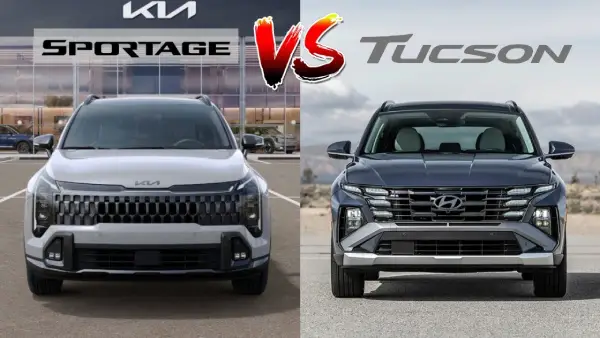
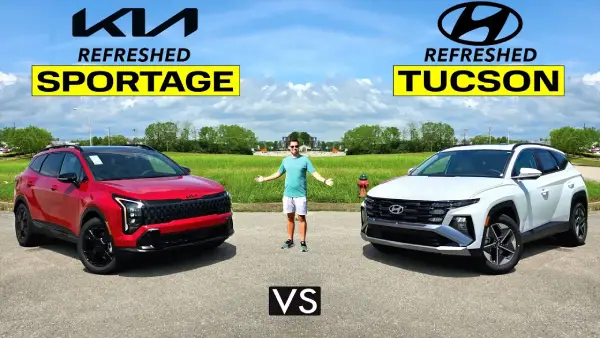
Kia Sportage vs Hyundai Tucson 2026: It may seem easy to decide between the Hyundai Tucson and Kia Sportage but a closer look reveal otherwise.
These two small SUV are similar in terms of engineering, basic powertrain options, and even remarkable warranty coverage. However they have distinct personalities, distinct strengths, and a slight but discernible price difference.
While You Care for Your Car, Care for Your Child’s Future Too 💖
A fun and educational book every parent should gift their kid.
 Get Kiddy Store Fortune Now
The interesting thing is that not every consumer would think the cheaper SUV is a better deal.
The Tucson and Kia Sportage have starting prices of $29,450 and $28,790 respectively. Even tho the difference is only $660, the scenario change when you look at fuel economy, interior space, equipment, resale value and hybrid choice.
Which one then should be in your driveway in 2026?
2026 Kia Sportage vs Hyundai Tucson The Brief Answer
If fuel economy and starting value are your main concern the Kia Sportage has a big advantage.
Its hybrid models can reach up to 41 mpg when combined and its plug-in hybrid has somewhat better electric efficiency than the Tucson PHEV.
The Hyundai Tucson, on the other hand makes a strong case because of its larger passenger interior, feature-rich upper grade lines and somewhat higher estimated resale value.
In other words there isn’t a single obvious winner for everyone.
For value and efficiency, go for the Sportage. For sophistication, features and resale value, go with the Tucson.
Cost: The Sportage Is Less Expensive
Customer typically look at price first, giving the Kia an early lead.
The initial cost of the Sportage is $28790 for the LX and $29450 for the Tucson. Thus before extras and destination fees the Kia is $660 less expensive.
The Sportage SX Prestige which is at the top of the gas powered range starts at $36,390 while the Tucson Limited is priced at $39,425.
However, the price difference varies significantly based on powertrain and trim. Equipment and drivetrain availability take precedence over starting MSRP once you enter hybrid and plug-in hybrid territory.
Starting prices at a glance
| Model | Starting MSRP |
| 2026 Kia Sportage LX | $28,790 |
| 2026 Hyundai Tucson SE | $29,450 |
| Kia Sportage Hybrid | $30,590 |
| Hyundai Tucson Hybrid | $30,950 |
| Kia Sportage PHEV | $40,590 |
| Hyundai Tucson PHEV | $40,325 |
Same Family, Very Different Looks
You might not realize how closely connected the two SUV are until you park them side by side.
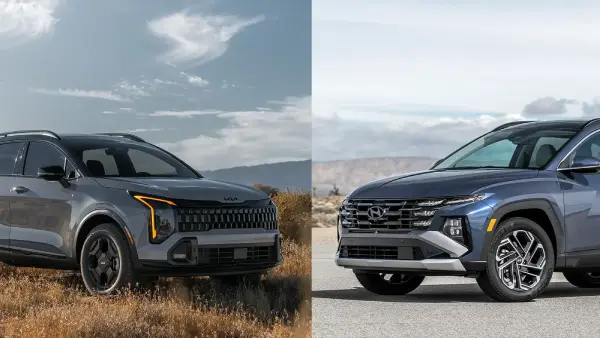
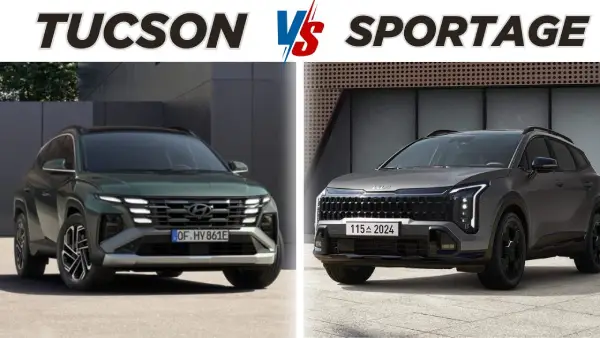
The Sportage adopts a more aggressive style. It has a youthful appearance due to its angular bodywork, muscular appearance, and bright lighting.
The Tucson follows a different path. It appears a little more mature because of its simpler, more subtle style.
There is no objective superiority between the two design. It all boil down to what you want your SUV to say about you.
Do you want anything to make a statement in a parking lot? The advantage belongs to the Sportage.
Would you rather something elegant and understated? Maybe the Tucson is more attractive.
Performance Is Almost a Dead Heat
The parallels become much more apparent beneath the sheet metal.
The traditional variant of both SUV are powered by a 2.5-liter four-cylinder engine. It has an eight-speed automatic transmission and generate 187 horsepower and 178 lb-ft of torque.
All-wheel drive is an option although front wheel drive is the standard.
An electric motor and a 1.6 liter turbocharged four cylinder engine power the hybrid variant. The Sportage Hybrid achieve 232 horsepower while the Tucson Hybrid generate 231.
Yes the difference is only one horsepower.
With 268 horsepower and 271 lb ft of torque the plug-in hybrid are even more similar.
Both model have a 2,000 pound towing capacity and the plug in hybrid variant come with AWD as standard.
Performance winner: It’s a tie
There simply isn’t enough mechanical difference here to declare a clear winner.
If you’re choosing based purely on power, the Sportage and Tucson are practically twins.
The Sportage Wins the Fuel-Economy Battle
This is where things finally get interesting.
The gasoline-powered variant match exactly. AWD model receive 24/30/26 mpg while FWD vehicle get 28 mpg overall 33 mpg on the highway and 25 mpg in the city.
Kia is superior when it comes to hybrids.
The most efficient Tucson Hybrid achieve a combined fuel economy of 38 mpg while the most efficient Sportage Hybrid with front-wheel drive achieves 41 mpg.
If you drive frequently that makes a significant difference.
The Kia is also favored by plug in hybrids.
The Sportage PHEV has an electric range of 33 mile and a rating of 83 MPGe. With a 32-mile electric range the Tucson PHEV achieve 77 MPGe.
The Sportage is rate at 36 mpg overall once the battery runs out compare to 35 mpg for the Tucson.
Which SUV Interior Is Larger?
It is not quite that simple.
Despite having a 108.5-inch wheelbase the two SUVs make quite different use of that area.
Passengers have better headroom in the Tucson especially in the front seats. Taller drivers and passengers may perceive a difference as a result.
But when you use the cargo compartment with the back seats upright the Sportage has a small advantage.
The Tucson feature 38.7 cubic feet of cargo capacity behind the second row compared to 39.6 cubic feet for the gas Sportage.
But when the back seats are folded down the Tucson lead with a maximum cargo capacity of more than 74 cubic feet.
Therefore, how you use the SUV will determine who wins.
Carrying luggage and groceries without folding seats? Sportage.
Moving larger items with the rear seats folded? Tucson.
Interior Features: Tucson Has a Slight Edge
Both SUVs offer plenty of technology even in their lower trims.
The Sportage comes standard with a 12.3-inch touchscreen and digital gauge display, along with wireless Apple CarPlay and Android Auto.
The Tucson also offers wireless smartphone integration, although its base instrument display is smaller.
Move higher up the trim ladder and both become considerably more luxurious.
Available equipment includes:
- Heated and ventilated front seats
- Dual-zone climate control
- Heated steering wheel
- Wireless phone charging
- Panoramic or standard sunroof options
- Premium audio systems
- Leather or leather-like upholstery
- Advanced driver-assistance technology
The Tucson gains some points with features such as leather seating and heated rear seats on its upper gas-powered trim.
Features winner: Hyundai Tucson
The differences aren’t huge but Hyundai makes a slightly stronger case for buyers who want maximum equipment.
What About Hybrid Models?
This is where both SUVs become particularly attractive.
The hybrid versions aren’t simply more efficient versions of their gas-powered siblings. They also provide stronger performance while keeping fuel consumption relatively low.
The Sportage Hybrid produce 232 horsepower while the Tucson Hybrid produces 231 hp.
But the Kia fuel economy advantage makes it particularly attractive for driver who spend a lot of time commuting.
The Tucson Hybrid still makes plenty of sense especially if you value its interior layout and features more than squeezing out the last few mpg.
Sportage or Tucson Plug-In Hybrid?
Customers who prefer electric driving for shorter trips without sacrificing the convenience of a gasoline engine are the target market for the plug-in hybrid models.
On paper, the Sportage PHEV has a small advantage.
Its electric range is 33 miles but the Tucson PHEV’s is only 32.
Additionally, the Tucson’s 77 MPGe rating is inferior to its 83 MPGe rating.
Both have standard AWD and generate 268 horsepower.
The Sportage PHEV is perhap a better choice for those who can frequently charge at home.
Kia Sportage is the PHEV winner.
The stats are in Kia’s favor, but it’s a minor victory.
Maintenance Costs Are Almost Identical
Long-term ownership isn’t only about the purchase price.
According to the figures cited in the comparison estimated repair and maintenance costs during the first five years are approximately:
- Kia Sportage $2,659
- Hyundai Tucson $2,694
That’s only a $35 difference.
The estimated probability of requiring a major repair over that period is also extremely close.
That means maintenance costs shouldn’t be the deciding factor between these two SUV.
They’re simply too close to call.
Which One Holds Its Value Better?
This is one area where Hyundai gets an important win.
The Tucson is projected to retain around 53% of its value after five years while the Sportage is projected to retain about 50%.
The difference isn’t enormous but it could matter when you eventually trade in or sell the vehicle.
For buyers who change vehicles every few years depreciation deserves more attention than a few hundred dollars of difference in the original purchase price.
Resale winner: Hyundai Tucson
The Tucson’s slightly stronger predicted resale value gives it an advantage for ownership planning.
Safety: Both Are Strong Choices
Neither SUV gives buyer much cause for concern when it comes to safety.
The comparison data showed that both cars receive high safety accolades including a 2026 IIHS Top Safety Pick+ award.
Additionally, both were given five-star NHTSA safety rating.
Automatic emergency braking, lane-keeping assistance, blind-spot monitoring, adaptive cruise control, and other technologies intended to lessen driver workload are some of the elements of its available driver-assistance systems.
That’s comforting for a family SUV.
Safety winner: Tie
Both are highly competitive choices for safety-conscious buyers.
Reliability: Another Small Kia Advantage
The reliability battle is also extremely close.
The Tucson receive an 83 on the JD Power quality and reliability scale, while the Sportage received an 84.
Again that’s hardly a massive difference.
The recall information cited in the comparison also gives the Sportage an advantage, with fewer recalls listed for the 2026 model year at the time of the article’s update.
Both vehicle also benefit from strong factory warranty coverage.
Reliability winner: Kia Sportage
It’s another narrow win, but Kia comes out ahead.
So, Which SUV Should You Buy?
After looking at the numbers the answer become clearer.
If fuel economy, buying value, hybrid efficiency, and sporty design are your top objectives, the Kia Sportage is the superior option.
If you’re looking for a more sophisticated look a little more room for passengers, plenty of equipment and a better chance of resale value the Hyundai Tucson makes more sense.
Here’s the simple breakdown:
| Category | Winner |
| Starting price | Sportage |
| Gas-powered performance | Tie |
| Hybrid fuel economy | Sportage |
| PHEV efficiency | Sportage |
| Passenger room | Tucson |
| Cargo space with seats up | Sportage |
| Maximum cargo space | Tucson |
| Features | Tucson |
| Maintenance | Tie |
| Resale value | Tucson |
| Safety | Tie |
| Reliability | Sportage |
Final Verdict
The $660 difference between the two base models isn’t enough to make the decision by itself.
Instead look at how you’ll actually use your SUV.
The Kia Sportage is the better overall value if you travel daily, desire greater fuel economy, and enjoy the Sportage’s bolder design.
The Tucson is worth the additional thot if you are more concerned with equipment, passenger comfort, interior design and resale value.
Fortunately neither option feels like a compromise. Both deliver practical dimension, strong safety credentials, multiple powertrain option and competitive pricing.
But if we had to choose one overall winner based on the number the 2026 Kia Sportage narrowly take the crown.
It’s not because it’s dramatically better than the Tucson.
It’s because it manages to combine a lower starting price with stronger hybrid fuel economy, slightly higher hybrid output and a compelling ownership package.
And that makes the Sportage particularly difficult to ignore in 2026.
FAQs
Q: Which gets better gas mileage the Sportage or Tucson?
A: The Kia Sportage Hybrid has the advantage. Its most efficient FWD configuration reaches 41 mpg combined compare with 38 mpg combine for the most efficient Tucson Hybrid.
Q: Is the Sportage or Tucson more powerful?
A: Their gas version produce the same 187 horsepower. The Sportage Hybrid produce 232 hp just one horsepower more than the Tucson Hybrid’s 231 hp. Their plug in hybrid version both produce 268 hp.
Q: Which has more cargo space?
A: The Sportage offer slightly more cargo space behind the second row while the Tucson provide slightly more maximum cargo room with the rear seat fold.
Also Read: The Lexus IS Is Selling Like Nobody Expected—And It Could Be Great News for Sports Sedans