
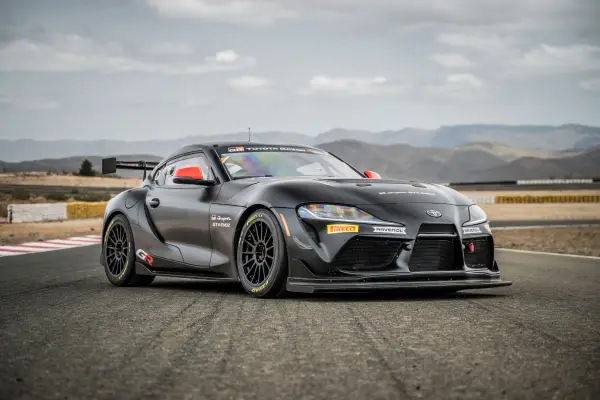
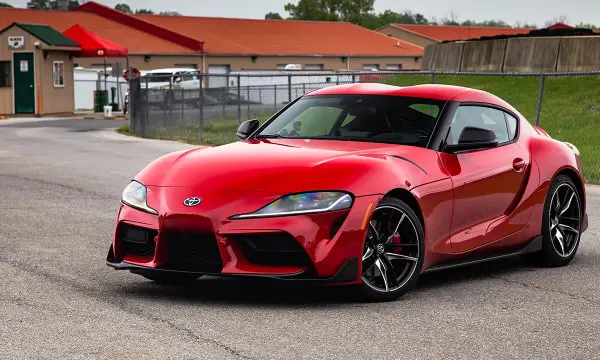
Toyota GR Supra: For years, one question followed the fifth-generation Toyota Supra everywhere it went:
“How can it really be a Supra if it has a BMW engine?”
While You Care for Your Car, Care for Your Child’s Future Too 💖
A fun and educational book every parent should gift their kid.
 Get Kiddy Store Fortune Now
It was a fair question.
Toyota own 2JZ-GTE straight-six engine which became practically legendary among auto aficionados was the driving force behind the iconic fourth-generation Supra. Therefore many fans were upset before they had even driven the new car when Toyota revived the Supra moniker for 2020 and disclose that it will share its turbocharged six cylinder engine with BMW.
However, there is a another perspective on the Mk5 Supra.
Toyota didn’t simply take a BMW, change the emblem and call it a day. The company started employing a shared sports-car chassis since building a whole new rear-wheel-drive performance car from scratch was not financially possible. Next Toyota engineer worked on the chassis, suspension calibration, weight distribution, steering response and overall character.
And the result of that choice was an intriguing sports vehicle with a BMW straight-six engine and a performance style that was very Toyota.
That formula seems even more important now that the fifth-generation Supra is nearing the conclusion of its production run.
The Mk5 Supra Was Never Supposed To Be Another Mk4
The biggest mistake when judging the fifth generation Supra is comparing every detail with the Mk4.
The fourth generation A80 Supra became famous for its 2JZ GTE engine rear-wheel-drive layout and enormous tuning potential. It was also produced during a very different period for the Japanese performance-car industry.
The sports car industry had drastically transform by the time Toyota made the decision to bring the Supra moniker back.
It would have cost a lot of money to build a brand new six cylinder rear-wheel-drive sports car that would never sell in large quantities. BMW had the hardware, expertise, and development resources to enable a collaborative endeavor, and Toyota needed a partner.
The Toyota GR Supra and BMW Z4 are two extremely distinct vehicles that share some basic mechanical DNA as a result of that collaboration.
Toyota obviously intended the Supra to feel like a true sports vehicle rather than a BMW with a Toyota logo, even though they shared many significant component.
That distinction matters.
BMW’s B58 Gave The Supra Exactly What It Needed
The BMW B58 is the star of the Mk5 Supra.
This 3.0-liter turbocharged inline six engine soon gain a solid reputation among enthusiast for its blend of torque, smooth power delivery and customization capability.
The B58 had 335 horsepower and 365 lb-ft of torque when the Supra was initial introduce in the United State. Toyota stated that it could reach 60 mph in about 4.1 second.
That was already quick.
Then Toyota turned things up.
The Supra’s output was significantly increase for the 2021 model year reaching 382 horsepower and 368 lb-ft of torque.
It was suddenly much more difficult to argue that the new Supra was not serious enough.
The Supra was a perfect fit for the B58 personality. The turbocharged six produces powerful torque without having the driver to continuously chase the redline in contrast to certain high-strung performance engine that only come alive close to the top of the rpm range.
Because of this, the Supra is both fun on a winding road and speedy in daily drive.
But The Engine Was Only Half The Story
Here’s where the “BMW Supra” argument starts to fall apart.
It would have been much simpler to refute the criticism if Toyota had just taken the B58 and put it in a regular chassis.
Rather Toyota paid close attention to the car’s behavior.
The Supra was built with a low center of gravity, a wide track and a short wheelbase. Toyota closely monitored the relationship between the car wheelbase and track width in order to achieve a nearly flawless 50:50 weight distribution.
These figures weren’t selected at random.
They were intended to create a compact sports car that could change direction quickly without becoming nervous at speed.
The suspension setup also received significant attention, including a double-joint MacPherson strut arrangement up front and a five-link rear suspension.
And then there was Toyota Gazoo Racing.
The Supra wasn’t merely developed around computer simulations and a handful of proving-ground runs. Engineer evaluated the car on demanding roads and track including the Nürburgring while continuously working on steering, suspension and chassis response.
The result was a car that could use BMW mechanical component while still having its own personality.
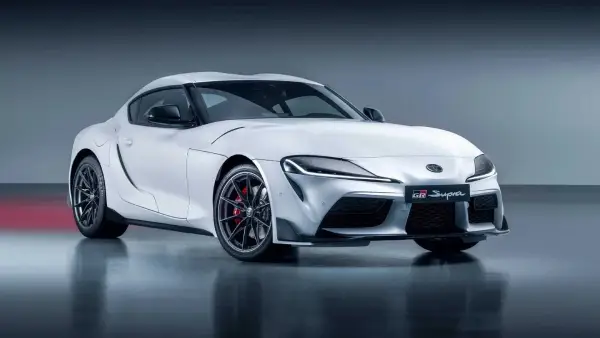
Toyota Kept Changing The Supra After Launch
One of the most interesting thing about the Mk5 Supra is how much it evolved.
Toyota could have launched the car and left it alone.
It didn’t.
The company increased engine output, revised suspension tuning and added structural improvements. Later versions also became available with a six-speed manual transmission paired with the higher-output engine.
That manual transmission was particularly important.
The modern sports-car market has increasingly moved toward automatic transmissions, dual-clutch gearboxes and increasingly complicated electronic systems. A manual Supra gave enthusiasts something they had been asking for since the car returned.
It also helped distance the Supra from the idea that Toyota had simply borrowed BMW’s formula without adding anything of its own.
Every revision showed that Toyota was willing to keep refining the car.
And that matters because great sports cars aren’t defined only by their launch specifications.
They’re defined by how they make you feel behind the wheel.
So, Is The B58 Really A Modern 2JZ?
This is where Supra conversations usually get heated.
You’ll often hear enthusiast call the B58 a modern day 2JZ.
Strictly speaking that’s not accurate.
The two engines were developed decades apart by different manufacturers and use very different engineering approaches.
But the comparison makes sense in one important way.
Both are turbocharged inline sixes that have attracted a huge aftermarket following.
The original 2JZ-GTE became famous because enthusiast discovered just how much power its robust construction could handle. The B58 has developed a similar reputation among modern tuners.
The B58’s strong internal construction and turbocharged architecture provide plenty of room for performance upgrades. Tuners have extracted power figures far beyond factory output, while Toyota itself demonstrated the potential of the Supra platform with higher-output special projects.
That doesn’t make the B58 a 2JZ.
It does make the comparison understandable.
In some ways the B58 became exactly what the modern Supra needed: a powerful, durable and highly tunable six-cylinder engine that could support both everyday driving and serious performance builds.
The Supra’s Reliability Story Is More Complicated Than The Badge Suggests
This is the point at which the Toyota connection should not be overstated.
Toyota has established a stellar reputation for reliable automobiles.
However the GR Supra is not your average Toyota crossover or sedan.
It share significant mechanical components with BMW, which may have an impact on maintenance costs, parts availability and servicing.
Over tens of thousands of miles, a long-term test of the Supra revealed reassuring mechanical durability with no significant engine drama taking center stage. That’s good news.
But ownership wasn’t necessarily cheap.
Routine maintenance still costs money, and BMW-related components can create a different servicing experience from what someone might expect after buying a conventional Toyota.
That’s why saying “it’s a Toyota, so it will never break” misses the point.
A better description is this:
The Supra combines Toyota’s development philosophy with a BMW-based powertrain and sports car hardware.
That’s a much more realistic way to understand the car.
The BMW Connection Actually Helped Save The Supra
There is an uncomfortable truth behind the whole project.
Without BMW the fifth-generation Supra might not have happened in the same form.
Low-volume sports cars are expensive to engineer. They require unique body structures, crash engineering, suspension development, electronics, powertrain integration and extensive testing.
And then manufacturer have to sell enough of them to recover those costs.
That’s difficult.
Sharing development work allowed Toyota to spread some of those costs while still producing a rear-wheel-drive sports car.
For enthusiasts, that trade-off was controversial.
For Toyota, it made practical sense.
And looking back at the finished product it’s difficult to argue that the result was unsuccessful.
The Supra returned with serious performance, a compact rear-wheel-drive layout a strong turbocharged six-cylinder engine and a growing aftermarket.
That is a pretty impressive outcome for a car that started life as a joint development project.
The “Zupra” Nickname Doesn’t Tell The Whole Story
The Supra and BMW Z4 sharing mechanical components led enthusiasts to create the nickname “Zupra.”
It was clever.
It was also a little misleading.
The two cars have different body styles, different driving positions, different suspension tuning and different intended personalities.
The Z4 is a roadster.
The Supra is a sports coupe with a fix roof.
These distinction are important.
The manufacturer can tune two vehicles in very different way even if they share fundamental mechanical components.
Instead of considering the engine as the whole recipe, consider it as ingredient.
BMW provided an excellent ingredient.
Toyota built the rest of the recipe around its own performance targets.
The Mk5 Supra Is Now A Piece Of Automotive History
There’s another reason the fifth-generation Supra deserves attention today.
Its production story has effectively reached its conclusion.
The shared manufacturing arrangement that supported the Supra could not last indefinitely and BMW discontinued production of the Z4. At the same time, maintaining outdated internal combustion sports car architecture becomes more difficult and costly due to more stringent emission and safety regulations.
Eventually Toyota announced that manufacture of the fifth-generation Supra will cease.
The final cars therefore carry a little more significance than ordinary end-of-production models.
They represent the end of a very unusual experiment.
Using a German engine and a jointly developed architecture, a Japanese automaker brought back one of its most well-known performance brands. The company then spent years perfecting the package until it was far more than the sum of its parts.
That is a somewhat unique period in the history of sports cars.
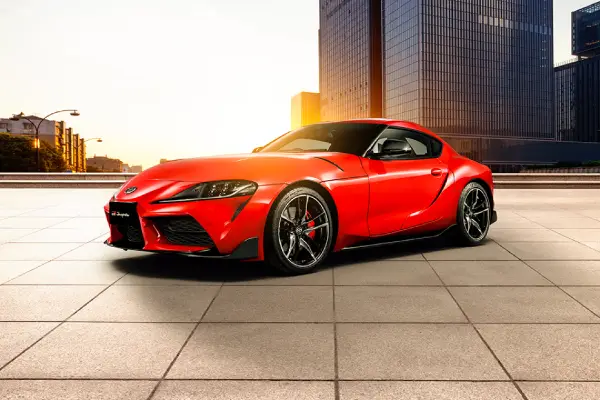
The Final Supra Wasn’t A Quiet Goodbye
Toyota didn’t let the Mk5 disappear without a proper sendoff.
The final-generation Supra received special attention in its last year, with the Final Edition receiving chassis and performance upgrades designed to make the last cars more focused.
The changes included upgraded braking hardware, suspension revisions, additional chassis bracing and other performance-oriented adjustment.
Limited production also gave the final cars greater collector appeal.
For a car that spent much of its life defending itself against the “it’s just a BMW” argument, the ending was fitting.
Toyota didn’t try to hide the BMW connection.
Instead, it pushed the shared platform as far as it could.
What Comes Next For The Supra?
This is perhaps the biggest question.
Toyota has not simply forgotten the Supra name.
The company has indicated that the nameplate could return in the future, but exactly what comes next remains uncertain.
The next Supra could look very different from the current car.
Electrification is changing performance cars rapidly, and Toyota has been exploring hybrid and other powertrain technologies across its performance lineup.
There has also been speculation about a future Supra using Toyota-developed powertrain technology rather than another BMW-sourced engine.
But until Toyota officially confirms those detail it’s best to treat them as possibilities rather than facts.
One thing is certain though.
The next Supra has a difficult job.
The Mk5 may have been controversial, but it established its own following. A future Supra will have to satisfy modern regulations while also carrying the weight of decades of history.
That’s not easy.
Was The BMW-Powered Supra Really A Betrayal?
After all the arguments, the answer depends on what you expected from the Supra.
If you wanted a direct replacement for the 2JZ-powered A80 the Mk5 was never going to completely satisfy you.
But if you judge it as a modern sports car, the story looks different.
It had a powerful straight-six.
It sent power to the rear wheels.
It offered an engaging chassis.
It eventually got a manual transmission.
It developed a strong tuning community.
And most importantly, it brought the Supra name back into the conversation.
The BMW engine wasn’t the end of the Supra’s identity.
It became part of its new identity.
Toyota did not build every component from scratch but it didn’t need to. The company’s real contribution was deciding how all those components should work together.
And perhaps that’s the most interesting lesson from the fifth-generation Supra.
A car doesn’t have to be built entirely by one company to have a personality of its own.
The B58 gave the Supra its muscle.
Toyota gave it the attitude.
And now that the Mk5 era is ending, that combination may become one of the most memorable examples of collaboration in modern performance-car history.
FAQs
Q: Is the B58 as reliable as the 2JZ?
A: The B58 has develop a strong reputation for durability and tuning potential but it shouldn’t simply be declared a modern 2JZ. They are different engine develop in different eras. The B58 long term reputation is still evolving compare with the legendary status of the 2JZ.
Q: Does the Toyota Supra use a BMW transmission?
A: The fifth generation Supra uses BMW sourced transmission hardware including an eight speed automatic. Toyota later offer a six-speed manual transmission with the more powerful six cylinder Supra.
Q: Is the Toyota Supra reliable?
A: The Mk5 Supra has shown encouraging mechanical durability but it should not be treated exactly like a conventional Toyota. BMW-sourced component and sports-car maintenance can result in different servicing requirements and costs.
Also Read: 2026 Lexus GX 550 Isn’t Just A Luxury SUV—It’s A Serious Off-Roader
1 thought on “Toyota Supra’s BMW Engine Isn’t Its Weakness—Here’s Why The Mk5 Became A Modern Legend”
Comments are closed.